Kawasaki took to the EICMA Milan Motorcycle Show to unveil a trio of electric motorcycles, with Electrek front and center to see the action live. The Kawasaki Ninja EV and Kawasaki Z EV were revealed as traditional battery electric motorcycles, while the company also unveiled an HEV hydrogen-powered concept motorcycle. While the electric Ninja and Z models are both still in prototype form, Kawasaki Motors president Hiroshi Ito announced to the audience that the two models would be available for purchase next year.
Kawasaki Z, Ninja electric bikes
The Japanese brand took the wraps off a number of bikes at EICMA 2022, yesterday. As per the company, it will roll out the Ninja electric bike and Z electric bike in global markets next year, which are officially called the Ninja BEV and Z BEV, respectively. Both the Ninja BEV and Z BEV electricbikes will be available for purchase in 2023.
These bikes appear to have been inspired by the Z400 and the Ninja 400. According to the brand, these bikes will abide by the A1 requirements. Moreover, they will be marketed as entry-level electric performance bikes and will share the same battery with a capacity of up to 3.0 kWh.
The hybrid electric vehicle prototype, on the other hand, is still a little ways off from going into production, but Kawasaki predicts that it will hit the market by 2024. Further information on the motorcycle is still expected, but the HEV will have robust hybrid technology and will use either hybrid power or simply electric power depending on the needs.
President Ito has reaffirmed that Kawasaki is still heavily focused on bikes with internal combustion engines even if the company has begun to move toward electric motorcycles. Additionally, he stated that Kawasaki will launch about 30 ICE models internationally between 2024 and 2025, with almost half of them arriving in Europe.
For the safety of the rider, both the Z EV and Ninja EV are equipped with disc brakes on both the front and rear wheels, along with dual-channel ABS and a regenerative braking system for improved braking performance.The suspension duties on both motorcycles are taken care of by telescopic forks on the front and a mono-shock unit on the rear end.
As of now, the pricing and availability details for the Z EV and Ninja EV are very much a mystery. When launched, we can expect both all-electric motorcycles to be priced at around Rs. 5 lakh (ex-showroom) in India.
Kawasaki took to the EICMA Milan Motorcycle Show to unveil a trio of electric motorcycles, with Electrek front and center to see the action live. The Kawasaki Ninja EV and Kawasaki Z EV were revealed as traditional battery electric motorcycles, while the company also unveiled an HEV hydrogen-powered concept motorcycle. While the electric Ninja and Z models are both still in prototype form, Kawasaki Motors president Hiroshi Ito announced to the audience that the two models would be available for purchase next year.
Kawasaki Z, Ninja electric bikes
The Japanese brand took the wraps off a number of bikes at EICMA 2022, yesterday. As per the company, it will roll out the Ninja electric bike and Z electric bike in global markets next year, which are officially called the Ninja BEV and Z BEV, respectively. Both the Ninja BEV and Z BEV electricbikes will be available for purchase in 2023.
These bikes appear to have been inspired by the Z400 and the Ninja 400. According to the brand, these bikes will abide by the A1 requirements. Moreover, they will be marketed as entry-level electric performance bikes and will share the same battery with a capacity of up to 3.0 kWh.
The hybrid electric vehicle prototype, on the other hand, is still a little ways off from going into production, but Kawasaki predicts that it will hit the market by 2024. Further information on the motorcycle is still expected, but the HEV will have robust hybrid technology and will use either hybrid power or simply electric power depending on the needs.
President Ito has reaffirmed that Kawasaki is still heavily focused on bikes with internal combustion engines even if the company has begun to move toward electric motorcycles. Additionally, he stated that Kawasaki will launch about 30 ICE models internationally between 2024 and 2025, with almost half of them arriving in Europe.
For the safety of the rider, both the Z EV and Ninja EV are equipped with disc brakes on both the front and rear wheels, along with dual-channel ABS and a regenerative braking system for improved braking performance.The suspension duties on both motorcycles are taken care of by telescopic forks on the front and a mono-shock unit on the rear end.
As of now, the pricing and availability details for the Z EV and Ninja EV are very much a mystery. When launched, we can expect both all-electric motorcycles to be priced at around Rs. 5 lakh (ex-showroom) in India.
The highly anticipated 2024 Kia EV9 will make its debut this year with a striking design and a slew of novel features. Despite the excitement, Kia has kept the EV9 specifications a secret. A customer survey sent to Electrek by a current Kia Telluride driver, on the other hand, reveals what could be our first look at the 2024 Kia EV9 specs. The survey displays five different trim options with all-electric ranges ranging from 220 to 290 miles and asks participants which one they would choose.
Although these specifications are not set in stone, we are learning more about the market Kia intends to target with its first electric SUV.
Kia first revealed its three-row SUV as a concept car at the 2021 LA Auto Show and has been building anticipation ever since. We got a closer look at the EV9 design last month, and now we’re learning more about its performance, pricing, and range.
credit: arenaev
According to the survey, prices will range from $56,000 to $73,000. The two lowest-priced models have RWD and 200 hp, while the higher-priced model has AWD and 400 hp. The $56,000 base model has a range of 220 miles and 19-inch wheels, but no towing capacity and no sunroof. Trim two features, 290 miles of range with 2,000 pounds of towing capacity, a sunroof, and captain chairs for second-row seating are available for an additional $5K ($61,000).
All trim levels have vehicle-to-load (V2L) capabilities, with the top two trim levels also having V2G options. The top Kia EV9 model costs $73,000 and includes 240 miles of range, AWD, 4,500 pounds of towing capacity, higher ground clearance with improved approach and departure angles, 21-inch black wheels, a full-length sunroof, and all the bells and whistles.
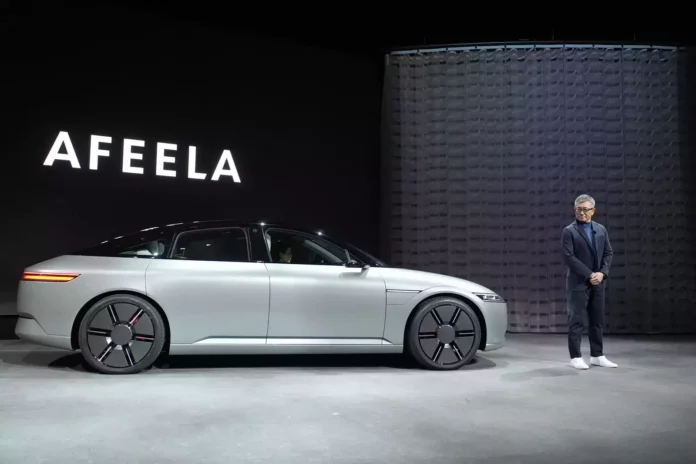
Sony, the Japanese electronics and media conglomerate, has emerged as the tech behemoth that, with their new brand “Afeela,” may have figured out how to make the rubber meet the road. The company has partnered with Honda to produce a new electric vehicle (EV) starting in 2026, most likely at Honda’s US facilities to take advantage of new EV tax credit rules.
The joint venture, called Sony Honda Mobility, will rely heavily on subscription features and Sony’s own vast library of video games and media properties for in-car entertainment under the brand Afeela.
These services will be available while drivers and passengers wait for the EV to charge or when autonomous vehicle features are activated. Yasuhide Mizuno, the venture’s CEO, has stated that it is aiming for lease deals of up to ten years, which is much longer than most cars are owned today, and that this will be supported by frequent over-the-air software updates and feature additions.
credit: theverge
The latest prototype from Sony is a sleek EV sedan with dashboard screens that span the width of the vehicle, 45 sensors and cameras for semi-autonomous driving assistance, all-wheel drive, and hints of augmented reality integration and “virtual worlds” embedded in the driving experience. With Honda’s manufacturing expertise, this could open up a whole new market and multiple revenue streams for Sony, which already has a strong presence in entertainment media and the devices that allow us to consume it.
At CES, Afeela’s launch party felt more like Sony’s than Honda’s. Sony handled the car’s communications, dealt with journalists, and debuted it as part of a larger keynote presentation that included a teaser for Neill Blomkamp’s Gran Turismo film and accessibility-focused game controllers for people with mobility challenges.
Tata Motors has announced on Monday that it has partnered with ICICI bank to provide financial solutions for the electric vehicle (EV) dealers. Under this scheme, ICICI Bank shall provide inventory funding to the authorized passenger EV dealers, in addition to the bank’s funding to diesel and petrol owners.
Shailesh Chandra, Managing Director, Tata Motors Passenger Vehicles and Tata Passenger Electric Mobility said, “In our aim towards achieving complete electrification and promoting green mobility, we are happy to partner with ICICI Bank to assist our authorised passenger electric vehicle dealer partners with an exclusive financing program.”
Chandra added, “ We are confident that through this tie-up, we will make EVs more accessible and the EV purchase process a seamless and memorable experience for our customers.”
Rakesh Jha, Executive Director, ICICI Bank, said, “Electric vehicle industry is growing at a rapid pace with the rising consumer demand for environment-friendly electric vehicles. The launch of EVs is one of the significant innovations in the automobile space. ICICI Bank has a legacy of supporting innovative technological initiatives.”
This is an excellent move and great collaboration between the well-renowned bank and the automobile giant. The automotive sector is changing rapidly and new EV models are entering the market. But still the EV infrastructure needs to be upgraded and there are still many challenges which needs to be overcome by us in the upcoming years. But, switching to EVs is really a need of the hour as pollution levels needs to be tamed and controlled immediately.
Tata Motors on their way to build EV Ecosystem:
Tata Motors is currently leading in bringing the e-mobility wave in India with a commanding market share of 85.8 percent, with over 57,000 EVs produced till date in personal and fleet segments. Tata Motors is continuously working all round the clock to find effective and strategic solutions to overcome the hurdles in the EV sector, bringing new EV models in the passenger and commercial vehicles and from partnering with financial organizations, bank and research institutions.
Tata Sons Ltd, the parent of Tata Motors has also invested to manufacture lithium-ion cells in India and Europe to forge a proper supply chain for its zero-emission vehicles in the coming decade. The Tata group are the first ones to understand the scope and future of the Electric vehicles, and is bringing all its various branches together to create a complete EV ecosystem.
At the launch of Tata Nexon, the company’s first EV, Chandrasekaran had announced that seven Tata group companies — Tata Motors, Tata Power, Tata Chemicals, Croma, Tata Auto Components, and Tata Motors Finance — would work together to build a complete ecosystem for EVs.
Commenting on the partnership, Shailesh Chandra, Managing Director, Tata Motors Passenger Vehicles and Tata Passenger Electric Mobility (TPEML), said, “As the pioneers of EVs in the country, we take responsibility for their successful adoption. In our aim towards achieving complete electrification and promoting green mobility, we are happy to partner with ICICI Bank to assist our authorized passenger electric vehicle dealer partners with an exclusive financing program. Our dealer network forms a part of our core support pillars, and through their constant effort, we ride the electrification wave in India. We are confident that through this tie-up, we will make EVs more accessible and the EV purchase process a seamless and memorable experience for our customers.”
The company has been successful in setting up around 3,000 chargers in the country in the last one year boosting the acceptance of EVs in their customers. The company is recreating and re-imagining its entire automotive portfolio, placing EVs in the heart of their portfolio and product range to achieve their net zero emission target by 2025.
There are some tag lines that capture the imagination of every generation and “Chal meri Luna” and “Hamara Bajaj” were two such tag lines for two iconic products, the Kinetic Luna moped and the Bajaj Chetak scooter, for a generation of Indians growing up in the 1970s and 1980s. However, Electric vehicles (EVs) are the talk of the town right now but these brands are making a comeback as EVs.
The Chetak has returned as an EV more than two years ago, but has yet to live up to the legacy of its predecessor. Only 12,023 units were shipped to dealers in the first five months of FY23. According to industry observers, one possible reason for this could be its high price. The original Chetak was designed for the middle class, while the electric Chetak begins at Rs 1.40 lakh.
credit: businesstoday
The original Luna was said to have been launched at Rs 2,000 in 1972, but the EV could be priced at around ‘50,000.
For the time being, Bajaj Auto and Kinetic Engineering are concentrating on production. With its new EV plant in Pune, Bajaj Auto hopes to double production and sales. The plant will have an annual production capacity of 500,000 units. It also intends to launch two new models. Kinetic has also established a dedicated production line with a monthly capacity of 5,000 units.
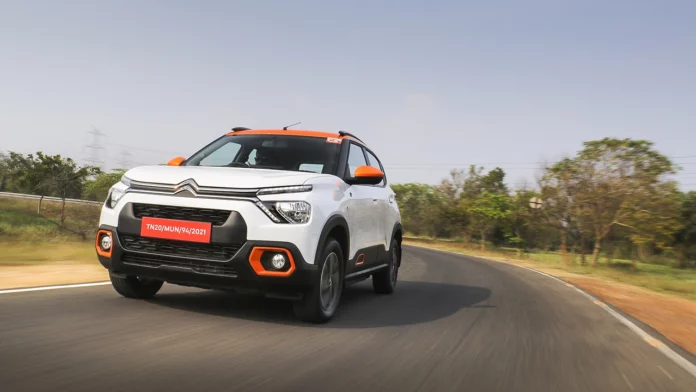
Citroen is India’s first OEM to launch an EV based on an ICE vehicle in less than 6 months. Bookings are now open, with a token fee of Rs 25,000. eC3 will be released next month, in February 2023. Citroen eC3 prices will be announced at the launch. According to the specifications, the eC3 will most likely compete with the recently launched Tata Tiago EV.
In terms of length, width, and height, the Nexon EV is the largest. Dimensionally, C3 and Tiago are nearly identical. Despite the fact that the eC3 is a crossover, Citroen markets it as a hatchback, just like the Tiago EV. It gets body cladding as a crossover, which adds character.
The Citroen eC3 has only one powertrain option, whereas the Tiago EV has two and the Nexon EV Prime has one. The Nexon EV Prime has the largest battery, measuring 30.2 kWh. Citroen comes in second with a 29.2 kWh battery, while the Tiago EV Long Range (LR) gets 24 kWh and the Medium Range (MR) gets 19.2 kWh.
The Nexon EV Prime has the most power and torque, producing 127 bhp and 245 Nm. Tiago EV MR produces 60 bhp and 110 Nm, while Tiago EV LR produces 74 bhp and 114 Nm.
Citroen may be less powerful than both Tiago EV variants at 56 bhp, but it is more torquey at 143 Nm.
credit: rushlane
Tiago EV has a faster 0-60 km/h time of 5.7 seconds, while the eC3 takes 6.8 seconds. The Nexon EV Prime sprints to 100 km/h in 9.9 seconds. None of the EVs on this list have adjustable regen braking, as the Nexon EV Max does. Tiago EV has the smallest boot at 240L. The eC3 has 315L of storage space, while the Prime has 350L. In terms of range, the Citroen C3 outperforms both competitors with 320 km. On a single charge, Nexon offers 312 km and Tiago EV offers 250 (MR) and 315 (LR) km.
The eC3 has the largest infotainment screen, as well as wireless phone connectivity and other features. eC3 offers exciting youthful colours and interior packages that look trendy and resonate with the same vibes in terms of personalisation. Tiago and Nexon EV, on the other hand, may not be as flashy, but they are far more feature-rich. Citroen is missing alloy wheels, climate control, a rear washer and wiper, a rear defogger, and other features. Some of these features were previously seen on a test mule, but will not be available with the launch vehicle. In terms of pricing, it is highly likely that it will be priced similarly to the Tiago EV.
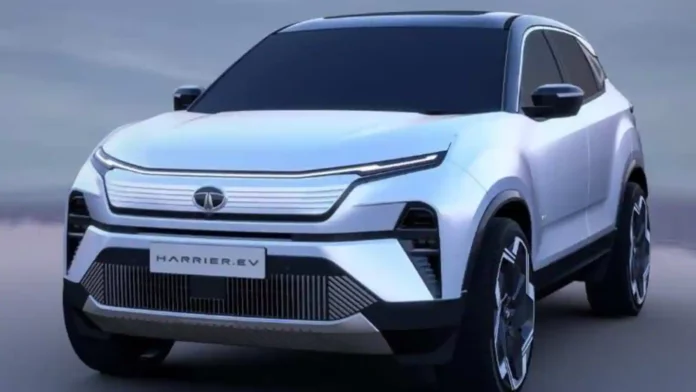
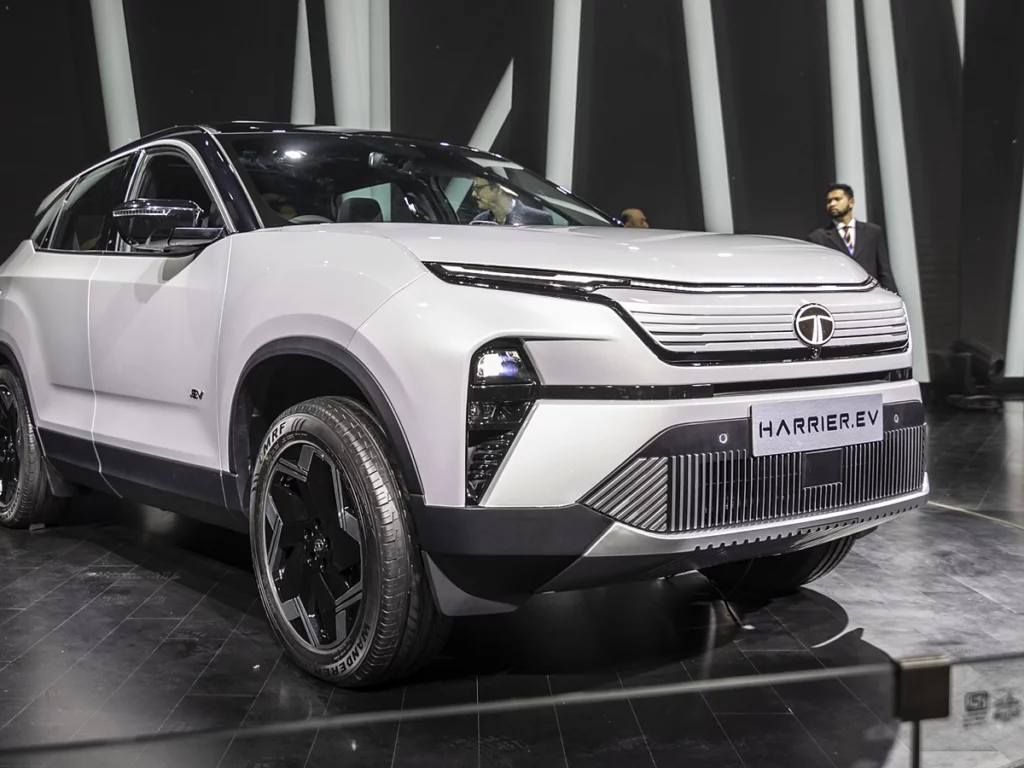
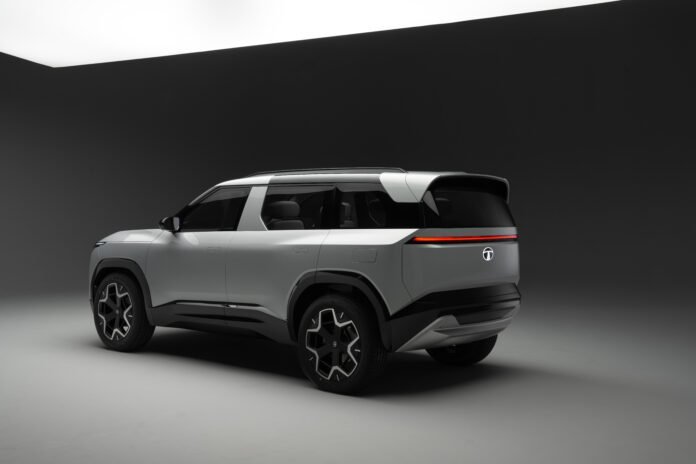
Tata Motors unveiled the electric version of the Tata Harrier SUV earlier this month at the Auto Expo 2023. According to Carwale, the Tata Harrier EV could arrive in the country in 2024. It claims that one of the EV models is getting closer to production. For safety, the Tata Harrier EV is said to have a 360-degree camera and an ADAS (advanced driver assistance system). The EV will have a blanked-off grille, as shown at the Auto Expo 2023 event. It will have a new bumper as well as a triangular-shaped headlamp cluster.
The EV’s rear end will be updated with new LED tail lights and a redesigned rear bumper with a revised skid plate. An LED light bar can also be seen running through the boot lid. The electric vehicle rides on dual-tone alloy wheels.
The Tata Harrier EV will have a 10.25-inch touchscreen information display in the cabin.
credit: carwale
The SUV will have a completely digital instrument cluster as well as a redesigned console. It will have seats with dual-tone upholstery. The company has not disclosed any information about the EV’s battery pack or driving range. According to a report published earlier this month, Tata Group intends to establish electric vehicle cell manufacturing operations in Europe in order to accelerate the transition of its British marque unit to battery-powered vehicles.
Tata Motors Chief Financial Officer P.B. Balaji said in an interview at the India Auto Expo this week on the outskirts of New Delhi that Jaguar Land Rover and Tata Motors will be the anchor customers for the facility, which will also sell battery cells to the wider market.
There is no denying the fact that Tata Motors had the most exciting and eye-catching stall at the Auto Expo 2023. The Tata Sierra EV and Tata Harrier EV have grabbed the most attention of the audience whilst, it was the Tata Sierra that has been a huge surprise for the audiences in the latest edition of the Auto Expo.
Tata Sierra to come back after 20 long years with new features and add-ons
Tata Motors has surprised everyone by bringing back its iconic vehicle – Tata Sierra in a completely new manner, with new features and additions.
Martin Uhlarik, head of design at Tata Motors, spoke in depth with Autocar India about the interior design philosophy of the Sierra EV and said, “We wanted to make less of an automotive interior and more of a living room”. Thus, on the production version, the company will offer a regular 5-seat version. Plus, there will be plenty of personalization options available.
The two rear seats in the lounge version will be wider and pushed further back to liberate a lot of legroom. The seats will be deeply contoured and have an extendable leg support or ottoman function, similar to a business-class airline seat. “Think of this as the business class version,” said Uhlarik.
He added, “This could be a working environment as well. Many of these vehicles will be chauffeured, so customers sitting at the back could potentially also be doing some work. So, all these use cases have to be considered during the design process.”
The design of the Tata Sierra has been kept clean but still looks impressive and dazzling with a slim LED light array at the top bar. The design of the rear has been kept minimal and very sleek, and the LED light bar at the rear has showcased a neat and discreet Sierra lettering.
It is based on the ALFA (Agile Light Flexible Advanced) architecture with a big glasshouse and black-out C and D pillars, but modified the height of the bonnet, as seen in the Sierra earlier. The alloy-finished wheels of the car look very striking, accompanied by the advanced sports tyre.
Adding to the lounge atmosphere, the Sierra show car had some interesting lighting and decorative elements, all of which Uhlarik says will make it to production. The vases on the rear door armrests that can house artificial plants will be offered as an accessory or the space could also be used as a small storage area instead. The unique C-Pillar-mounted interior ambient lamps will also make it to production; these too will be offered as an accessory.
Even the moss-like decorative element on the dashboard (also featured on the original 2020 Sierra concept) will be offered as an accessory, or customers can even choose from several other materials to deck up that space. “These things just bring out that element of making it more like your home. It’s a space where you would want to spend time in,” said Uhlarik.
He added, “This could be a working environment as well. Many of these vehicles will be chauffeured, so customers sitting at the back could potentially also be doing some work. So, all these use cases have to be considered during the design process.” To that effect, customers can also specify features such as fold-out tray tables, fold-down armrests, rear seat entertainment screens, phone chargers and several other connectivity options.
In the interior, the car is spacious and the front seats get their own set of resting arms and are larger than the previous version. It has a clean center console with a large charging pad. In the back seat, there is a massive headrest given for the passengers enjoying their ride in the backseat. The backseats resemble Ottoman-type seating and seem very comfortable. As it is an electric vehicle, it has a flat floor offering ample amount of space and comfort for its users.
The dashboard design and the mounted controlled steering wheels, with high-resolution image bars, look quite futuristic. The Sierra SUV is expected to be offered in two seating configurations – the regular 5-seater (with rear bench seat) and the 4-seater lounge version. In order to ensure a premium experience, the lounge variant will have independent seats at the rear with an electric adjustment feature.
In the back seat, there is a massive headrest given for the passengers enjoying their ride in the backseat. The backseats resemble Ottoman-type seating and seem very comfortable. As it is an electric vehicle, it has a flat floor offering ample amount of space and comfort for its users.
The might come with the ottoman function and individual display for the rear seat passengers. The interior of the car portrays a luxurious image but as it is a Sierra, it will have some off-roading capabilities too if needed. There are three parking sensors with no tailpipes as it is an EV. It also has nice large and stout rocker panels too.
The Tata Sierra is already grabbing everyone’s attention and all we have to do now is to wait for 2025 when the brand-new electric vehicle shall come into the showrooms. Currently “white” color is available for the car but more colors might arrive in the market according to the demand and production of the model.
The bold and intelligent Tata Harrier EV
The second car which has grabbed the most attention after the Tata Sierra is the new Tata Harrier EV. The launch date of the Tata Harrier is yet to be finalized but this new bold EV has many exciting new features to offer.
The front grill of the car has been removed to give a minimalistic and futuristic look like the Tata Sierra. The front side of Harrier also features a LED strip, sports a 360 degrees camera which was the expectation of many of the audiences and Tata Motors has finally implemented the ADAS system and we find the radar-based sensors in the lower part in the front side of the car, accompanied with a glowing Tata logo.
One of the interesting features of the Harrier EV is that is gets a touch to open doors in the front as well as in the rear doors. We can spot new Z-shaped rear lights in the Harrier EV. The tail lamp is also connected to the rear lights. In the front, it carries the split headlamp design but gets a new LED light bar spanning all along the width of the SUV.
In the interior, the all-new Tata Harrier leather finished seats which give the car a sporty look and feel. The infotainment system in the new Harrier has been updated, there is a 7 inches Touchscreen Infotainment System with High-Resolution Display. It has a 6-way Power Adjustable driver seat with adjustable Lumbar Support and both the driver and co-driver seats are ventilated. The vehicle has been imbibed with 5 Smart USB Chargers (A & C Type) at the Front and Rear seats. The vehicle has been provided with 9 JBL Speakers (4 Speakers + 4 Tweeters & Subwoofer) with Amplifier, Acoustics tuned by JBL.
With all these new exciting features and updates, customers are eagerly waiting for both the EVs to grace their way into the showroom and add new choices for the customers to enter or expand their EV ecosystem.
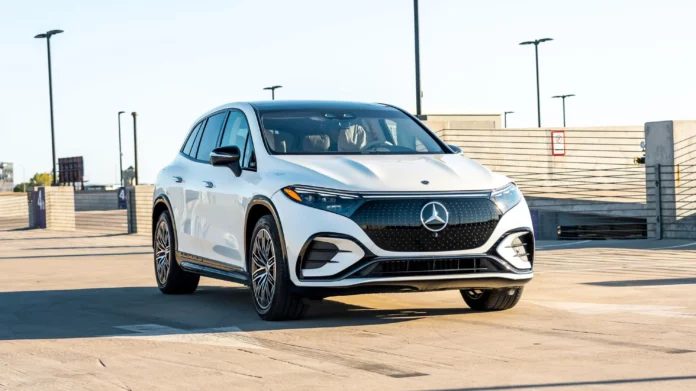
According to a report, Mercedes-Benz will discontinue the use of the ‘EQ’ branding for its next-generation electric vehicles, which will be available in late 2024. According to company insiders, the branding will become obsolete as Mercedes’ lineup becomes increasingly dominated by electric models, according to the German trade newspaper Handelsblatt. The company previously stated that by 2025, it would have an electric equivalent for each of its models.
Mercedes-Benz currently sells seven pure-EV models worldwide: the EQE, EQE SUV, EQS, EQS SUV, EQC, EQA, and EQB.
Mercedes-Benz sells the EQB SUV, the EQC, and the EQS sedan in India. Over the next two years, the brand will expand its international lineup with an electric version of the rugged G-Class 4×4 and a long-range compact sedan based on the EQXX concept, bringing its EV range to roughly the same magnitude as its long-established combustion car lineup.
credit: autocarindia
The name ‘EQ’ is now also used on mild-hybrid and plug-in hybrid models, with ‘EQ Boost’ denoting electric motor assistance for the internal combustion engine and ‘EQ Power’ denoting direct drive from the electric motor. Mercedes expects to phase out combustion engines in the majority of markets by 2030. The recently launched C-Class is expected to remain on the market until around 2028, a new combustion-engine E-Class is set to make its global debut later this year, and the GLC and GLE, the pair’s respective SUV siblings, will also return with combustion power for another generation.
According to reports on Tuesday, the Society of Manufacturers of Electric Vehicles (SMEV) has asked for an extension of EV subsidies under the FAME-II scheme. To promote electric mobility, the industry has also sought the inclusion of light to heavy commercial vehicles.
The industry body also advocated for a uniform 5% GST on electric vehicle spare parts in its pre-Budget recommendations. According to the EV industry body, market trends indicate that e-mobility, particularly electric two-wheelers (E2W), has the potential to grow further once it reaches 20% of the total two-wheeler market.
“The validity of FAME II is set to expire on March 31, 2024. We believe FAME’s validity needs to be extended since we have yet to meet the penetration the subsidy was supposed to catalyse,” news agency PTI reported SMEV as saying in a statement. The new FAME II scheme should be linked to e-mobility conversion rather than being time-based, it added.
“The subsidy can be tapered thereafter,” it said, adding the FAME II scheme should have provisions to directly transfer the subsidy to customers.
EV sales in India have increased significantly in recent years. While 48,179 electric vehicles were sold in 2020-21, the figure rose to 2,37,811 in 2021-22 and 4,42,901 in 2022-23.
credit: rediff
In a written reply to the Lok Sabha, Minister of Heavy Industries Mahendra Nath Pandey stated that the ministry has implemented a scheme titled ‘Faster Adoption and Manufacturing of Electric Vehicles in India Phase II’ (FAME India Phase II) to promote the adoption of electric/hybrid vehicles in the country.
Phase-II of the FAME India scheme is currently being implemented for a five-year period beginning April 1, 2019, with a total budgetary support of Rs 10,000 crore. Subsidies for 10 lakh e-two-wheelers (e-2Ws), 5 lakh e-three-wheelers (e-3Ws), 55,000 e-four-wheeler (e-4Ws) passenger cars, and 7090 e-buses are provided in this phase to support electrification of public and shared transportation.
SMEV also proposed including light commercial vehicles (LCV) and medium and heavy commercial vehicles (M&HCV) on a project-mode basis, citing the need for India to prepare for the transition to e-mobility in trucks and heavy commercial vehicles within three to four years.
Simple Energy, a leading electric vehicle and clean energy start-up, opened its first manufacturing plant in Shoolagiri, Krishnagiri district, Tamil Nadu, on Thursday. The plant, dubbed Simple Vision 1.0, was built with an INR 100 crore investment and is now ready to begin production of the company’s flagship vehicle, Simple ONE.
The plant, which spans 200,000 square feet, can produce up to one million units per year. The facility includes the best-in-class GA Line (General Assembly Line), India’s first patented in-house motor manufacturing line, a battery manufacturing line, and other amenities such as cell storage, CAL (Customer Acceptance Line), and so on.
The factory, which is one of the safest in the country, also has a testing facility for in-house vehicle testing, according to a press release from Simple Energy.
credit: autoeconomictimes
Suhas Rajkumar, founder and CEO, of Simple Energy, said, “We started this journey four years ago and have reached a stage just one step away from production and deliveries. The inauguration of Simple’s first manufacturing unit in Shoolagiri, TN, is a stepping stone for future expansion plans. Having the right and experienced talent has shown us the right path to churning out the best strategies in R&D and setting up a well-equipped plant that will commence the production of the Simple One electric scooter.”
The plant also intends to employ over 700 locals and anticipates having a female-dominated workforce. Simple Energy aims to be at the forefront of the ongoing global transition to green mobility, he said, with more products in the pipeline and a core focus on R&D.