Kawasaki took to the EICMA Milan Motorcycle Show to unveil a trio of electric motorcycles, with Electrek front and center to see the action live. The Kawasaki Ninja EV and Kawasaki Z EV were revealed as traditional battery electric motorcycles, while the company also unveiled an HEV hydrogen-powered concept motorcycle. While the electric Ninja and Z models are both still in prototype form, Kawasaki Motors president Hiroshi Ito announced to the audience that the two models would be available for purchase next year.
Kawasaki Z, Ninja electric bikes
The Japanese brand took the wraps off a number of bikes at EICMA 2022, yesterday. As per the company, it will roll out the Ninja electric bike and Z electric bike in global markets next year, which are officially called the Ninja BEV and Z BEV, respectively. Both the Ninja BEV and Z BEV electricbikes will be available for purchase in 2023.
These bikes appear to have been inspired by the Z400 and the Ninja 400. According to the brand, these bikes will abide by the A1 requirements. Moreover, they will be marketed as entry-level electric performance bikes and will share the same battery with a capacity of up to 3.0 kWh.
The hybrid electric vehicle prototype, on the other hand, is still a little ways off from going into production, but Kawasaki predicts that it will hit the market by 2024. Further information on the motorcycle is still expected, but the HEV will have robust hybrid technology and will use either hybrid power or simply electric power depending on the needs.
President Ito has reaffirmed that Kawasaki is still heavily focused on bikes with internal combustion engines even if the company has begun to move toward electric motorcycles. Additionally, he stated that Kawasaki will launch about 30 ICE models internationally between 2024 and 2025, with almost half of them arriving in Europe.
For the safety of the rider, both the Z EV and Ninja EV are equipped with disc brakes on both the front and rear wheels, along with dual-channel ABS and a regenerative braking system for improved braking performance.The suspension duties on both motorcycles are taken care of by telescopic forks on the front and a mono-shock unit on the rear end.
As of now, the pricing and availability details for the Z EV and Ninja EV are very much a mystery. When launched, we can expect both all-electric motorcycles to be priced at around Rs. 5 lakh (ex-showroom) in India.
Kawasaki took to the EICMA Milan Motorcycle Show to unveil a trio of electric motorcycles, with Electrek front and center to see the action live. The Kawasaki Ninja EV and Kawasaki Z EV were revealed as traditional battery electric motorcycles, while the company also unveiled an HEV hydrogen-powered concept motorcycle. While the electric Ninja and Z models are both still in prototype form, Kawasaki Motors president Hiroshi Ito announced to the audience that the two models would be available for purchase next year.
Kawasaki Z, Ninja electric bikes
The Japanese brand took the wraps off a number of bikes at EICMA 2022, yesterday. As per the company, it will roll out the Ninja electric bike and Z electric bike in global markets next year, which are officially called the Ninja BEV and Z BEV, respectively. Both the Ninja BEV and Z BEV electricbikes will be available for purchase in 2023.
These bikes appear to have been inspired by the Z400 and the Ninja 400. According to the brand, these bikes will abide by the A1 requirements. Moreover, they will be marketed as entry-level electric performance bikes and will share the same battery with a capacity of up to 3.0 kWh.
The hybrid electric vehicle prototype, on the other hand, is still a little ways off from going into production, but Kawasaki predicts that it will hit the market by 2024. Further information on the motorcycle is still expected, but the HEV will have robust hybrid technology and will use either hybrid power or simply electric power depending on the needs.
President Ito has reaffirmed that Kawasaki is still heavily focused on bikes with internal combustion engines even if the company has begun to move toward electric motorcycles. Additionally, he stated that Kawasaki will launch about 30 ICE models internationally between 2024 and 2025, with almost half of them arriving in Europe.
For the safety of the rider, both the Z EV and Ninja EV are equipped with disc brakes on both the front and rear wheels, along with dual-channel ABS and a regenerative braking system for improved braking performance.The suspension duties on both motorcycles are taken care of by telescopic forks on the front and a mono-shock unit on the rear end.
As of now, the pricing and availability details for the Z EV and Ninja EV are very much a mystery. When launched, we can expect both all-electric motorcycles to be priced at around Rs. 5 lakh (ex-showroom) in India.
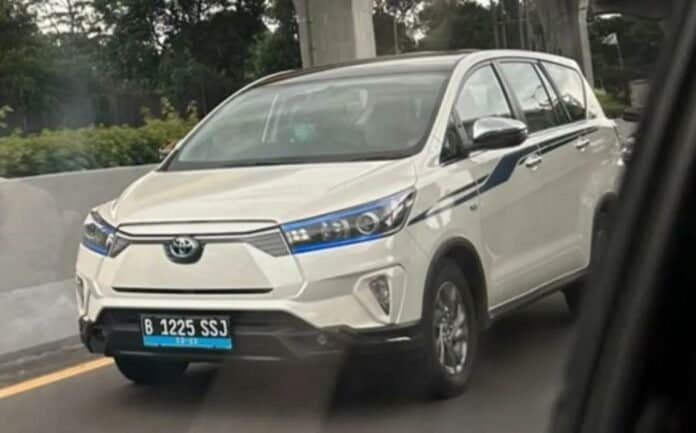
At the Indonesian International Motor Show earlier this year, the Japanese automaker Toyota showed a concept prototype of an electric MPV based on the Toyota Innova. The conceptual basis of this idea was comparable to Innova Crysta, which is available in India.
The firm, however, declared that it had no plans to introduce an electric vehicle (EV) based on the obsolete IMV2 ladder-on-frame platform. Toyota further clarified that this concept is only being created for future EV research and development.
But in an intriguing turn of events, this electric MPV powered by the Innova Crysta was seen for the first time operating on public roads. The front fascia of the car is identical to that of the Innova Crysta in the spy photographs, but it has a blanked-out grille design and blue highlights all over, hinting that it is an electric vehicle. Additional exterior modifications include a new front bumper, blue LED headlight and taillight inserts, “Innova EV” stickers on the D-pillar, new side decals, and EV badging on the back.
credit: team-bhp
Toyota has not provided any technical information or specifications regarding this concept. As a result, the battery’s capacity, maximum range, and power output are yet unknown.
Additionally, Toyota just debuted the Innova HyCross in the nation and is concentrating more on hybrid vehicles in India, according to the brand’s plans. Despite being tested on the road, it is unlikely that the Innova electric concept would be sold in India.
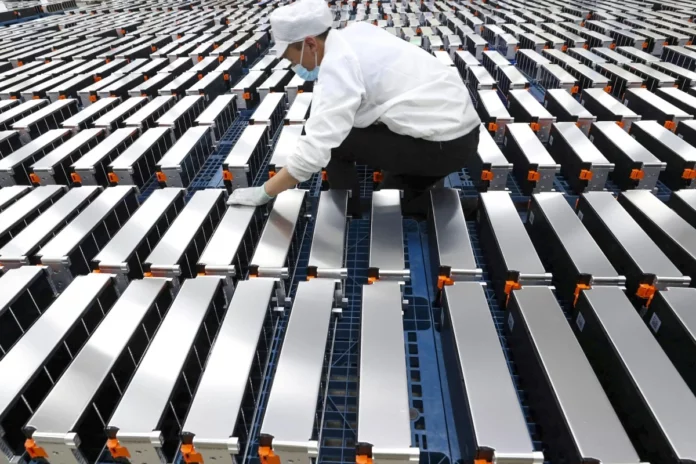
China is predicted to experience an electric vehicle battery issue in 2025 that will make other nations jealous. Electric vehicle battery manufacturing will reach 3,000 gigawatt-hours (GWh) in 2025, according to the South China Morning Post, which is six times more than the 500GWh of EV batteries produced this year. The issue is that China’s domestic battery demand is only anticipated to be 1,000 GWh in 2025.
In order to avoid having to either scale back manufacturing or find suitable storage facilities for all those extra batteries, companies is China are being urged to find international buyers.
Phate Zhang, founder of Shanghai-based EV news site CnEVpost, said “the battery companies may need to look beyond the domestic market to get their demand digested now that China is already a leader in battery technology.”
credit: pcmag
The largest manufacturer of EV batteries in the world, Contemporary Amperex Technology Limited (CATL), has agreements in place to supply Tesla and BMW. If they are to continue operating and expand, the other 47 Chinese EV battery makers will need to form similar alliances.
In the meantime, due to a combination of violent employee protests at the largest iPhone manufacturing in the world and export prohibitions put in place by the US government, China is unable to develop additional cutting-edge technology.
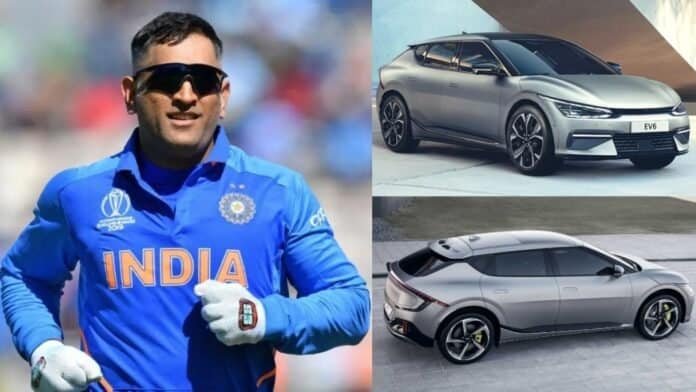
Legendary cricketer and former captain of the Indian national cricket team Mahendra Singh Dhoni has purchased a brand-new Kia EV6 electric crossover. MS Dhoni, who is frequently referred to as Captain Cool, bought the EV6 with an exterior paint job in Moonscape Grey. The Kia EV6 was just recently introduced in India, and the ex-showroom starting price is currently Rs. 59.95 lakh.
credit: financialexpress
In Ranchi, MS Dhoni brought his colleagues cricketers Kedhar Jadhav and Ruturaj Gaikwad on a joyride in his treasured eco-friendly vehicle, according to a video that an MSD fan posted on Twitter. It’s important to note that MS Dhoni also has a number of other high-end SUVs in his massive garage in addition to the EV6, like the Jeep Grand Cherokee Trackhawk, Hummer H2, Nissan Jonga, Audi Q7, and others.
the India-specific Two variations of the Kia EV6 are available, each with a single 77.4 kWh battery pack. Its RWD version has a single motor that produces 350 Nm of torque and 229 horsepower.
The AWD model, on the other hand, has a dual motor setup with one on each axle and produces a maximum torque of 325 horsepower.
According to Kia, the EV6’s AWD version can accelerate from 0 to 100 km/h in 5.2 seconds. Additionally, it is stated to have a 528 km driving range per charge. A 50 kW DC fast charger can charge it from 10% to 80% in 73 minutes. Priced ex-showroom at Rs 59.95 lakh for the RWD model and Rs 64.95 lakh for the AWD model, respectively, of the Kia EV6.
Mahindra is stepping into the electric future with its Born Electric unified platform and its first mainstream electric SUV XUV400 has already been announced but bookings, as well as pricing, are yet to be announced. As per the timeline, XUV400 will have a media review and complete details coming up in December itself while actual price reveals and bookings will be open from January 2023 onwards.
The wait time again will be greater and as Mahindra is growing hype we expect a lot of bookings if they keep pricing competitive because providing up to 456km range in itself is a great deal. The Indian buyers do love the Mahindra cars and it’s evident from the sales numbers, now while EVs are their new area of interest but their quality assures a lot of buyers. Now, just before the launch while we did get an idea about its expected pricing, color variants and a lot more, it seems there will be a special variant as well.
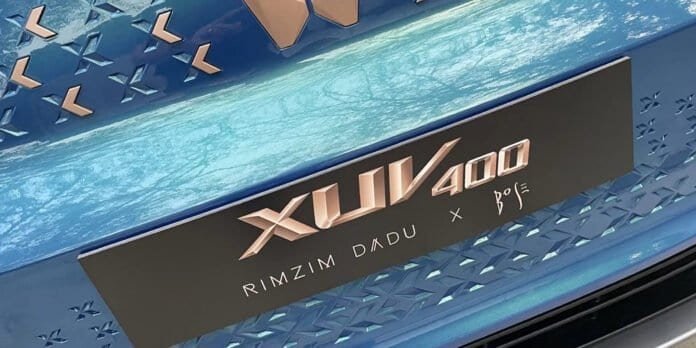
This seems to be a special collaboration with fashion icon Rimzim Dadu with Mahindra’s Pratap Bose to create a fancy new variant which will be purely a style upgrade over the XUV400 unveiled previously. With a slight touch of premiumness and styling, this variant does in fact have that Infinity Blue styling and copper elements with slight touch in interiors and other places.
As you see from the teaser, in every aspect from the seats to the cup holder, the seatbelts, badging, bonet, everywhere there is a slight designer appeal and signifies to be the Special Edition. This XUV400 Rimzim Dadu Special variant should cost a bit more than usual ones and will be no less of a style appeal to make this new-age EV even more attractive in the market.
Rest, all specs should remain the same including a 7-inch touchscreen infotainment system, dual-zone automatic climate control, a single-pane sunroof, connected car technology, a push start-stop button, and six airbags are all included in the equipment list. The XUV400 can accelerate from 0 to 100 km/h in 8.3 seconds thanks to the motor’s maximum output of 310 Nm and 150 PS. Mahindra claims that the electric powertrain and 39.5 kWh battery pack together can go 456 km at their maximum range on a single charge.
We expect this Special Edition XUV400 EV to be announced alongside the other standard variants in January 2023 itself and we cannot wait for it actually makes its presence in the Indian market!
The government has stated that it intends to grow electric vehicle ( EV) deals in India to capture the requests of 30 of private buses , 70 of marketable vehicles and 80 of two and three- wheelers by 2030.
The target may appear dispiriting at first, but consider that EVs ’ share of all vehicle deals in India has grown from0.75 in 2019 to over 4 for the first six months of 2022. still, which seems likely, the target should be achieved well in time, If this trend continues and picks up further instigation
There are several factors behind this sanguinity. First, EV prices are falling constantly and are no longer as steep when compared to conventional ICE( petrol, diesel, or CNG) vehicles. Nitin Gadkari, the Union Road Transport and Highways Minister, stated in June that the price difference would be excluded by coming time. The reduction in GST on EVs from 12 to 5 is a step in the right direction.
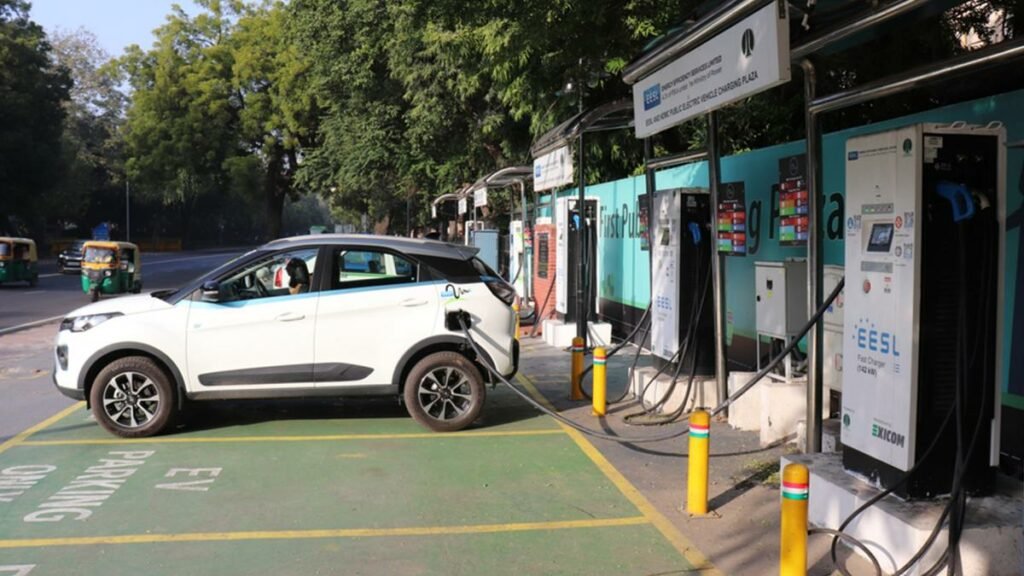
Away from the purchase price and functional costs, one major factor discouraging most buyers from copping EVs in the first place is ‘ range anxiety ’. A recent exploration report said that India would need at least 20 lakh public charging stations civil by 2030 if the government’s thing for EV relinquishment is achieved. 5 lakh of these are formerly in the channel.
This is aggravated by regular power outages in utmost Indian countries, and a poor public charging structure that presently exists with lower than,000 functional charging stations civil. Of course, there’s a huge ongoing trouble to make EV charging stations in all corridor of the country with public and private participation.
How India Can Achieve Electric Mobility 2030 Target With EV Startups?
First, an EV buyer’s home will always be the cheapest and most accessible place to charge an EV. In fact, in 90 of use cases, home charging is and will remain the favored option. Public charging stations aren’t only precious to use, but they’re also infelicitous for completely charging an EV due to the time it would take, not to mention the battery declination caused by by fast charging. perfecting the quality and thickness of power force to homes must therefore be the top precedence.
Second, further policy impulses are needed for public charging structure to come financially and operationally feasible on a large enough scale. Further, these impulses or subventions must cover charging outfit, the cost of power, as well as parcel or reimbursement costs. A functional public charging structure is only possible if the costs of running and operating them are precisely calibrated against the earnings it’s likely to induce, or differently the loss- making stations will simply shut down.
Third, all EV manufacturers must prioritise nonstop exploration and development of new technologies that either increase the vehicle’s range or reduce the time needed to completely charge the EV. further than just fast charging, having further the robust products with lesser range is an effective cure to ‘ range anxiety. ’ Policy measures and impulses for manufacturers that are applicable and targeted can help to accelerate the development and commercialisation of technologies that support this thing.
To summarise, while the transition from internal combustion machines to electric vehicles is necessary, as it’s a global miracle, accelerating this transition in India can be a significant contributor to making mobility more sustainable and affordable for generations. All we need is close collaboration between colorful government ministries and departments at the external, state, and civil situations, as well as between government and private assiduity.
Royal Enfield has stood true to its ‘ four motorcycles a time ’ strategy. We got Scram 411, a new Classic 350, new Hunter 350 and lately unveiled Super Meteor 650. Royal Enfield’s share for new launches in 2022 seems to have come to an end.
That said, hereafter noway sleeps and with a future of EVs gaining traction, mainstream 2W manufacturers ca n’t go to miss the EV train. clearly not Royal Enfield, as it seems to have a monopoly on classic and antique motorcycles at least in India. shaft has a ton of overseas fanbase to please as well.
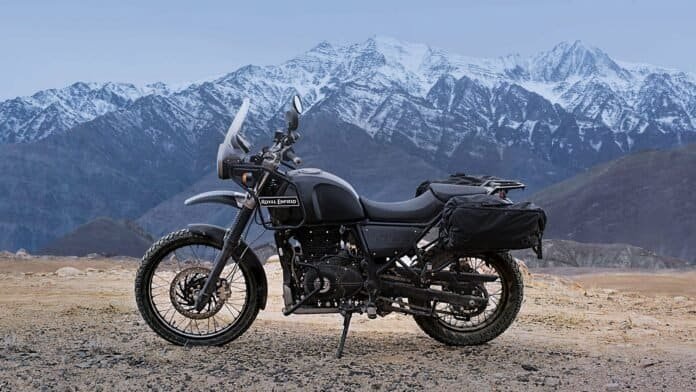
To continue being at the top of their game, Royal Enfield has planned multiple launches over the coming many times. One of them is an electric Himalayan. You heard that right. An electric ADV from a mainstream motorcycle manufacturer. Let’s take a look.
Royal Enfield Himalayan EV
It was at Hunter 350 launch that Eicher Motors CEO Siddhartha Lal gave subtle hints as to what kind of EVs may come out of Royal Enfield forces in the coming times. He mentioned that the veritably first Royal Enfield electric vehicle will be revealed in a three to four times timeline. Indeed though it meant staying, RE verified that it had its bottom on the ground.
Lately we saw Electrik01 conception in a blurted picture which looked extremely radical. commodity no bone had seen in a century. It had a futuristic vibe and stood by its retro charms along the way. Enfield Electric Himalayan radiates the same vibes. In this sense, it’s stillneo-retro in its appeal, but gets a futuristic design language.
Gone is its beak and in its place is a bikini donation that holds its round headlights. A altitudinous bill adorns its frontal fascia and gives it an ADV feel. It’s apparent that Royal Enfield is cleverly incorporating its frame as its body panels, exposed for display. At the reverse, we can see a sharp subframe and a clean profile.
Line spoke skirtings are retained and are likely to be 21 ” at front and 17 ” or 18 ” at the reverse. Royal Enfield Himalayan Electric gets amid-mounted motor transferring power to rear bus via chain drive. Mono- shock hinder suspense and swish aluminium swingarm are part of its package as well.
Unlike Electrik01 which is a prototype, Enfield Himalayan Electric is still in conception design phase. It’s possible that when the new strain of electric 2W from Royal Enfield sees the light of day, electric Himalayan could be the flagship. We say this because owing to its nature, an ADV should have a long range.
Tata Motors is the current leader in the electric vehicle market, but MG has established itself. With only the ZS EV to offer, MG is only second behind Tata Motors in terms of the top 10 electric car manufacturers. It recently underwent a redesign, and the business even released the base Excite variant.
The Astor sibling of ICE is on the other end of the spectrum. It competes with other small SUVs including the Hyundai Creta, Kia Seltos, and similar models. New photographs from the land of the dragon have surfaced, showing concept art for the impending MG ZS EV/Astor Facelift.
It has undergone a second facelift since its debut. The initial facelift involved a thorough nip and tuck. It had a redesigned bumper, a closed-off grille, and sharper headlamps. Still, the general appearance of the face was extremely similar.
However, the patent photos of the second facelift show numerous modifications at the front that go far beyond a simple nip and tuck. First off, the MG ZS EV Facelift has a completely new face that is much crisper and differs from the previous model. Through the addition of a new front fascia, it creates a distinct identity. However, it appears that the charging socket’s front grille placement has moved.
credit: team-bhp
The redesigned headlights have a metallic insert with slight vertical lines, making them even more svelte. The facelifted vehicle no longer retains the outgoing model’s closed-off grille aesthetic. A modest cooling air dam and a seamless bumper with a mesh effect are located below this metallic addition. Fake air vents at the lower bumper, which have been added with this new facelift, weren’t there in the first facelift.
At the centre of the false grille, which is now mounted to the bonnet, was the MG emblem. The older model does not have access to all of the ADAS functions that the Astor does. Its lower bumper has a square panel that will hold the radars and sensors needed for ADAS.
With the exception of the new aerodynamic wheels, the side profile is almost unchanged. Although interiors have not been made public, there have been rumours that the MG 4 EV may have served as inspiration. Expect a clean, simple design that is dominated by a sizable touchscreen and devoid of any buttons or knobs.
It’s expected that the outgoing model’s 50.3 kWh battery and single motor, which produces 174 horsepower and 280 Nm, will remain. The launch timetable is yet unknown. Having said that, it is likely that these modifications would be implemented in China before moving on to ASEAN nations and finally India. These adjustments are quite likely to be applied to Astor as well. In the meanwhile, MG plans to increase the number of EVs it offers in India by introducing the Air EV, a micro-EV that will probably make its debut at the 2023 Auto Expo.
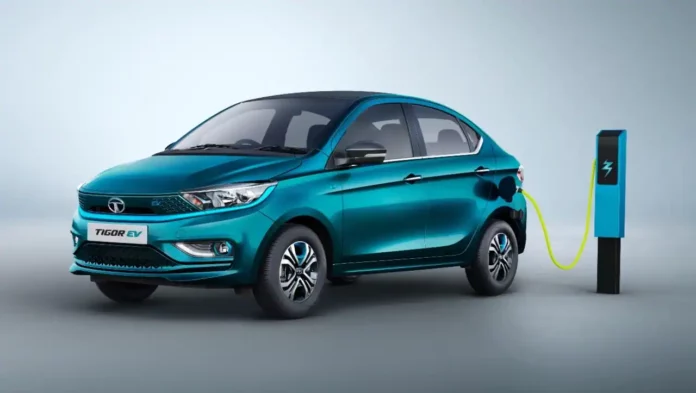
In September 2022, the Tata Tiago EV has released in the Indian market at an initial price of Rs. 8.49 lakh (ex-showroom). The Tiago EV has received over 20,000 reservations in a single month, according to the brand, and deliveries will start in January 2023. The EV’s launch price will only be available to the first 10,000 reservations at that time. Customers interested in purchasing the Tata Tiago EV can do so for an initial cost of Rs 20,000 online or at their local Tata dealership.
Tata Motors has added further 10,000 units to the initial price after noticing the tremendous demand. In some cities, clients must wait anywhere between two and four months.
credit: carwale
The Tata Tiago EV comes in five colour options: Tropical Mist, Midnight Plum, Pristine White, Teal Blue, and Daytona Grey. It is offered in four trims: XE, XT, XZ+, and XZ+ Tech Lux. It has a 7-inch touchscreen infotainment system with Android and Apple CarPlay, cruise control, multi-mode regenerative braking, leatherette seating, a reverse parking camera, automatic climate control, and more inside features.
City and Sport are the available driving modes for the Tata Tiago EV. Two battery packs—one 19.2 kWh battery with a 230 km range and the other 24 kWh battery with a 315 km range—power the EV. A 3.3 kW and 7.2 kW charger can be used to charge the battery at home. The EV battery can be charged from 10-80% with a DC fast charger in 57 minutes.
The government of Chief Minister Yogi Adityanath has pledged to turn western and central Uttar Pradesh into a hub for the auto and electric vehicle sectors as well as their supporting components in order to increase the state’s economy to USD 1 trillion.
The demand for electric vehicles in the auto business is rising swiftly, thus CM Yogi Adityanath told the officials at a high-level meeting that the auto and electric vehicle industries in western and central UP already have enough of resources and just need to be encouraged to grow. As a result, this industry will also have a lot of work opportunities.
According to a survey, the Growth State Value Addition (GSVA) of UP in the car industry was 1.5 billion dollars in 2019 and can reach five billion dollars during the next five years. An official announcement claims that 9000–10,000 acres of land will be required in western and central UP for the development of the sector, and the Yogi government will spend 19–20 billion dollars on it. The UK, USA, Australia, and South Asia will all receive car parts made in this country for use in electric vehicles at the same time. In fact, there is a high need for batteries for two- and three-wheeled electric vehicles.
Both huge companies and MSMEs (Ministry of Micro, Small & Medium Enterprises) play a key role in the auto sector and are already well-established in adequate numbers in western and central UP, according to Chief Minister Yogi Adityanath, who made the statement during the meeting.
credit: economictimes
Additionally, the expressway is accessible for the export of this industry’s equipment. The Easton Dedicated Freight Corridor can also be simply built here and connected to the expressway in order to encourage exports. According to a statement, the Yogi government chose Agra, Shahjahanpur, Aligarh, Prayagraj, Saharanpur, and Etawah to support MSME development while Gautam Budh Nagar, Ghaziabad, Lucknow, Hapur, Kanpur Nagar, and Meerut were chosen for the development of large businesses to support the auto industry.
There are already enough resources available to develop western UP into an original equipment manufacturing belt and build a trillion-dollar economy for the region. The most significant metal sector for the car industry and other allied industries, on the other hand, is well suited to central Uttar Pradesh. The MSME industry already exists for these sectors; it just has to be given a larger form.
In order to develop the auto zone and automotive industry in western UP, Chief Minister Yogi Adityanath stated at the meeting that emphasis must be given to ancillary and downstream sectors related to the automotive sector. Green zones will need to be established for the glass, mechanical, plastic, metal, and ancillary sectors of electric car original equipment manufacturers in order to achieve this.
The CM also stated that the state’s EV charging network has to be increased. The focus of the electric vehicle industry is on product development, research, and EV charging. This involves a significant amount of battery, battery chemical, cell manufacture, fuel, and welding. In such a situation, technicians for casting, welding equipment, electric car assembly, and heat treatment will be most needed. The announcement stated that these positions would have the most employment opportunities.
According to the study research, 60,000 to 70,000 people found employment in this industry in 2017, but due to its expansion, 90,000 to 1.10 lakh job openings will be available annually over the course of the next five years. The UK, USA, Australia, and South Asia will receive two- and three-wheeler electric vehicles built in Central and Western UP, according to CM Yogi Adityanath . For the supply of EVs and EV parts, these nations are best.
Although the holiday season is over, celebrations are still going on for the manufacturers of electric vehicles (EVs), with November sales likely to match the record established last month during Navratri and Diwali. According to information from the government website Vahan, which registers vehicle registrations, EV sales this month have already surpassed 99,000 units, breaking the previous record of 115,861 units established in October. According to industry officials, this is happening as backlog bookings are still being sold and as more and more vehicle owners are becoming aware of EVs.
“EVs are at an inflexion point across multiple vehicle categories – the total cost of ownership is already favourable for two-wheelers and is near par for three-wheelers,” said Sohinder Gill, CEO of electric bike and scooter maker Hero Electric and director-general of Society of Electric Vehicle Manufacturers (SMEV).
More electric two-wheeler product introductions at competitive price points are expected over the course of the next two years, which will contribute in increasing their uptake, according to Gill. Although the country’s EV ecosystem is still growing, two- and three-wheelers are driving adoption as more people rely on them for last-mile connectivity, helped by their affordable operating costs.
According to the past seven months, EV sales will surpass a million units in 2022–23, an increase of 84% from the previous fiscal year. According to SMEV, sales of electric two-wheelers are anticipated to increase by 117% year over year to reach 750,000 units this fiscal year, while sales of three-wheelers are anticipated to increase by 12% to 200,000 units.
credit: economictimes
Considering their greater price, electric car sales are still relatively modest, but in the first half of the current fiscal year, they increased 268% year over year to 18,142 units. According to the Vahan dashboard, 4,935 electric car units were sold in October. The market is predicted to expand quickly since EVs have substantially lower operating costs than cars and trucks fueled by gasoline and diesel.
“At Rs 1.1 per km of running cost (for an electric car), the monthly expense is a fraction of what is incurred driving a petrol/diesel car, making it simply unbeatable,” said Vivek Srivatsa, head, sales, marketing and service strategy, at Tata Passenger Electric Mobility, which dominated the EV passenger vehicle market with a share of about 85% and has the largest electric car portfolio.
As the EV demand goes up and supply bottlenecks ease, original equipment makers (OEMs) have been ramping up production. “The waiting period has reduced as production goes up in multiples. Now electric OEMs are able to deliver vehicles faster,” said Hemal Thakkar, director at credit rating firm Crisil.
The entry of established automobile firms into the EV market has increased consumer and financial confidence. Dealers claim that even after the festival season, the switch to EVs is unabated. “The affordability and running cost, specifically in two- and three-wheelers, have drastically improved, making it a viable choice for consumers,” said Nikunj Sanghi, an automotive dealer based out of Alwar. While the acceptance of EVs is progressing steadily, it will still take some time for them to become widely used.