

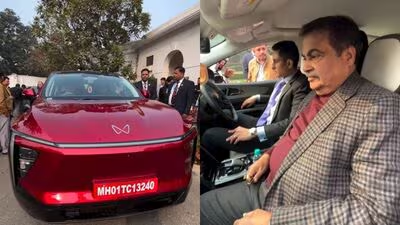

Union Minister Nitin Gadkari projects India’s EV sector will reach ₹20 lakh crore valuation, signaling unprecedented expansion in electric mobility. When Nitin Gadkari speaks about India’s automotive future, industries listen. The Road Transport and Highways Minister’s projection of a ₹20 lakh crore EV sector valuation isn’t mere political optimism—it’s a roadmap backed by policy initiatives, manufacturing investments, and rapidly shifting consumer preferences. This ambitious target reflects confidence in India’s capacity to become a global electric vehicle powerhouse.
Table of Contents
Understanding the Scale
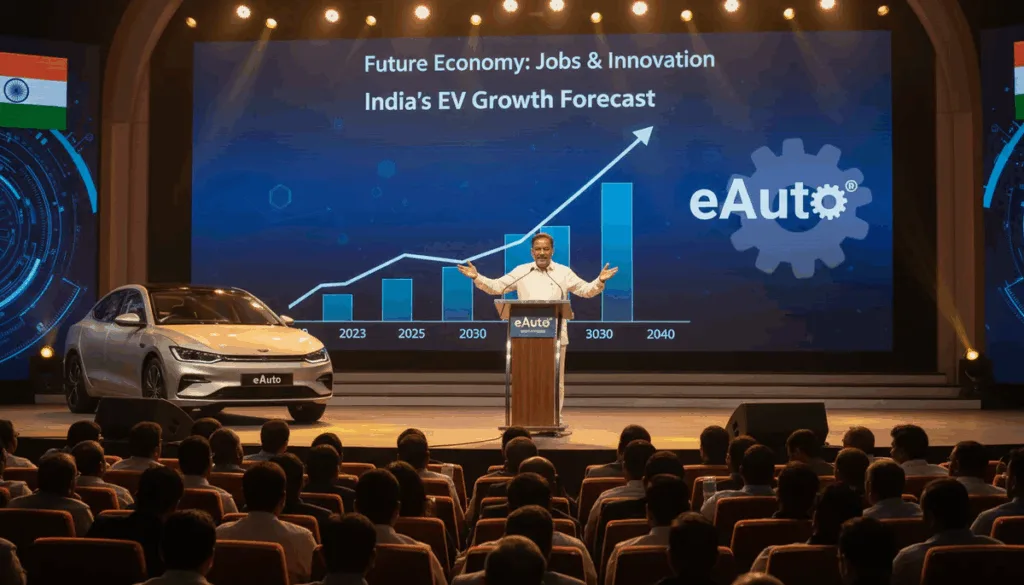
Twenty lakh crore rupees represents transformational economic impact. This valuation encompasses vehicle manufacturing, battery production, charging infrastructure, component supplies, software development, and supporting services. It’s not just about cars and scooters—it’s an entire ecosystem generating employment, driving innovation, and positioning India strategically in the global green economy.
For context, this projection suggests electric mobility will rival India’s traditional automotive sector in economic significance within years, not decades. Such rapid transformation requires coordinated efforts across manufacturing, infrastructure, policy, and consumer adoption—challenges India appears increasingly equipped to address.
Policy Push
Gadkari’s confidence stems from comprehensive government initiatives. Production-linked incentives encourage domestic manufacturing, import duty structures favor local assembly, and charging infrastructure programs address range anxiety. The government’s multi-pronged EV strategy creates conditions for exponential growth rather than incremental progress.
State governments are amplifying central efforts with region-specific policies, subsidies, and infrastructure investments. This coordinated approach—central vision implemented through state action—could accelerate adoption faster than skeptics anticipate.
Manufacturing Momentum
India’s automotive manufacturing prowess provides a foundation for EV dominance. Established players like Tata Motors and Mahindra are investing billions in electric portfolios, while new entrants bring fresh perspectives and technologies. International brands increasingly view India as both market and manufacturing base, further validating the sector’s potential.
Battery manufacturing—historically India’s weakness—is receiving focused attention. As domestic battery production scales up, dependence on imports decreases, costs moderate, and India’s EV value chain becomes more self-sufficient and competitive.
Investment Opportunities
The ₹20 lakh crore projection signals opportunities across the ecosystem. Component manufacturers, software developers, charging network operators, battery recyclers, and countless other specialists will find growing demand for their products and services. For entrepreneurs and investors, India’s EV transformation represents rare growth prospects in an established industry undergoing complete reinvention.
Realistic Timeline?
Skeptics question whether such ambitious targets are achievable. However, India’s digital transformation exceeded pessimistic predictions, and the EV sector could follow similar trajectories—slower than optimists hope, but faster than skeptics expect.
Gadkari’s projection isn’t guaranteed destiny, but it’s credible aspiration backed by substantial policy commitment and market momentum. For India’s economic future, betting on electric mobility leadership isn’t speculation—it’s strategic necessity in a decarbonizing global economy.

