

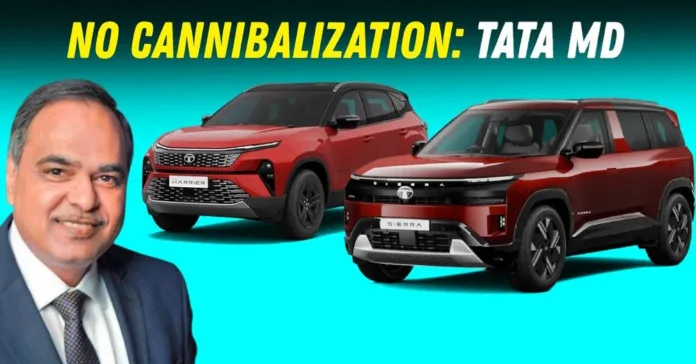

Picture this: You walk into a Tata showroom eyeing a mid-size SUV. The salesperson points to the Harrier on one side and the brand-new Sierra on the other. Same size. Similar price. Both Tata. So… which one? Tata Managing Director Shailesh Chandra has an answer that might surprise you: They’re for completely different people.
Table of Contents
The Cannibalization Question Everyone’s Asking
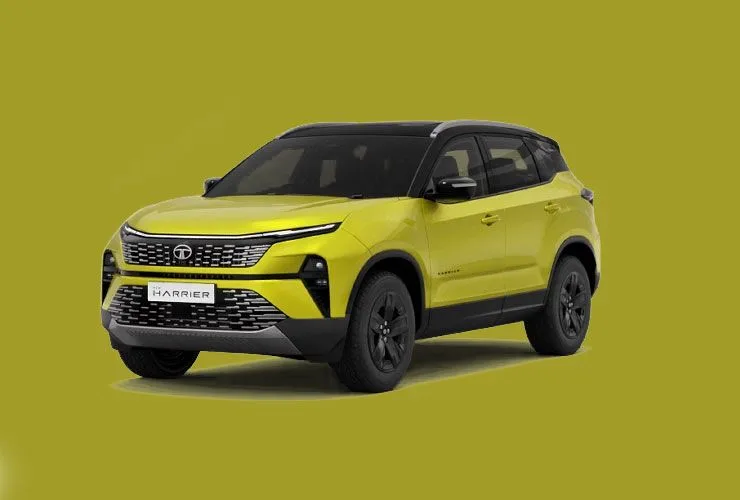
When Tata launched the Sierra at ₹11.49 lakh, automotive analysts immediately questioned whether it would steal sales from the Harrier. On paper, the concern seems valid—both SUVs overlap in dimensions and price, creating what appears to be internal competition.
But Chandra addressed this head-on at the Sierra launch, emphasizing that each Tata SUV targets distinct customer profiles.
Tata’s SUV Customer Psychology:
| SUV Model | Target Buyer Profile | What They Value Most |
|---|---|---|
| Harrier | Dynamic performance seekers | Powerful styling, strong performance, big upgrade feel |
| Curvv | Trend-conscious millennials | Styling appeal, modern coupe-like design, trendiness |
| Sierra | Premium lifestyle buyers | Distinctiveness, iconic upright styling, plush cabin without size |
Chandra explained that Harrier customers want dynamic styling and strong power, Curvv buyers prioritize styling and trendiness, while Sierra customers value distinctiveness and premium feel without increasing vehicle size.
The “Premium Mid SUV” Space: Tata’s New Category
The Sierra isn’t just another mid-size SUV—Tata positions it in a newly created “premium mid SUV” category, targeting buyers who want luxury-level refinement in a manageable footprint.
The Gap Tata Identified:
Chandra pointed out the mid-size SUV segment has grown quickly but has become repetitive with too many similar products. At the same time, rising incomes push buyers toward upgrades, but crowded city parking makes larger SUVs impractical.
The Sierra Solution:
| Consumer Challenge | Sierra’s Answer |
|---|---|
| Want premium feel | Lounge-like interiors, panoramic sunroof, triple-screen layout |
| Worried about size | Mid-SUV footprint (4.27m length, 2.7m wheelbase) |
| Tired of generic SUVs | Iconic upright design, recognizable silhouette |
| Need daily practicality | Segment-leading boot space, easy parking, city-friendly |
| Desire social status | Premium positioning above Curvv, retro-cool heritage |
The idea is simple: buyers get the indulgence and refinement of larger SUVs while maintaining a footprint that’s easy to live with in daily use and parking.
The Market Share Mission: 16% to 25%
Here’s where strategy becomes numbers. Tata currently holds about 16-17% of the SUV market, and with the Sierra, aims to reach 20-25%.
The Growth Math:
To achieve that target, the Sierra must pull in incremental customers instead of just drawing Harrier or Safari buyers away.
Success Scenario:
- Sierra attracts buyers who would’ve purchased Creta, Seltos, or Grand Vitara
- Harrier and Safari sales remain stable or grow
- Tata’s overall SUV market share expands 4-9 percentage points
Failure Scenario:
- Sierra simply replaces Harrier/Safari purchases
- Total Tata SUV volume stays flat
- Market share target remains unmet
The positioning strategy depends entirely on whether real-world buyers perceive the Sierra as genuinely distinct rather than a Harrier alternative.
Design Language: The Visual Differentiator
While the Harrier uses dynamic, sweeping lines and the Curvv carries a coupe-like profile, the Sierra goes the opposite direction with an upright, boxy shape that nods to the original.
Design Philosophy Breakdown:
| Design Element | Harrier Approach | Sierra Approach |
|---|---|---|
| Overall Shape | Dynamic, flowing curves | Upright, boxy, retro-inspired |
| Front Design | Aggressive, sporty grille | Piano black grille, LED DRLs |
| Side Profile | Muscular, sculpted surfaces | Flat panels, generous cladding |
| Roof Design | Sweeping roofline | Boxy, large Panora Max sunroof |
| Rear Design | Tapered, sporty tail | Full-width LED taillamps, vertical |
| Design Intent | Modern, aggressive power | Iconic, recognizable heritage |
The Sierra appeals to buyers who want something recognizable and different, not just another soft-edged crossover. In an era where mid-size SUVs increasingly look identical, the Sierra’s bold retro-modern design is its primary differentiator.
Interior Philosophy: Premium Without Size
Tata focused on making the cabin feel airy and upmarket without chasing sheer size.
Sierra’s Cabin Strategy:
| Interior Feature | Purpose | Premium Appeal |
|---|---|---|
| Panoramic sunroof (Panora Max) | Creates open, airy feel | Luxury segment feature |
| Triple-screen dashboard (Theatre Pro) | Modern tech experience | Horizon View displays for driver & passenger |
| Lounge-like rear seats | Passenger comfort priority | Premium seating experience |
| Segment-leading boot | Practicality without compromise | More cargo than competitors |
| Natural color themes | Calm, premium ambiance | Soft-lighting elements |
| 12-speaker JBL audio | Audio enthusiast appeal | Dolby Atmos sound system |
The promise is that owners get the sense of a bigger SUV without the everyday compromises that come with extra length and width.
This is crucial for urban buyers who want premium feel without sacrificing parking convenience or maneuverability in tight spaces.
The Harrier & Safari Connection: December 9 Matters
Chandra also discussed how Harrier and Safari fit into this picture, especially with their petrol variants launching December 9.
The Powertrain Sharing Strategy:
The Harrier and Safari will share the Sierra’s new 1.5-litre turbo petrol engine, but target buyers who want a larger footprint and additional capability.
Why This Matters:
| Vehicle | Engine Options | Target Buyer |
|---|---|---|
| Sierra | 1.5L NA petrol, 1.5L turbo petrol, 1.5L diesel | Premium mid-SUV buyers prioritizing compactness |
| Harrier (Dec 9) | 1.5L turbo petrol (new), 2.0L diesel (existing) | Buyers wanting larger size, dynamic styling |
| Safari | 1.5L turbo petrol (new), 2.0L diesel (existing) | 7-seater families needing maximum space |
By sharing the new petrol engine across models, Tata reduces development costs while offering different size/seating options for different buyer needs.
The December 9 petrol launch for Harrier/Safari is strategically timed—it expands powertrain choices without cannibalizing the Sierra’s November 25 launch momentum.
The “Me Too” Problem: Why Sierra Exists
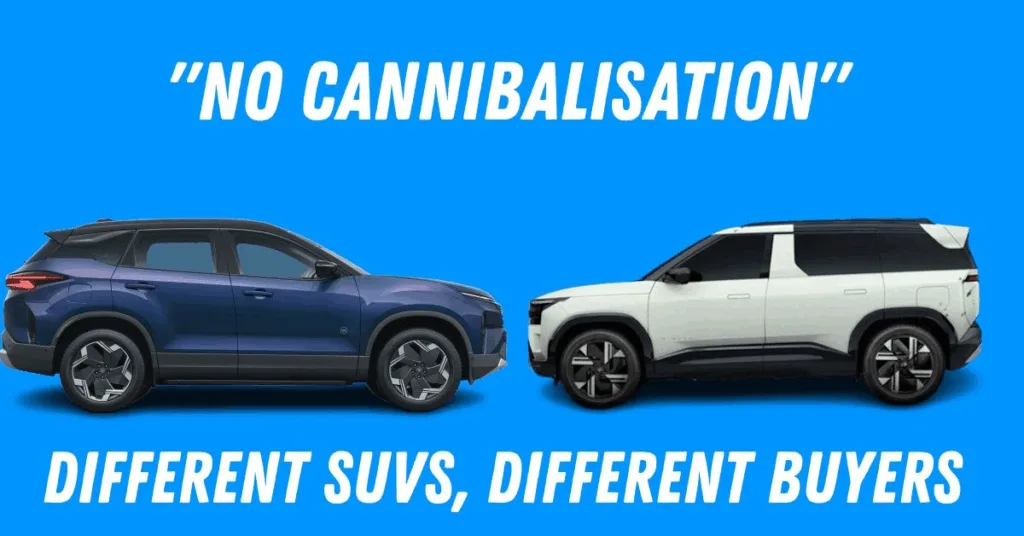
Chandra pointed out that there are too many “me too products” in the mid-size SUV segment.
The Repetition Reality:
Walk through any showroom area and you’ll see:
- Hyundai Creta: Flowing, modern design
- Kia Seltos: Sporty, aggressive styling
- Maruti Grand Vitara: Conservative, mainstream appeal
- Honda Elevate: Soft, rounded crossover look
- Toyota Hyryder: Twin of Grand Vitara
- MG Astor: Generic crossover design
They’re all competent, well-featured SUVs—but visually and philosophically, they’re increasingly similar. Rounded edges, flowing lines, safe designs that offend nobody but inspire no one.
The Sierra’s Counter-Narrative:
The Sierra deliberately rejects this homogeneity. Its upright, boxy silhouette immediately identifies it as different. You won’t confuse it with a Creta in your rearview mirror.
For buyers tired of generic crossovers, this distinctiveness is the entire point—even if it means sacrificing some aerodynamic efficiency or mainstream appeal.
The Income Factor: Upgrade Anxiety
Higher disposable incomes have made more buyers consider an upgrade, but many still worry about the practical side of owning a larger SUV in crowded cities.
The Upgrade Dilemma:
| Buyer Situation | Internal Conflict | Sierra’s Appeal |
|---|---|---|
| Rising income | Want premium car but fear size | Premium feel, manageable dimensions |
| First luxury purchase | Status conscious, parking anxious | Distinctive design, city-friendly |
| Upgrading from compact SUV | Want more features, not more length | Loaded features, similar footprint |
| Urban professional | Premium expectations, practical needs | Business-class interiors, daily usability |
The Sierra targets this specific psychological space—buyers who’ve outgrown their Nexon or Venue but aren’t ready for the bulk of a Fortuner or Endeavour.
The Risk: Will Buyers Actually See the Difference?
Here’s the brutal reality: Tata’s positioning only works if customers perceive genuine distinction between Sierra and Harrier.
Potential Problems:
Confusion: Buyers may simply see two similar-sized Tata SUVs and choose based on price alone Feature Overlap: Both offer premium interiors, safety, and tech—blurring the lines Sales Pressure: Dealers might push whichever model has better margins, undermining positioning Market Perception: If the market views Sierra as “smaller Harrier,” the cannibalization risk becomes real
Success Factors:
Visual Distinction: The upright design must be polarizing enough to attract a different buyer Clear Marketing: Tata must communicate “premium mid-SUV” positioning consistently Pricing Discipline: Sierra must maintain premium positioning without undercutting Harrier Dealer Training: Sales teams must understand and communicate the distinct buyer profiles
Tata’s Multi-Model Strategy: Cover Every Use Case
Tata’s plan is to cover different use cases and buyer priorities within the same broad market band.
The Complete Lineup Strategy:
| Model | Size Category | Price Band | Primary Appeal |
|---|---|---|---|
| Punch | Micro SUV | ₹6-10 lakh | Affordability, compact size |
| Nexon | Compact SUV | ₹8-15 lakh | Mainstream appeal, safety |
| Curvv | Compact coupe SUV | ₹10-20 lakh | Styling, trendiness, youth |
| Sierra | Premium mid-SUV | ₹11-20 lakh | Distinctiveness, premium cabin |
| Harrier | Mid-size SUV | ₹15-25 lakh | Performance, dynamic design |
| Safari | 3-row SUV | ₹16-28 lakh | Family space, 7-seater capacity |
The overlapping price bands are intentional—Tata wants to offer multiple options at similar price points, letting buyers self-select based on priorities rather than just budget.
The Electric Future: Sierra EV Coming
While the initial launch focuses on ICE variants, an electric version of the Sierra is planned for early next year.
EV Strategy Implications:
The Sierra EV will further differentiate from the Harrier EV (also launching December 2024), giving buyers:
- Sierra EV: Premium mid-size electric with distinctive design
- Harrier EV: Performance-oriented electric with 75 kWh battery, AWD capability
Even in the EV space, Tata is maintaining distinct positioning—suggesting the company truly believes in segmented buyer psychology rather than just creating model proliferation.
Dimensions Tell a Story: Close But Not Identical
While Chandra emphasized distinct positioning, let’s examine the actual size difference:
Size Comparison:
| Dimension | Sierra | Harrier | Difference |
|---|---|---|---|
| Length | 4,270 mm | 4,607 mm | -337 mm (Harrier longer) |
| Width | ~1,900 mm | 1,894 mm | ~Similar |
| Height | ~1,650 mm | 1,706 mm | -56 mm (Harrier taller) |
| Wheelbase | 2,700 mm | 2,741 mm | -41 mm (Harrier longer) |
The Sierra is noticeably shorter in length (337 mm = 13.3 inches), making it genuinely easier to park and maneuver. This isn’t marketing spin—it’s a real, measurable difference that affects daily usability.
The similar width means both SUVs offer comparable shoulder room, but the Sierra’s shorter length improves agility in tight spaces.
The Verdict: Smart Positioning or Risky Overlap?
If this positioning works in practice, the Sierra will not be a Harrier replacement in disguise, but an additional option that helps Tata move closer to its 20-25% SUV market share target.
Best Case Scenario:
- Sierra attracts buyers who would’ve bought Creta, Seltos, or Grand Vitara
- Its distinctive design creates a new niche within the mid-SUV segment
- Harrier sales remain stable, appealing to performance-focused buyers
- Tata’s market share grows to 20-25% as planned
Worst Case Scenario:
- Buyers see Sierra and Harrier as interchangeable, choosing based on discounts
- Sierra cannibalizes Harrier sales without bringing new customers to Tata
- Combined Sierra + Harrier volume equals previous Harrier-only numbers
- Market share remains stuck at 16-17%
The real test comes in Q1 2026, when sales data reveals whether buyers actually perceive the Sierra and Harrier as serving different needs—or just as two similar Tata SUVs competing for the same wallets.
The Bottom Line
Shailesh Chandra’s explanation makes theoretical sense: distinct buyer profiles, different priorities, separate market segments. But automotive history is littered with well-intentioned positioning strategies that collapsed when confronted with actual buyer behavior.
The Sierra’s success depends on whether its distinctive upright design, premium cabin focus, and manageable footprint genuinely appeal to a different buyer than the Harrier attracts. If yes, Tata’s 20-25% market share target becomes achievable. If no, the Sierra becomes an expensive hedge that merely redistributes existing Tata buyers across more models.
Initial bookings (opening December 16) and early sales data (deliveries start January 15) will reveal the truth. Until then, Chandra’s confidence in “very distinct sets of customers” remains a compelling strategy awaiting market validation.

