

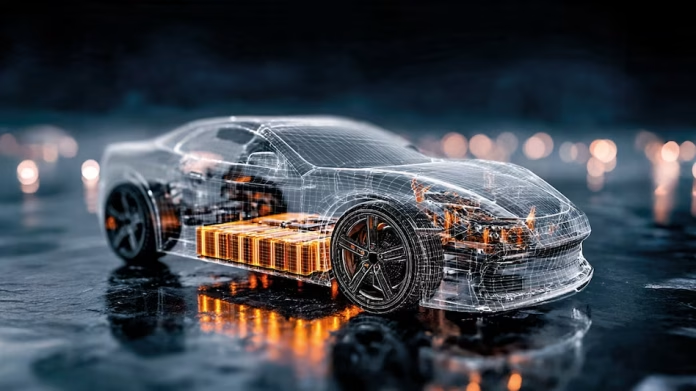

India’s electric vehicle sector is accelerating beyond flashy cars and battery technology into a critical phase where rare earth metals determine success. With EV registrations crossing 1.3 million units in FY25 and charging infrastructure installations jumping 83%, while battery-pack manufacturing capacity exceeded 120 GWh, the foundation is set for explosive growth—if supply chains can keep pace.
Table of Contents
India’s Rare Earth Challenge
| Key Metric | Current Status | Future Projection |
|---|---|---|
| EV Registrations (FY25) | 1.3 million units | 6+ million by 2030 |
| Battery Capacity | 120 GWh | 50+ GWh production by 2030 |
| Charging Infrastructure Growth | 83% increase | Expanding nationwide |
| Material Intensity | 6x more minerals than ICE | Rising with scale |
| India’s Global Reserves | 5th largest (6.9 MT) | Under-utilized |
Why Rare Earth Metals Matter for EVs
An electric vehicle uses nearly six times more minerals than an ICE vehicle, with copper usage jumping from 20 kg to 85 kg, aluminum exceeding 250 kg per vehicle, zinc-coated parts increasing 10-20%, and silver usage rising steadily in electronics and charging systems. Rare earth magnets are critical components powering everything from EV motors and wind turbines to smartphones and defense systems.
China imposed restrictions on rare earth exports on April 4, 2025, following U.S. President Donald Trump’s reciprocal tariffs announcement on April 2, with no shipments reaching India since then. This disruption highlighted India’s vulnerability, with the country importing nearly ₹1,200 crore worth of neodymium magnets annually, mostly from China which produces 85% of rare earth magnets used globally.
Government Initiatives Driving Self-Reliance
The Union Cabinet approved a ₹15 billion incentive scheme under the National Critical Mineral Mission to promote recycling of key minerals including lithium, cobalt, copper, nickel, and rare earth elements, targeting development of at least 270 kilo tonnes of annual recycling capacity translating to about 40 KT of annual critical mineral production.
Additionally, the Production Linked Incentive (PLI) Scheme for Rare Earth Magnets announced in 2025 allocates ₹7,350 crore to incentivize domestic manufacturing of rare earth permanent magnets vital for electric vehicles and renewable energy technologies, aiming to triple India’s magnet production capacity by 2030.
Top Rare Earth Stocks Powering India’s EV Revolution
1. Hindustan Zinc Ltd (HZL)
HZL commands roughly 75% of India’s zinc market, mining 1.03 million tonnes of zinc annually that feeds into battery casings, die-cast structural components, and thermal management systems for EVs, with demand for these applications expected to grow 6-8% annually over the next decade. With reserves exceeding 150 million tonnes, supply security is guaranteed for decades.
Industrial demand for silver in EV and solar applications surged 20% last year, with HZL increasing production by 5% to 714 tonnes. Over the past five years, sales and net profit have grown at a CAGR of 13% and 9% respectively, maintaining EBITDA margins above 50%.
2. Owais Metals
This mid-cap specialist has developed in-house technology to recycle rare earth mineral waste, enabling extraction of critical metals like tantalum, tin, and niobium from industrial slag at 99.9% purity, with capacity of 100 kg per day generating estimated annual revenues of nearly ₹580 million at profit margins of 36-40%.
The company posted massive growth of 166% year-on-year in sales in FY25 while net profit more than tripled to ₹470 million from ₹155 million, demonstrating the viability of waste-to-wealth innovation in critical minerals.
3. Sterling Tools
Specializing in precision-engineered fasteners, Sterling earns 42% of revenue from EVs, growing 60% YoY in this segment, as EV battery packs, thermal modules, and high-reliability joints require over 250 specialized fasteners. The company’s revenue has compounded at 26% over three years, with net profit growing at 32% CAGR during the same period.
4. Coal India
With 73% of India’s power coming from coal-fired plants and EV charging demand potentially adding 6-8% to peak power needs, Coal India remains central to ensuring EVs have reliable charging infrastructure as peak power demand could push north of 280 GW within five years. The company maintains strong cash flows exceeding ₹280 billion with negligible net debt.
5. GMDC
GMDC produces lignite, bauxite, fluorspar, silica sand, and specialty minerals, with aluminium-intensive EV architectures driving bauxite demand as India’s aluminum consumption projects to surpass 9 million tonnes by 2030. The company is also advancing plans to create a complete rare earth elements value chain covering mining, processing, separation, and manufacturing, setting up a major rare earth processing hub supporting India’s self-reliant critical mineral supply goals.
GMDC’s sales and net profit have grown at a CAGR of 16% and 36% over the past five years, positioning it as a diversified rare earth play.
Market Outlook
EV battery pack production in India is projected to rise from 12 GWh in FY24 to 50 GWh by 2030, while vehicle production could grow from 1.3 million units to over 6 million units per year, amplifying demand for metals and minerals across every stage.
For comprehensive coverage of India’s electric vehicle transformation and investment opportunities, explore more insights at India EV News. For detailed market analysis and rare earth sector developments, visit Equitymaster’s Rare Earth Sector coverage.
Disclaimer: This article is for informational purposes only and should not be considered investment advice. Investors should conduct thorough due diligence evaluating company fundamentals, corporate governance, and valuations before making investment decisions.

