

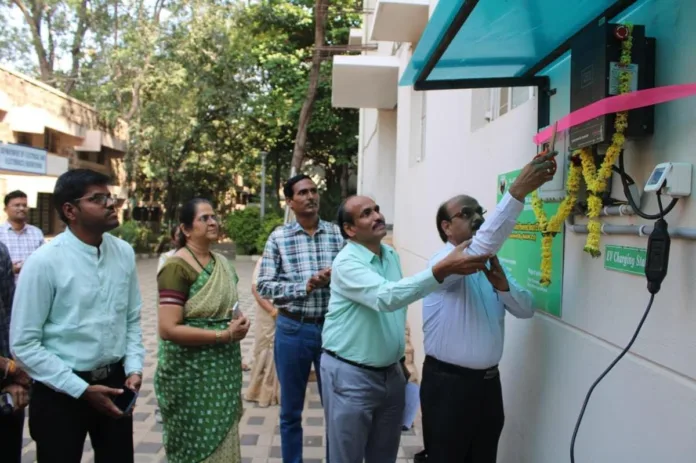

In the quiet town of Vijayapura, Karnataka, a group of engineering students is quietly rewriting the story of renewable energy and electric vehicle (EV) infrastructure.
At BLDE ACET Vijayapur (B.L Dhanalakshmi & Lakshminarasimha Engineering College of Engineering & Technology), these young thinkers have designed and built a solar-wind hybrid smart EV charging station—a small prototype today, but a potentially big deal for India’s green mobility future.
Table of Contents
What makes the project special
| Feature | Details |
|---|---|
| Hybrid Power Sources | Combines photovoltaic solar panels and wind turbines to generate renewable electricity—so the charger isn’t solely dependent on the grid. |
| Smart Charging | Incorporates control electronics and possibly data monitoring so EVs get charged efficiently while the renewable sources are maximised. |
| Local Innovation | Entirely conceived and executed by students—proof that grassroots can drive change. |
| Sustainability Impact | Less reliance on fossil-fuel power, lower carbon footprint for EV charging, smarter use of renewables in mobility. |
Even though I couldn’t access the full article for every detail, other similar student research emphasises solar + wind combos, storage (batteries/super-capacitors) and EV charging.
Why this matters for the future
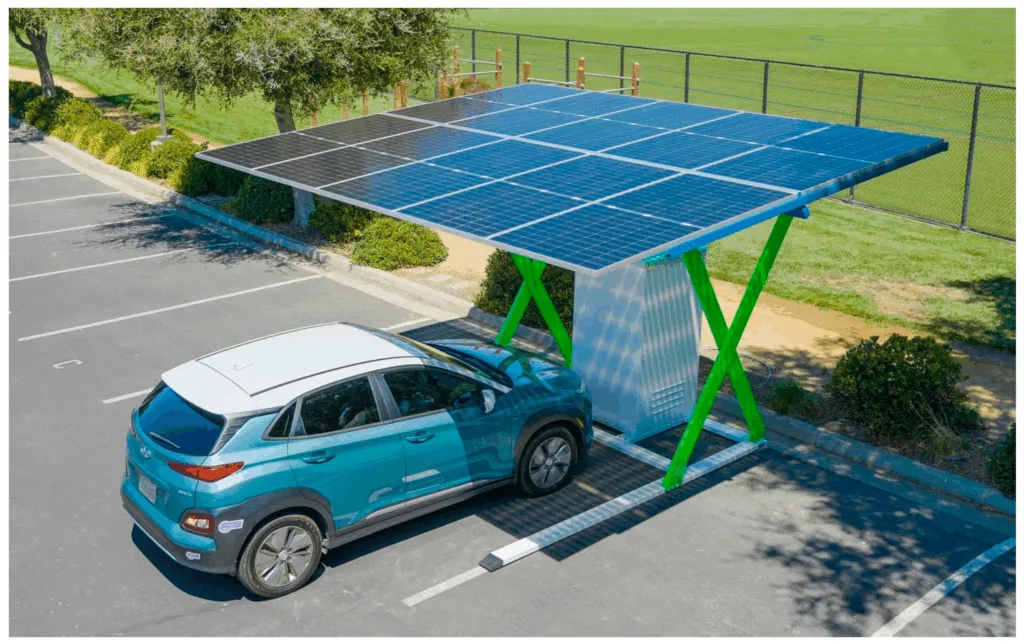
- Electric Vehicle adoption in India is accelerating. But infrastructure often lags. Having charging stations powered by renewables can reduce dependency on conventional (and often carbon-heavy) grid electricity.
- Rural and peri-urban areas like Vijayapura are perfect test-beds: sunlight, wind, space, but often limited infrastructure. A hybrid system bridges that gap.
- Educational institutions doing such projects bring talent, fresh ideas and on-ground prototypes rather than just theory. They help create a pipeline of innovation.
- When one academic institution shows feasibility, the model can scale: more campuses, more villages, more hybrid stations. That’s good for the planet and good for business.
What challenges remain (yes, even smart ideas have them)
- Capital cost: Solar panels + wind turbines + smart electronics + battery/storage all add up.
- Intermittency: Wind and sun are variable. Hybrid helps but there still needs to be good design for uptime and reliability.
- Maintenance & Operation: Prototype is great; long-term operation (maintenance of turbines, panels, control systems) is another layer.
- Grid integration: How does this hybrid station play with the main grid? Is it off-grid or grid-tied? What happens during peak load or when renewables are low?
- Scalability: A prototype is one thing; scaling to dozens/hundreds of stations will require standards, cost-optimisation, and business models.
What the future could look like
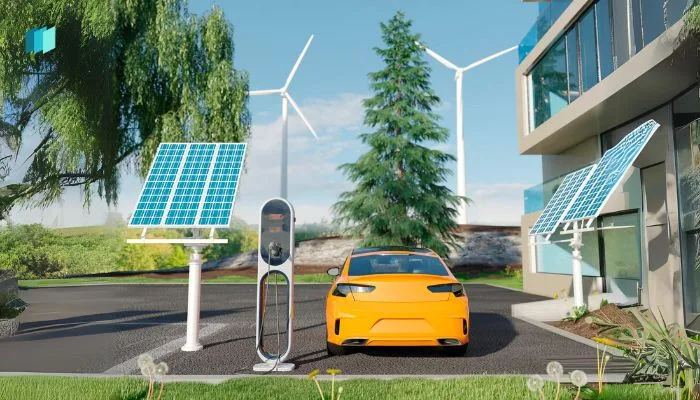
Imagine a row of EVs pulling into a station in rural Karnataka. Above them: solar panels glinting in the sun; around them: small wind turbines spinning in the breeze. A smart charger adjusts based on how much power is coming in, how much storage is available, how many vehicles are waiting. The vehicles leave charged—and the station pulls minimal power from the grid, if any. That’s not sci-fi. That’s what this project hints at.
CONCLUSION
In a world hyping “future tech,” it’s low-key poetic that a small group of students from Vijayapura is actually building it. Their solar–wind hybrid EV charging station is more than a college project—it’s a wake-up call that genuine innovation doesn’t always need billion-dollar labs or Silicon Valley budgets. It just needs curiosity, purpose, and a willingness to solve real problems.
If scalable, this model could transform how EVs are powered across semi-urban and rural India, reducing grid dependency and pushing us closer to truly sustainable mobility. It proves that renewable energy and electric vehicles aren’t just compatible—they’re stronger together.
As India races toward its EV targets, projects like these show the route isn’t just through corporate boardrooms and policy frameworks—it also runs through classrooms, workshops, and youthful ambition.
The road to green mobility may be long, but if it starts with students generating power from the sun and wind, we’re headed in the right direction.

