

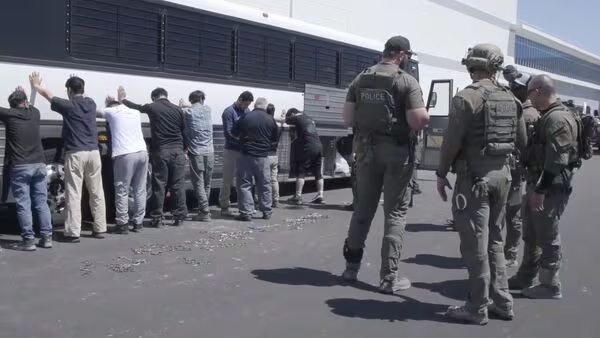

Hyundai, Imagine investing $7.6 billion in America’s future, building the nation’s largest automotive project, and then watching 475 of your workers get detained in a single day.
That’s exactly what happened to Hyundai Motor Group on September 4, 2024, when U.S. Immigration and Customs Enforcement conducted its largest-ever single-site enforcement operation at the company’s Georgia EV battery plant. The aftermath? A diplomatic crisis between South Korea and the United States, a minimum 2-3 month construction delay, and serious questions about foreign investment in America. Yet somehow, Hyundai is doubling down.
Table of Contents
What Happened at the Metaplant?
On September 4, ICE agents raided the Hyundai-LG Energy Solution battery facility in Ellabell, Georgia, detaining 475 workers—over 300 of whom were South Korean nationals. These weren’t random workers. They were skilled technicians and engineers brought specifically to install, inspect, and maintain highly specialized battery manufacturing equipment.
The Department of Homeland Security executed a search warrant stemming from allegations of unlawful employment practices and federal crimes, investigating visa overstays, unauthorized work on visa waivers, and other immigration violations.
The timing couldn’t have been worse. The $4.3 billion HL-GA Battery Company facility was originally scheduled to open later in 2024, but the raid brought construction to a complete halt.
The Damage Assessment
Hyundai CEO José Muñoz confirmed the raid will delay the battery plant opening by at least two to three months, with the facility now expected to open in the first half of 2026. His explanation was blunt: “Now all these people want to get back [to South Korea]. Then you need to see how can you fill those positions, and for the most part, those people are not in the U.S.”
| Impact Category | Details |
|---|---|
| Workers Detained | 475 (300+ South Korean nationals) |
| Construction Delay | Minimum 2-3 months |
| New Expected Opening | First half of 2026 |
| Original Investment | $4.3 billion (battery plant) |
| Total Site Investment | $12.6 billion |
| Diplomatic Fallout | U.S.-South Korea tensions |
The human cost was significant too. A poll in South Korea found nearly 60% of respondents called the enforcement action “excessive” and expressed disappointment with the U.S.
The Diplomatic Scramble
The raid didn’t just delay construction—it nearly derailed billions in foreign investment. South Korean officials immediately raised concerns about the incident chilling future investments in America.
Following the raid, the situation mushroomed into a diplomatic dispute between South Korea and the United States. Both governments rushed to smooth things over. After negotiations at a U.S.-Korea working group meeting, an agreement allowed B-1 and ESTA visa holders to perform installation, inspection, and maintenance at U.S. factories.
The detained South Korean nationals were eventually released and returned home on a charter flight after the two countries reached a deal.
Hyundai’s Surprising Response: All In
Here’s where the story takes an unexpected turn. Instead of retreating, Hyundai committed even harder to American manufacturing.
Just weeks after the raid, Hyundai confirmed it would proceed with a previously announced $2.7 billion expansion to increase the Ellabell plant’s production capacity by 200,000 vehicles over three years, bringing total capacity to 500,000 vehicles annually.
The expanded plans include:
- 10 models of electric and hybrid vehicles (up from 2)
- Commitment to hire 8,500 workers by 2031
- Extended-range EVs launching by 2027 with over 600-mile range
- Deeper investment in robotics and automation
CEO José Muñoz called the raid a “bad surprise” but emphasized that it hasn’t dented Hyundai’s commitment to investing in the U.S.
Why Georgia Still Makes Sense
Georgia Governor Brian Kemp expressed confidence that the state’s business advantages would “win out” for foreign investment, suggesting the raid might even smooth the way for South Korean employees to more easily obtain legal permission for future projects.
The math supports Hyundai’s optimism:
- State and local governments promised $2.1 billion in tax breaks and incentives
- Strategic location near Savannah port for imports/exports
- Access to skilled workforce and automotive supply chain
- 17 supplier companies establishing nearby facilities
The Broader Implications
This incident highlights a critical tension in America’s EV ambitions. The U.S. desperately wants domestic battery production to compete with China, yet skilled battery manufacturing expertise overwhelmingly resides in Asia—specifically South Korea, Japan, and China.
LG Energy Solution stated its newly opened LFP production lines are expected to reach 17GWh annual capacity by end of 2025, increasing to over 30GWh the following year, showing these companies remain committed despite the challenges.
The reality is simple: Building cutting-edge battery plants requires specialized knowledge that currently doesn’t exist at scale in the U.S. workforce. Foreign technical experts aren’t taking American jobs—they’re creating them by establishing facilities that will eventually employ thousands of Americans.
What’s Next?
Construction at the HL-GA Battery Company has resumed with essential personnel returning to the U.S. under clarified visa arrangements. The facility still aims to become operational in the first half of 2026, though the timeline remains tight.
As part of Hyundai’s global expansion, the Ellabell boost is the biggest component of plans to raise worldwide production by 1.2 million vehicles annually, with additional capacity coming from India, South Korea, Saudi Arabia, Vietnam, and North Africa.
The Bottom Line
The ICE raid on Hyundai’s Georgia battery plant was a $4.3 billion wake-up call about the complexities of rebuilding American manufacturing. It exposed the delicate balance between immigration enforcement and economic development, between protecting American workers and attracting the expertise needed to build America’s future.
Hyundai’s decision to stay the course—and actually expand—suggests the company believes this was an isolated incident rather than a systemic risk. The real question is whether other foreign investors will feel the same confidence.
With 475 workers detained, months of construction lost, and diplomatic tensions ignited, the raid’s full impact extends far beyond one battery plant. It’s a test case for whether America can simultaneously enforce immigration rules and attract the massive foreign investment needed to compete in the global EV race.
For now, Hyundai is betting it can do both. The next 18 months will reveal whether that gamble pays off.

