

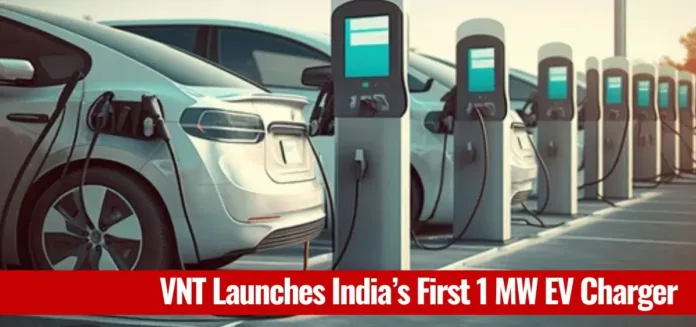

First 1MW EV Charger, Imagine charging a massive electric truck in the time it takes to grab a cup of coffee. Sound impossible? Not anymore. VNT (Vrinda Nano Technologies) just dropped a bombshell on India’s EV industry—the country’s first 1-megawatt (MW) electric vehicle charger. And here’s the kicker: it’s 100% designed and built in India.
This isn’t just another charging station. It’s a paradigm shift that could transform how India powers its electric future, especially for heavy-duty vehicles that keep our economy moving.
Table of Contents
What Makes a 1MW Charger Revolutionary?
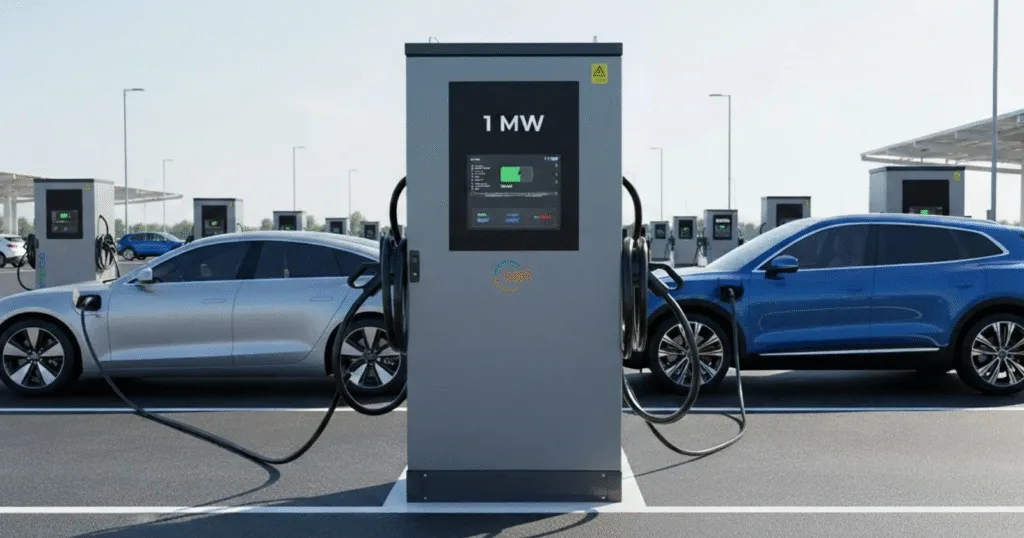
To put it simply, megawatt-scale charging is to regular EV charging what a fire hose is to a garden hose. We’re talking about ultra-fast charging that can power heavy-duty commercial vehicles, long-haul trucks, and electric buses—the backbone of India’s transportation network.
Traditional EV chargers max out around 50-350 kW. VNT’s 1MW charger? It delivers 1,000 kilowatts of raw charging power. That’s enough to charge next-generation, high-capacity EVs at speeds that were previously unimaginable in India.
The Technology Behind the Power
| Feature | Benefit |
|---|---|
| 1MW Charging Capacity | Ultra-fast charging for heavy-duty vehicles |
| Dynamic Load Balancing | Optimizes power distribution efficiently |
| Intelligent Energy Management System | Minimizes energy losses, maximizes performance |
| Multiple Connectors Support | Charges entire fleets simultaneously |
| 100% Indigenous Design | Fully developed in-house in India |
VNT hasn’t just imported technology and slapped a label on it. The charger was conceptualized, designed, and developed entirely in-house—a proud moment for India’s growing clean tech sector.
The intelligent Energy Management System (EMS) is the brain behind the brawn. It dynamically balances loads, minimizes energy wastage, and keeps operational costs in check—critical factors for commercial fleet operators watching every rupee.
Not Just for Trucks: The Fleet Game-Changer
Here’s where it gets really interesting. While megawatt charging is designed for heavy-duty vehicles, VNT’s technology can also power entire fleets of smaller vehicles using multiple connectors.
Think about it: delivery companies, ride-hailing services, and logistics operators could charge dozens of vehicles simultaneously from a single charging hub. No need to build multiple charging stations. One powerful unit does it all.
Dr. Vikas Almadi, Managing Director & Chairman of VNT, captured the significance perfectly: “The introduction of India’s first 1MW EV charger marks a defining moment for the country’s EV ecosystem.”
He’s not exaggerating.
How India Compares Globally
India’s joining an elite club. Megawatt charging is already gaining momentum worldwide:
China has deployed megawatt chargers for ultra-fast “flash charging” of smaller vehicles—though most conventional passenger EV batteries can’t handle such extreme power yet.
Europe is racing ahead with major players entering the arena:
- Sungrow launched the ChargeStack 1000 (1MW-3.5MW capacity)
- Siemens introduced SICHARGE FLEX (up to 1.68MW)
- Iceland deployed megawatt charging along freight routes
- The European Commission funded a €10 million project for a megawatt charging network for electric trucks by 2030
With VNT’s launch, India is no longer playing catch-up—it’s competing on the global stage.
Why This Matters for India’s EV Future
India’s electric transition faces a unique challenge: how do you electrify commercial transport that operates on tight schedules and razor-thin margins? Long charging times equal lost revenue.
Megawatt charging solves this equation. A truck driver can charge during a meal break instead of losing hours of productive time. Fleet operators can maximize vehicle utilization. Logistics companies can confidently switch to electric without sacrificing efficiency.
For India’s ambitious net-zero goals and commitment to clean energy, megawatt charging infrastructure is the missing piece that makes large-scale commercial electrification viable.
The Road Ahead
VNT’s 1MW charger isn’t just a product—it’s a statement. It proves that Indian innovation can lead, not just follow, in critical clean energy technologies.
As more heavy-duty electric vehicles hit Indian roads, the demand for megawatt-scale charging will explode. VNT has positioned itself at the forefront of this revolution, with technology designed specifically for India’s unique needs.
The question isn’t whether megawatt charging will become standard—it’s how quickly India can deploy it nationwide. And with homegrown solutions like VNT’s, that future just got a lot closer.
India’s EV ecosystem just leveled up. The era of megawatt charging has officially begun.

