


The numbers don’t lie, but Tesla investors seem willing to ignore them. For the first time in over a decade, Tesla’s electric vehicle sales declined in 2024—yet the stock soared 70% anyway. What’s happening here? Welcome to the new reality where dreams of autonomous robotaxis matter more than actual car deliveries.
Here’s the uncomfortable truth: Tesla delivered 1.79 million vehicles in 2024, a 1.1% decline from 2023, marking its first annual sales drop since launching the Model S in 2011. Meanwhile, investors pushed the company’s valuation past $1 trillion, betting not on today’s EVs but on tomorrow’s AI revolution.
Table of Contents
The Great Pivot: From Cars to Code
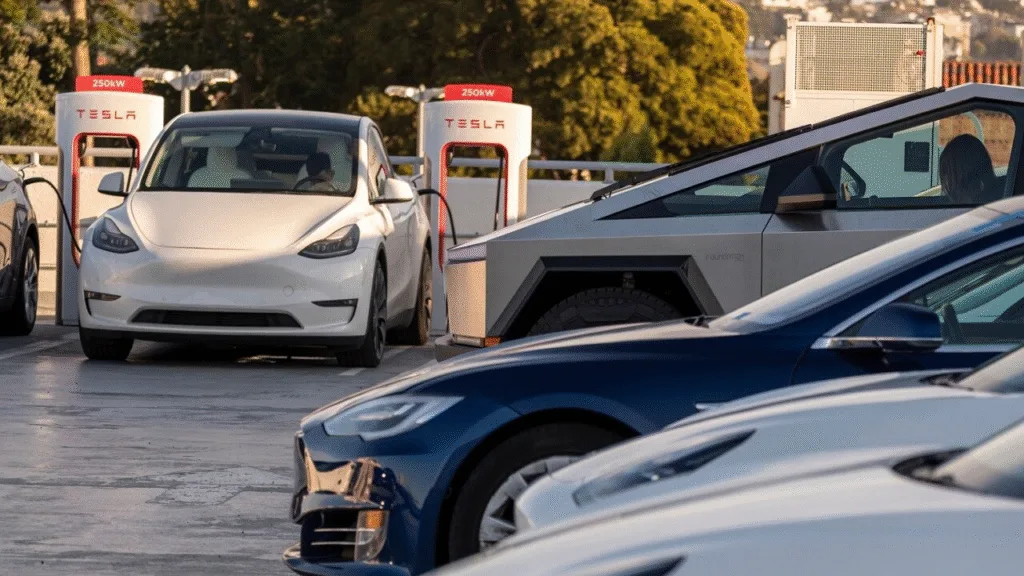
Tesla’s transformation from electric vehicle manufacturer to AI company represents one of the boldest investor bets in modern markets. While earnings per share plunged 32% through the first three quarters of 2024, the stock defied gravity based purely on speculation about full self-driving (FSD) software and the upcoming Cybercab robotaxi.
Ark Investment Management founder Cathie Wood believes Tesla stock is the biggest artificial intelligence play in the world because of FSD technology. That’s a powerful narrative—but is it justified by the fundamentals?
The Valuation Disconnect
| Metric | Tesla | Nvidia | Market Reality |
|---|---|---|---|
| P/E Ratio | 106.6 | ~50 | Tesla trades at double Nvidia’s multiple |
| 2024 EPS Change | -32% | +139% | Tesla earnings fell while Nvidia soared |
| Core Business | Declining | Exploding | EV sales down vs. AI chip demand up |
| Revenue Timeline | Uncertain | Immediate | FSD profits years away vs. current AI demand |
Based on trailing-12-month EPS of $3.65, Tesla trades at a P/E ratio of 106.6—triple the Nasdaq-100 index and almost double Nvidia’s ratio. Here’s the kicker: while Nvidia’s earnings are growing explosively, Tesla’s are shrinking.
This creates a bizarre situation where a company with declining sales and profits trades at a premium to the world’s leading AI chip manufacturer.
The AI Promise vs. Present Reality
Tesla’s bulls point to massive potential in autonomous driving. Cathie Wood’s Ark Investment Management predicts Tesla will generate $1.2 trillion in annual revenue by 2029, with 63% attributable to FSD and the Cybercab.
That’s an intoxicating vision. But consider the timeline: If the Cybercab enters production in 2026, investors probably won’t see real revenues until 2027 and 2028. You’re paying AI-company prices today for profits that might materialize half a decade from now.
Meanwhile, Tesla’s actual business—the one generating 79% of current revenue—is struggling. The company faces surging competition from low-cost manufacturers in countries like China, with BYD selling an EV called the Seagull for less than $10,000.
Why Investors Keep Believing
The post-election rally provides clues. Most of Tesla’s 56% year-to-date gain came after Trump won reelection in November, as investors speculate the incoming administration will regulate autonomous driving with a relatively light touch.
CEO Elon Musk’s political influence has become a pricing factor, with markets betting on favorable regulatory treatment for FSD technology. That’s not traditional investment analysis—it’s political speculation.
The Uncomfortable Questions
Several realities challenge the AI-driven bull case:
Competition isn’t waiting. Companies like Waymo already operate autonomous ride-hailing services in multiple cities. Tesla’s FSD remains in beta testing with uncertain regulatory approval timelines.
The math doesn’t work short-term. Even with Musk’s recent projection of 20-30% delivery growth in 2025, he canceled plans to produce a new low-cost model—the very product needed to compete globally.
Political risks cut both ways. Trump’s antipathy toward electric vehicles could suppress Tesla’s sales in its home market, while Musk’s increasingly strident right-wing positions might present headwinds for vehicles geared toward addressing climate change.
What This Means for Investors
Some analysts predict Tesla’s market cap could fall to around $630 billion—a 47% decline—just for its P/E ratio to trade in line with Nvidia’s. That’s not bearish speculation; it’s arithmetic.
The investment thesis has shifted entirely: you’re no longer buying a car company that happens to be working on AI. You’re buying an AI promise that happens to sell cars to fund development.
| Investment Scenario | What You’re Betting On |
|---|---|
| Bull Case | FSD revolutionizes transportation; Cybercab generates trillion-dollar revenues by 2029; regulatory approval comes quickly |
| Bear Case | EV competition intensifies; FSD approval takes years; current business continues declining; valuation compresses |
| Realistic Case | Long development timeline; meaningful FSD revenue not before 2027-2028; continued EV market pressure |
The Bottom Line
Tesla represents a fascinating test: can investor belief in an AI-powered future sustain a trillion-dollar valuation while the actual business shrinks?
The company recorded a drop in annual vehicle sales for the first time in more than a decade, yet still sports a forward earnings multiple of about 120 times—more than three times Nvidia’s multiple.
This isn’t necessarily irrational. Transformative technologies often get priced for potential rather than present performance. But it requires acknowledging what you’re really buying: not a stable car company, but a high-risk bet on autonomous driving becoming both technically feasible and regulatory approved within your investment timeframe.
The AI dream might come true. Just be honest about the price you’re paying to chase it.

