

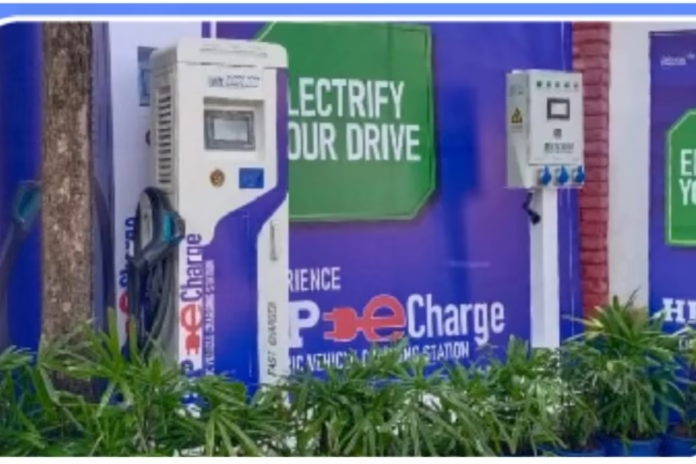

Karnataka isn’t just keeping pace with India’s electric vehicle revolution—it’s leading it. With plans to install 1,500 new charging stations under the PM E-DRIVE scheme, India’s tech hub is positioning itself as the blueprint for EV adoption nationwide. And the numbers already prove they’re serious.
Table of Contents
The Leader Nobody’s Talking About
While Delhi and Maharashtra grab headlines, Karnataka has quietly become India’s undisputed EV charging champion. As of October 2025, the state operates over 6,097 public charging stations—more than any other state in India.
India’s Top 5 EV Charging Leaders:
| Rank | State | Charging Stations | Market Share |
|---|---|---|---|
| 1 | Karnataka | 6,097 | 20.8% |
| 2 | Maharashtra | 4,155 | 14.2% |
| 3 | Uttar Pradesh | 2,326 | 7.9% |
| 4 | Delhi | 1,931 | 6.6% |
| 5 | Tamil Nadu | 1,221 | 4.2% |
That’s nearly 21% of all India’s public charging infrastructure concentrated in one state. And they’re not stopping.
PM E-DRIVE: The ₹2,000 Crore Game Changer
The PM Electric Drive Revolution in Innovative Vehicle Enhancement (PM E-DRIVE) scheme represents the government’s most ambitious EV infrastructure push yet. Running from October 2024 to March 2026 with a ₹10,900 crore total outlay, it allocates ₹2,000 crore specifically for charging infrastructure.
The Big Picture:
- 72,300 new charging stations nationwide
- 22,100 fast chargers for four-wheelers
- 48,400 fast chargers for two and three-wheelers
- 1,800 fast chargers for e-buses
Karnataka’s share? A substantial portion targeting 1,500 new installations focused on Bengaluru and key highway corridors.
Why Karnataka Dominates (And It’s Not Just Luck)
Bengaluru alone houses over 2,900 charging stations—more than entire states. But this dominance didn’t happen accidentally. It’s the result of strategic planning and aggressive execution.
Karnataka’s Winning Strategy:
- Early mover advantage: State Budget 2021 announced 1,000 EV charging stations under PPP model
- Government integration: BESCOM (Bangalore Electricity Supply Company) chairs charging infrastructure workgroup
- Tech ecosystem: Silicon Valley of India = early adopter population
- Highway coverage: DC fast charger every 50 km on major corridors
- Renewable integration: Solar-powered charging hubs pioneered in Bengaluru
The state’s RE2EV (Renewable Energy to Electric Vehicle) hub exemplifies this approach—45 kWp solar system powering 23 charging points using second-life EV batteries for storage. That’s not just charging infrastructure; it’s sustainable engineering at scale.
The Subsidy Structure That Changes Economics
PM E-DRIVE’s subsidy framework makes previously uneconomical projects viable:
Subsidy Tiers:
- 100% subsidy: Government buildings, hospitals, schools, residential complexes with free public access
- 80% subsidy (upstream) + 70% (EVSE): PSU outlets, airports, bus/metro stations, ports, toll plazas
- Up to 70% subsidy: General public charging infrastructure
Benchmark Costs (with government-defined pricing):
- 50 kW charger: ₹6.04 lakh
- 50 kW CCS-II charger: ₹7.25 lakh
- 100 kW CCS-II charger: ₹11.68 lakh
- 150 kW+ charger: ₹24 lakh
With 70% subsidies, a ₹7.25 lakh charger costs just ₹2.18 lakh out-of-pocket. That dramatically shortens payback periods and makes EV charging stations profitable within 2-3 years instead of 5-7.
Bengaluru: The EV Capital You Didn’t Know About
The city’s EV trajectory is staggering. With approximately 273,000 EVs and 5,880 charging stations as of April 2025, experts predict Bengaluru will have 2.3 million EVs by 2030.
What Makes Bengaluru Special:
- Density: 75% of Karnataka’s 6,097 stations concentrated in Bengaluru
- Scale: India’s largest charging hub with 130 simultaneous charging points (ChargeZone facility)
- Power capacity: Mega hubs with 4+ megawatt capacity serving buses and trucks
- Innovation labs: Green Urban Mobility Innovation Living Lab testing next-gen solutions
The city recently opened India’s largest charging hub featuring 80 DC fast chargers with dual guns plus 50 AC chargers—allowing 210 EVs to charge simultaneously. That’s not infrastructure; that’s a statement.
The Highway Strategy That Eliminates Range Anxiety
Karnataka cracked the code on long-distance EV travel: blanket coverage on major corridors.
Four key highways now guarantee fast chargers every 50 km:
- Tumakuru Road
- Bengaluru-Mysuru Expressway
- Coast-to-Coast NH-66 stretch
- Hyderabad-Bengaluru corridor
This isn’t aspirational planning—it’s operational reality. Weekend road trips that seemed impossible for EV owners three years ago are now routine.
The Business Case That’s Attracting Investors
Property owners and entrepreneurs are discovering EV charging stations aren’t just infrastructure—they’re profit centers.
Revenue Model Highlights:
- Leasing 150-200 sq ft at busy junctions
- Operator shoulders installation costs
- Property owner collects revenue share
- Karnataka’s dedicated EV tariff: ₹5-6/kWh (vs. ₹8-10/kWh commercial rates)
- Electricity duty exemption for 5-10 years
Real estate developers are now pre-wiring 10% of parking spots in new apartment complexes. Malls, office parks, and hotels view charging facilities as customer attractions, not cost centers.
BESCOM: The Unsung Hero
The Bangalore Electricity Supply Company isn’t just a power distributor—it’s the architect of Karnataka’s EV charging ecosystem.
BESCOM’s Achievements:
- Chairs charging infrastructure workgroup with all government departments
- Issued LOAs for 530 locations across 9 districts under PPP model
- Developed EV MITRA mobile app for users to find, book, and pay for charging
- Pioneered solar-integrated charging with battery storage
- Won multiple awards for innovative charging solutions
Their roadmap and bidding documents became the template other states now follow.
The Challenges Nobody Mentions
Karnataka’s success isn’t without obstacles:
Grid Management: Peak evening demand strains feeders when clustering is too dense. Smart chargers with dynamic throttling are becoming mandatory.
Rural Penetration: While tier-two cities flourish, agricultural belts need targeted subsidies and smaller battery-swap models for two-wheelers.
Standardization: Multiple charging standards (CCS2, GB/T, CHAdeMO, Type 2) create compatibility confusion for users.
What This Means for EV Buyers
If you’re in Karnataka considering an EV:
The Good:
- Charging station every few kilometers in urban areas
- Fast charging (0-80% in 30 minutes) widely available
- Competitive charging costs (₹6-7/kWh average)
- Mobile apps show real-time availability
- Highway coverage eliminates long-distance anxiety
The Reality Check:
- Peak hour queues at popular locations
- Uneven distribution in emerging neighborhoods
- Some older chargers poorly maintained
- Payment systems not always unified
The 2030 Vision
Karnataka’s aggressive targets under PM E-DRIVE are just the beginning. The state aims to:
- Achieve 30% EV penetration by 2030 (national target)
- Install charging infrastructure ahead of demand curve
- Integrate renewable energy in all new installations
- Expand battery swapping for two and three-wheelers
- Position as EV manufacturing and assembly hub
With companies like Mitsubishi investing ₱7 billion in EV and renewable initiatives, and Ayala Corporation’s ACMobility securing $100 million from ADB for charging infrastructure, the private sector is aligned with government ambitions.
The Bottom Line
Karnataka’s 1,500 new charging stations under PM E-DRIVE aren’t just infrastructure—they’re economic strategy. By solving range anxiety, creating business opportunities, and demonstrating sustainable integration, the state is writing the playbook for India’s EV transition.
When 6,097 existing stations grow to 7,500+ by 2026, Karnataka won’t just lead India in charging infrastructure—it’ll prove that aggressive, coordinated EV policy works at scale.
For investors, it’s opportunity. For EV buyers, it’s reassurance. For other states, it’s a challenge: match Karnataka’s ambition, or watch your EV buyers migrate to where charging their vehicles is as easy as fueling petrol cars once was.
The electric revolution has a capital. It’s called Karnataka.

