

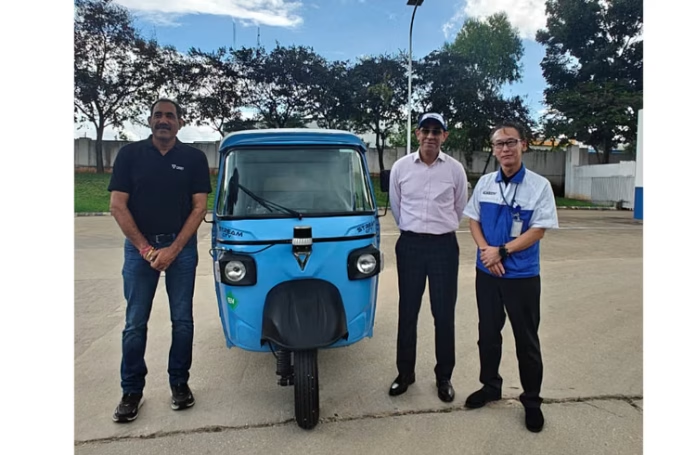

Omega Seiki Mobility has unveiled its boldest innovation yet—the Swayamgati, India’s and the world’s first production-ready autonomous electric three-wheeler. Priced at just ₹4 lakh for the passenger version, Swayamgati is set to revolutionize mobility across airports, smart campuses, and industrial hubs, making futuristic transportation accessible, reliable, and uniquely Indian.
Table of Contents
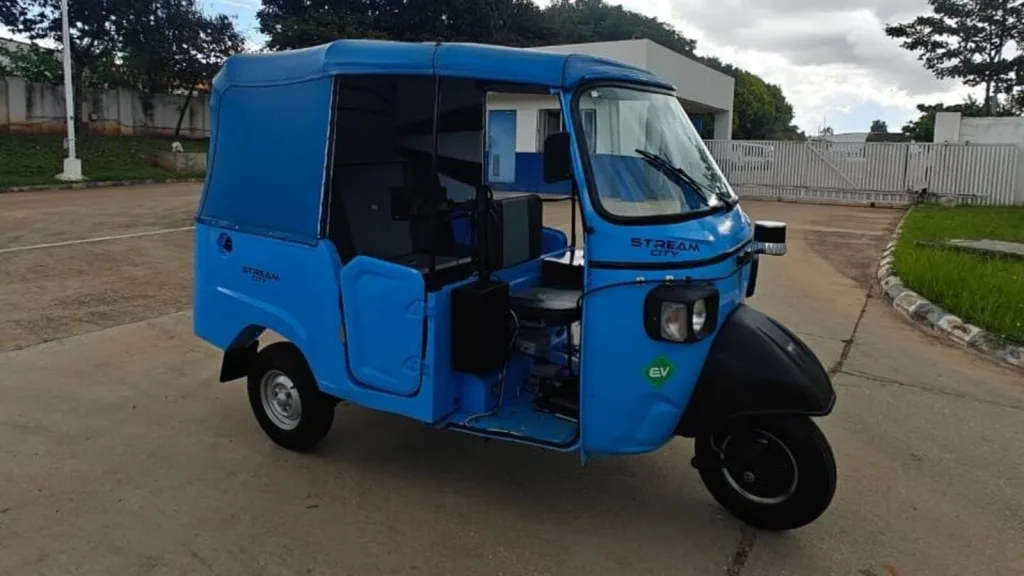
Swayamgati: The Dawn of Driverless Mobility
Imagine stepping out at a bustling airport or inside a sprawling tech park, and being greeted by a smart, silent vehicle ready to whisk passengers away—no driver needed. That’s the promise of Swayamgati, Omega Seiki’s latest marvel. Designed for high-density, low-speed environments, this three-wheeler uses a robust 10.3 kWh battery to travel up to 120 km per charge—perfect for business parks, gated communities, and industrial corridors that crave dependable last-mile connectivity.
How Swayamgati Transforms Urban Transport
Powered by artificial intelligence, it maps out pre-set routes tailored to each deployment zone. The vehicle’s “eyes and ears”—lidar, GPS, and other smart sensors—detect obstacles up to six meters away and ensure every journey remains safe, smooth, and fully autonomous. With its low maximum speed of 12 km/h, it expertly navigates crowded environments, ensuring passengers travel securely and efficiently—even through India’s diverse road scenarios.
Affordable Autonomy for All
At ₹4 lakh, Swayamgati is priced just ₹75,000–1 lakh above conventional three-wheelers, yet it removes the need for a human driver. According to Omega Seiki, businesses can recover this premium cost in just three to five months—a convincing case for rapid adoption. For logistics providers and campus operators, this translates into meaningful cost savings and a tangible leap toward modern, sustainable transport.
Built “Make in India,” Built for the World
Swayamgati is not simply imported high-tech; it’s developed for Indian conditions, fully “Make in India”—combining smart engineering with hardworking functionality. Its successful pilot phase—covering a 3 km route with seven stops and flawless real-time obstacle handling—proves its readiness for deployment. Omega Seiki plans to deploy 1,500 units over the next two years, solidifying its commitment to practical, scalable electric mobility.
Why Choose Swayamgati?
- First production-ready autonomous EV three-wheeler globally.
- 120 km range on a single charge, zero tailpipe emissions.
- AI-powered navigation for maximum safety and efficiency.
- Ready for real-world conditions—perfect for campuses, airports, cities, and more.
Challenges on the Road Ahead
Of course, the path is full of obstacles:
- Regulatory and legal frameworks for autonomous vehicles in India are still evolving
- Public trust will need to keep pace with the tech
- Real-world variability—unstructured roads, unpredictable traffic—could test the system’s limits
But every major innovation runs this gauntlet. Swayamgati’s real test begins now.
Final Thoughts
Swayamgati isn’t just another EV—it’s a collapse of the boundary between imagination and execution. At ₹4 lakh, Omega Seiki Mobility makes a bold claim: that autonomy can be local, electric, and accessible.
This small three-wheeler may just be the first wave of India’s autonomous electric revolution. And if it succeeds, it’ll shift the way we see city mobility—not as machines guided by people, but as machines guided by smart systems.

