

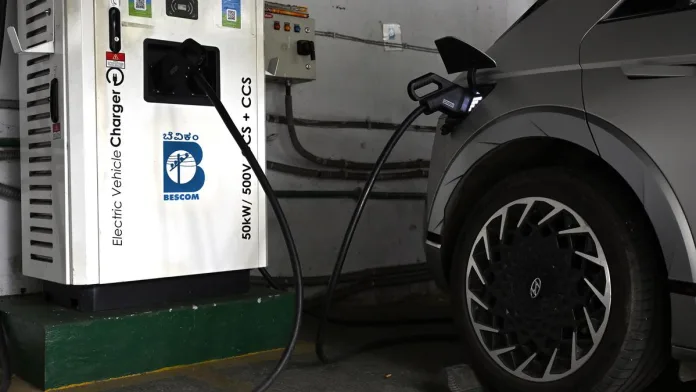

India just made electric vehicle ownership dramatically easier. The government’s new PM E-DRIVE scheme has rolled out subsidies reaching up to 100% for EV charging infrastructure—a move that could finally eliminate range anxiety and accelerate the nation’s electric revolution.
Table of Contents
The Rs 2,000 Crore Promise
Under the massive Rs 10,900 crore PM E-DRIVE initiative, the Ministry of Heavy Industries earmarked Rs 2,000 crore specifically for building charging infrastructure. This isn’t just another government announcement—it’s a comprehensive blueprint to install over 72,000 charging stations across India.
The numbers are staggering: 22,100 fast chargers for four-wheelers, 48,400 for two and three-wheelers, and 1,800 for buses. That’s enough infrastructure to support millions of electric vehicles currently facing the dreaded “Where do I charge?” question.
Who Gets the Full 100% Subsidy?
Here’s where it gets exciting for stakeholders. Government premises offering free public access hit the jackpot with complete financial coverage. We’re talking about:
- Government offices and buildings
- Public hospitals and healthcare facilities
- Educational institutions and schools
- Central public sector enterprises
The catch? These charging stations must remain freely accessible to the public. It’s not just about building infrastructure—it’s about creating a truly public charging ecosystem that benefits everyone.
Generous Support for Strategic Locations
Even locations not qualifying for full subsidies receive substantial support. Bus stations run by state transport undertakings, metro stations, municipal parking lots, and highway toll plazas get 80% coverage for upstream infrastructure and 70% for charging equipment.
Similarly, airports, railway stations, and fuel retail outlets of Indian Oil, Bharat Petroleum, and Hindustan Petroleum receive the same generous 80-70 split. Battery swapping stations? They’re covered too, with 80% subsidy support.
Where the Chargers Will Appear
The government isn’t randomly placing charging stations. Strategic priority goes to:
- Urban powerhouses: Cities with over one million population
- Smart cities: Tech-forward municipalities leading India’s urban transformation
- Metro satellites: Towns connected to seven major metros (Delhi, Mumbai, Kolkata, Chennai, Hyderabad, Bengaluru, Ahmedabad)
- State capitals: Administrative centers ensuring statewide coverage
- Highway corridors: High-density national and state highways for long-distance travel
This intelligent placement strategy addresses both daily urban commuting and intercity travel—the two biggest EV adoption concerns.
Smart Technology Integration
Here’s the innovation twist: BHEL (Bharat Heavy Electricals Ltd) will develop a National Unified Hub with a companion mobile app. Imagine having real-time charger availability, slot booking, and seamless payments—all in one platform. No more driving around hoping to find an available charger.
Every subsidized charger must integrate with this unified system, creating India’s first truly connected charging network. It’s the digital infrastructure to match the physical infrastructure.
How the Money Flows
Subsidy disbursement follows a practical two-stage model. Seventy percent arrives at procurement—giving entities capital to actually build the infrastructure. The remaining thirty percent releases after commissioning and integration with the Unified Hub, ensuring quality and functionality.
This staged approach protects taxpayer money while enabling rapid deployment. It’s accountability meeting ambition.
Technical Specifications That Matter
The guidelines establish clear charging standards:
- Two and three-wheelers: Up to 12 kW
- Four-wheelers, buses, trucks: 50 kW to 500 kW fast charging
These specifications ensure compatibility across vehicle types while future-proofing infrastructure for increasingly powerful batteries.
Why This Changes Everything
Range anxiety has long been electric vehicles’ Achilles heel. You can offer incredible cars with zero emissions, but if drivers fear being stranded with dead batteries, adoption stalls. PM E-DRIVE directly attacks this barrier.
For businesses, the generous subsidies transform charging infrastructure from a costly gamble into a financially viable opportunity. For consumers, it promises the convenience that makes EV ownership practical rather than aspirational.
The Road Ahead
With BHEL as the Project Implementation Agency and IFCI handling project management, the institutional framework exists to actually deliver these ambitious targets. This isn’t vaporware—it’s happening.
India’s electric future is being built today, one charging station at a time. The question isn’t whether this infrastructure will materialize, but how quickly stakeholders will move to claim these generous subsidies.
The race to electrify India just accelerated dramatically.

