

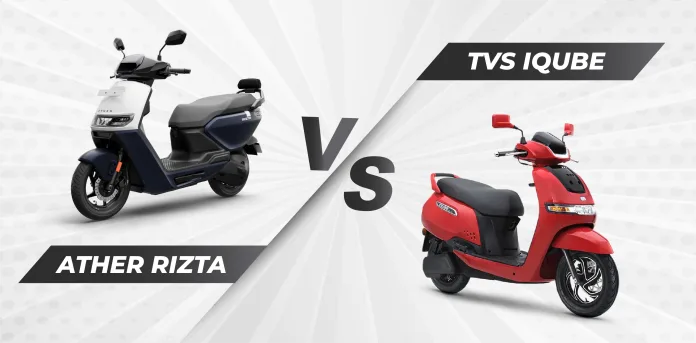

Ather Rizta, Imagine walking into India’s most competitive electric scooter showdown. In one corner, we have Ather’s family-focused Rizta, designed for comfort and practicality. In the other, TVS’s tech-loaded iQube, promising cutting-edge features and impressive range. Both are vying to be your daily companion, but which one deserves your hard-earned money?
This isn’t just about choosing between two scooters – it’s about picking the electric future that fits your lifestyle. Whether you’re a tech enthusiast craving the latest features or a family-oriented rider prioritizing comfort, this battle has a clear winner for every type of rider.
Table of Contents
The Specification Showdown: Numbers That Matter
Let’s cut through the marketing buzz and see how these electric champions stack up where it counts:
| Specification | Ather Rizta | TVS iQube |
|---|---|---|
| Starting Price | ₹1.15 lakh | ₹94,434 |
| Top-End Price | ₹1.50 lakh | ₹1.46 lakh |
| Motor Power | 4.3 kW PMSM | 4.4 kW (peak) |
| Range (Base) | 123 km | 94 km |
| Range (Top) | 158 km | 212 km |
| Battery Options | 2.9 kWh / 3.7 kWh | 2.2 – 5.3 kWh |
| Charging Time | 4-5 hours | 5 hours |
| Top Speed | 80 km/h | 75 km/h |
| Weight | 125 kg | 118 kg |
| Boot Space | 34 liters | 32 liters |
Price Battle: TVS Takes the Lead
The TVS iQube starts at an attractive ₹94,434, making it significantly more affordable than the Rizta’s ₹1.15 lakh entry point. That’s a whopping ₹20,566 difference – enough to cover insurance and accessories!
However, when you look at the top-end variants, both scooters are neck-and-neck. The Ather Rizta tops out at ₹1.50 lakh, while the TVS iQube maxes out at ₹1.46 lakh.
Performance Showdown: Close Combat
Both scooters pack serious electric punch. The iQube’s 4.4 kW peak power delivers acceleration from 0-40 km/h in just 4.2 seconds, while the Rizta’s 4.3 kW PMSM motor provides steady, reliable performance.
The Rizta edges ahead in top speed at 80 km/h versus the iQube’s 75 km/h – perfect for those occasional highway merges.
Range Reality Check: TVS Dominates
Here’s where the iQube flexes its muscles. The top-spec iQube ST with 5.3kWh battery delivers an impressive 212km range per charge, completely obliterating range anxiety.
Meanwhile, the Rizta provides 125 km range on a full charge, with real-life range around 115–120 km. Solid for daily commuting, but the iQube clearly wins for long-distance touring.
Features Face-Off: Innovation vs Practicality
Ather Rizta Strengths:
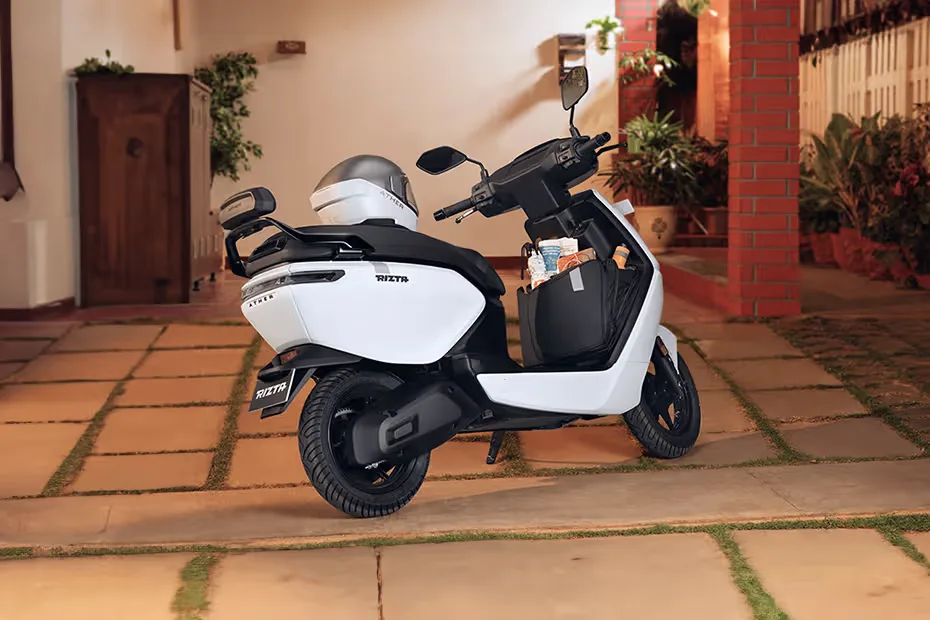
- Huge boot space and large legroom for family comfort
- Touch display with comprehensive connectivity
- Better ground clearance for speed breakers
- Family-oriented spacious design
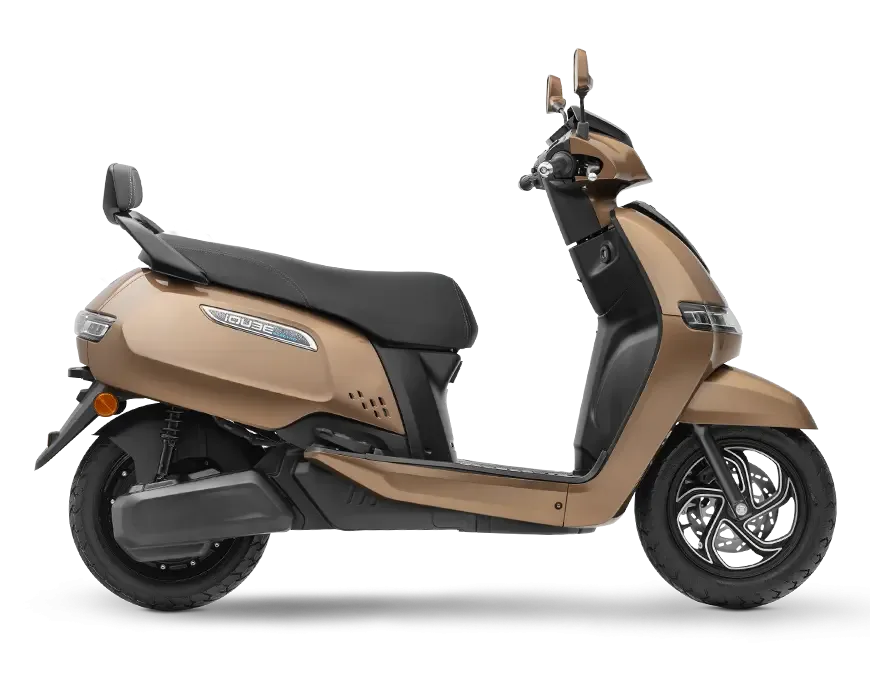
TVS iQube Advantages:
- Smartphone connectivity with turn-by-turn navigation, music streaming, voice commands with Alexa compatibility
- Safety features like Anti Theft Alarm, Automatic Headlamps, Speed Limit Alert
- Advanced features including Reverse Mode, Cruise Control, Inbuilt Navigation
- More battery options across price points
User Experience: What Riders Actually Say
User ratings tell an interesting story: the iQube scores 4.6/5 while the Rizta gets 4.5/5. Rizta users praise “good features, comfort, ride quality and decent performance” though note “the design is not all that outstanding”.
The iQube is praised as “a good option for families in need of an electric scooter”, with users appreciating its reliability and feature set.
The Charging Game: Both Win
Both scooters offer practical charging solutions. The Rizta takes about 4-5 hours for full charge, while the iQube needs 5 hours. The difference is marginal, making both suitable for overnight charging routines.
Family Factor: Who Fits Where?
Choose Ather Rizta if:
- Family comfort is your top priority
- You need maximum boot space (34L vs 32L)
- You prefer higher ground clearance for Indian road conditions
- You want a proven family-focused design
- Daily commute is under 100 km
Choose TVS iQube if:
- You want the most affordable entry point
- Maximum range is crucial (212 km top variant)
- You love cutting-edge tech features
- Alexa integration and advanced connectivity appeal to you
- You need multiple battery options to fit your budget
The Verdict: Different Champions for Different Needs
There’s no universal winner because both excel in different areas:
For Budget-Conscious Buyers: TVS iQube wins with its ₹94,434 starting price – nearly ₹21,000 less than the Rizta.
For Range Enthusiasts: iQube dominates with 212 km maximum range versus Rizta’s 158 km.
For Family Comfort: Rizta takes the crown with superior boot space, legroom, and family-focused design.
For Tech Lovers: iQube leads with Alexa integration, advanced navigation, and comprehensive smartphone connectivity.
Market Impact: Evolution vs Revolution
The Rizta represents evolution – taking proven electric scooter technology and optimizing it for family use. The iQube embodies revolution – pushing boundaries with maximum range and cutting-edge features.
The Bottom Line
Your choice depends on priorities: maximum value and range (iQube) or maximum family comfort and practicality (Rizta). As user experiences suggest, “iQube ST is a winner for you if you are seriously looking for mileage, but Ather Rizta is better on the grounds of performance, comfort, maintenance and features”.
Both scooters represent excellent choices in India’s electric future. The iQube democratizes electric mobility with affordable pricing and impressive range, while the Rizta perfects the family electric scooter experience.
The revolution isn’t just electric – it’s diverse, affordable, and designed for every Indian lifestyle.

