

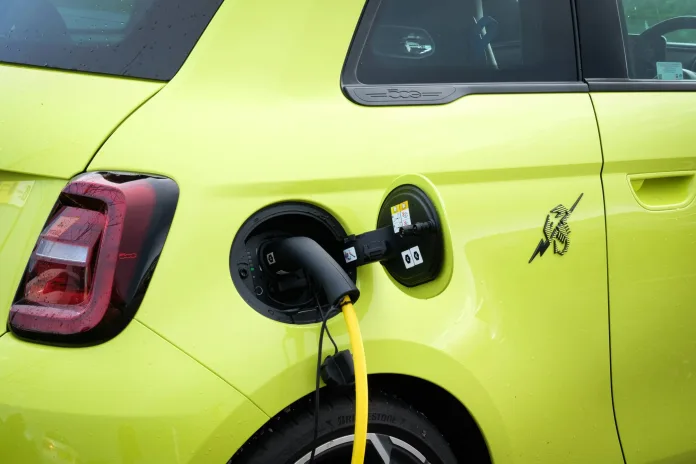

EV Battery, Imagine pulling into a charging station and having your electric vehicle fully charged in the time it takes to grab a coffee. This isn’t science fiction anymore—it’s the reality promised by groundbreaking research from Korea that could finally eliminate the last major barrier to widespread EV adoption.
Table of Contents
EV Battery : The Game-Changing Discovery
Scientists at the Korea Advanced Institute of Science and Technology (KAIST) and LG Energy Solution have cracked the code that has puzzled battery researchers for decades. Their lithium-metal battery can charge from 10% to 80% in around 15 minutes, making electric vehicle charging as convenient as filling up a gas tank.
Revolutionary Performance Metrics:
| Battery Type | Charging Time (10-80%) | Cycles | Energy Density |
|---|---|---|---|
| Current EV Batteries | 30-40 minutes | 300-500 | 250-280 Wh/kg |
| New Lithium-Metal | 15-17 minutes | 180-350+ | 386 Wh/kg |
| Improvement | 50%+ faster | Comparable | 40%+ higher |
Why This Breakthrough Matters Now
Electric vehicles have already solved the range problem—most EVs now travel farther than gas cars on a single charge. But charging time remained the stubborn obstacle keeping many drivers from making the switch. When your “fill-up” takes 30-40 minutes instead of five minutes, it can be quite annoying.
This delay has been the single greatest barrier to the electric vehicle revolution, affecting everything from road trip planning to daily convenience.
The Science Behind the Magic
Here’s where the story gets fascinating. For years, scientists approached fast-charging batteries like building a stronger fortress. They focused on creating tougher materials to withstand the destructive forces of rapid charging.
The Old Approach vs. The New Way:
| Traditional Method | KAIST Innovation |
|---|---|
| Stronger materials | Weaker, more flexible chemistry |
| Aggressive reactions | Subtle, delicate approach |
| Fighting dendrites | Preventing dendrite formation |
| “Better walls” | “Smarter building” |
The Dendrite Problem Solved
The breakthrough came from understanding why fast charging destroys batteries. When you try to charge a lithium-metal battery too quickly, the lithium forms microscopic, needle-like growths called dendrites. These dendrites are like tiny daggers that can pierce through the battery’s internal barriers, causing short circuits, fires, or complete failure.
Professor Hee-Tak Kim’s team made a counterintuitive discovery: the solution wasn’t building stronger defenses, but using “weaker” chemical components that don’t fight the charging process.
Real-World Performance Results
The results speak for themselves:
High-Power Version:
- Charging Speed: 5% to 70% in just 12 minutes
- Durability: Over 350 repeated charging cycles
- Target Use: Quick charging applications
High-Energy Version:
- Charging Speed: 10% to 80% in 17 minutes
- Range: 386 Wh/kg energy density (40% better than current EVs)
- Cycles: 180 cycles tested successfully
What This Means for EV Drivers
This technology promises to transform the electric driving experience:
Immediate Benefits:
- Road Trip Freedom: Charging stops become coffee breaks, not meal breaks
- Urban Convenience: Quick top-ups during errands
- Range Anxiety: Completely eliminated with faster, denser batteries
- Grid Impact: Less strain from shorter charging windows
The Counterintuitive Chemistry
The breakthrough came from using “weakly Li-associating anions” which are, in a chemical sense, relatively weak. Instead of clinging tightly to lithium ions like traditional approaches, these components allow more natural, uniform charging patterns.
Think of it like traffic flow: aggressive, pushy drivers create jams, while courteous, flexible drivers keep traffic moving smoothly.
Industry Impact and Timeline
“This research has become a key foundation for overcoming the technical challenges of lithium-metal batteries,” explains Professor Kim. The collaboration with LG Energy Solution, one of the world’s largest battery manufacturers, suggests this technology could reach production faster than typical laboratory discoveries.
Expected Timeline:
- 2025-2026: Prototype development and testing
- 2027-2028: Pilot production and automotive partnerships
- 2029-2030: Mass market availability in premium EVs
- 2031+: Widespread adoption across all EV segments
Challenges and Future Development
While revolutionary, this technology still faces hurdles:
Technical Challenges:
- Scaling up production processes
- Cost optimization for mass market
- Long-term durability validation
- Integration with existing EV architectures
Market Considerations:
- Charging infrastructure upgrades needed
- Consumer education about new technology
- Competition with solid-state batteries
- Regulatory approvals and safety testing
The Bigger Picture
This breakthrough represents more than just faster charging—it’s a paradigm shift that could accelerate the global transition to electric transportation. When EVs become as convenient as gas cars, the tipping point for mass adoption becomes inevitable.
The technology also has implications beyond cars, potentially revolutionizing energy storage for homes, businesses, and the electrical grid itself.
Conclusion
The 15-minute EV battery isn’t just a technological marvel—it’s the key that unlocks the final door to our electric future. By thinking differently about battery chemistry and embracing counterintuitive solutions, Korean scientists have solved a problem that seemed insurmountable just years ago.
As this technology moves from laboratory to production line, we’re witnessing the moment when electric vehicles truly become superior to gas cars in every meaningful way. The revolution is no longer coming—it’s here.

