

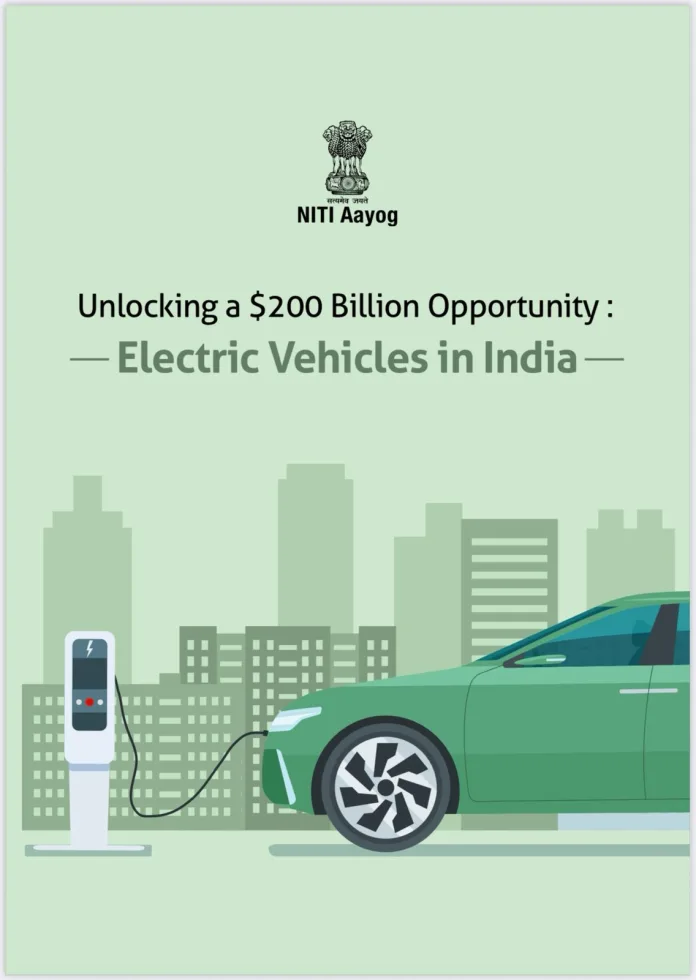

India’s electric vehicle landscape is about to witness a transformational shift. NITI Aayog has just unveiled its groundbreaking report titled “Unlocking a $200 Billion Opportunity: Electric Vehicles in India,” revealing the immense potential that could reshape the nation’s automotive future and economic trajectory.
Table of Contents
NITI Aayog : The Numbers That Tell a Remarkable Story
The statistics are nothing short of extraordinary. India’s EV sales have surged from just 50,000 units in 2016 to an impressive 2.08 million units in 2024, demonstrating an unprecedented growth trajectory that outpaces many global markets. This remarkable journey reflects not just consumer acceptance, but a fundamental shift in how Indians perceive sustainable transportation.
To put this in perspective, while global EV sales grew from 918,000 to 18.78 million units during the same period, India’s percentage growth far exceeds the global average, positioning the country as one of the world’s fastest-growing electric vehicle markets.

The Ambitious 2030 Vision
India aims to achieve a 30% share of electric vehicles in total vehicle sales by 2030, an ambitious target that represents more than just environmental consciousness—it’s an economic revolution in the making. This goal isn’t just about reducing emissions; it’s about creating millions of jobs, fostering innovation, and establishing India as a global leader in clean transportation technology.
Strategic Roadmap for Success
The report serves as a strategic roadmap to help India achieve its EV targets, outlining comprehensive strategies that move beyond traditional approaches. The focus shifts from incentives to mandates and disincentives, targeting high-potential vehicle segments and specific geographies where maximum impact can be achieved.
Key Strategic Pillars
Financing Revolution: The report emphasizes enabling financing for electric buses and trucks, which currently face significant barriers. This commercial vehicle focus could accelerate adoption in sectors that contribute most to emissions and fuel consumption.
Geographic Prioritization: Rather than a scattered approach, the strategy involves identifying high-potential regions where EV adoption can create ripple effects across neighboring areas.
Segment-Specific Strategies: Different vehicle categories require tailored approaches, and the report provides nuanced strategies for each segment.
The Economic Promise
India’s EV market could generate a $200 billion opportunity by 2035 through jobs, manufacturing, and clean energy initiatives. This isn’t just about vehicle sales—it’s about creating an entire ecosystem of battery manufacturing, charging infrastructure, renewable energy integration, and supporting services.
Job Creation Potential
The ripple effects extend far beyond automotive manufacturing. From battery research and development to charging station maintenance, from software development for smart vehicles to recycling technologies, the EV revolution promises to create diverse employment opportunities across skill levels.
Current Momentum and Market Reality
The report offers a thorough evaluation of challenges facing the electric vehicle sector while emphasizing critical steps needed to expedite India’s transition. This balanced approach acknowledges obstacles while maintaining optimism about solutions.
The current growth trajectory provides confidence. With 2.08 million EVs sold in 2024 compared to just 50,000 in 2016, India has demonstrated that when conditions align—supportive policies, improving infrastructure, and consumer awareness—adoption can accelerate rapidly.
Beyond Transportation: A Holistic Transformation
This $200 billion opportunity extends beyond vehicle manufacturing. It encompasses the entire value chain: lithium-ion battery production, charging infrastructure development, renewable energy integration, and digital technologies that make EVs smarter and more efficient.
The report also introduces the India Electric Mobility Index, providing a framework for measuring progress and identifying areas needing additional focus.
The Path Forward
The report outlines actionable steps to achieve 30% EV sales by 2030, moving from aspiration to implementation. Success requires coordinated efforts across government policies, private sector innovation, and consumer adoption.
As India stands at this inflection point, the NITI Aayog report serves as both a blueprint and a call to action, demonstrating that the $200 billion electric vehicle opportunity isn’t just possible—it’s inevitable with the right strategic approach.

