

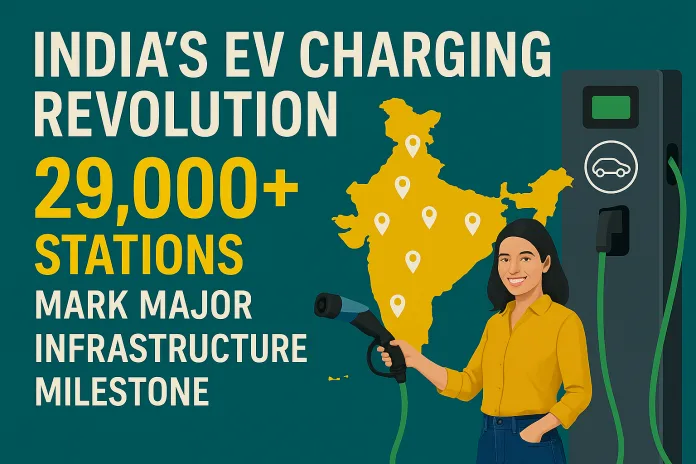

Karnataka emerges as national leader with 6,097 EV charging stations as India accelerates toward comprehensive electric mobility ecosystem
India has reached a significant milestone in its electric vehicle journey, with public EV charging stations crossing the 29,000 mark nationwide. This achievement reflects the government’s aggressive push toward building robust charging infrastructure to support the country’s growing electric vehicle adoption.
Table of Contents
State-wise EV Charging Infrastructure Leaders
| State/UT | Charging Stations | Market Position | Key Strength |
|---|---|---|---|
| Karnataka | 6,097 stations | National Leader | Early EV policies & PPP support |
| Maharashtra | 4,155 stations | Strong #2 | Industrial hub advantage |
| Uttar Pradesh | 2,326 stations | Rapid growth | Large market potential |
| Delhi | 1,967 stations | Urban leader | Policy innovation center |
Karnataka’s EV Infrastructure Leadership
Karnataka’s dominance with 6,097 charging stations isn’t accidental. The state’s early adoption of EV-friendly policies, proactive government involvement, and strong support for public-private partnerships have created an ideal ecosystem for charging infrastructure development.
The state’s tech hub status, combined with progressive regulatory frameworks, has attracted significant private investment in charging networks, making it the benchmark for other states to follow.
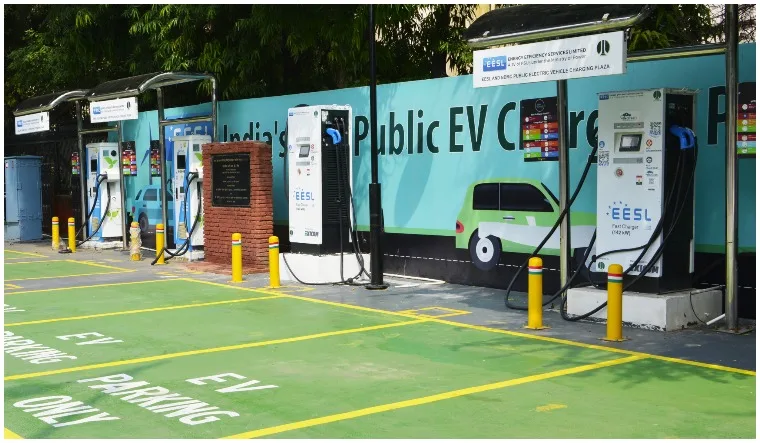
Government’s ₹12,900 Crore Investment Push
The Central government has allocated substantial funds to accelerate EV adoption:
- ₹2,000 crore dedicated to charging station development
- ₹10,900 crore in subsidies for electric vehicle purchases
- PM e-Bus Sewa and PM E-DRIVE schemes driving infrastructure expansion
FAME India Success Metrics
Under the FAME India schemes, impressive progress has been achieved:
- 1.88 million EVs supported as of June 30, 2025
- 9,332 charging stations sanctioned across the country
- 8,885 stations already operational (95% implementation rate)
Infrastructure Challenges Remain
Despite the milestone, challenges persist in India’s EV charging ecosystem. Currently, there’s only one public charger for every 235 EVs, indicating that infrastructure development still lags behind the rising demand for electric vehicles.
The government recognizes this gap and continues working on strategic rollouts, particularly focusing on tier-2 cities and highway corridors where charging accessibility remains limited.
Policy Framework Strengthening
Recent policy developments have strengthened the foundation:
- September 2024: Ministry of Power issued comprehensive Guidelines for EV Charging Infrastructure
- January 2025: Battery swapping standards introduced for enhanced flexibility
These frameworks provide clarity for investors and operators, encouraging faster deployment of charging networks across diverse urban and rural locations.
As India transitions toward greener transportation, enhanced charging infrastructure accessibility will be crucial for achieving the government’s ambitious electric mobility targets. With states like Karnataka leading by example, the 29,000+ charging stations milestone represents just the beginning of India’s comprehensive EV infrastructure revolution.
Stay updated with India’s EV infrastructure developments at IndiaEVNews.com and explore our comprehensive charging station locator.
Source: KNN India | Ministry of Power Guidelines

