

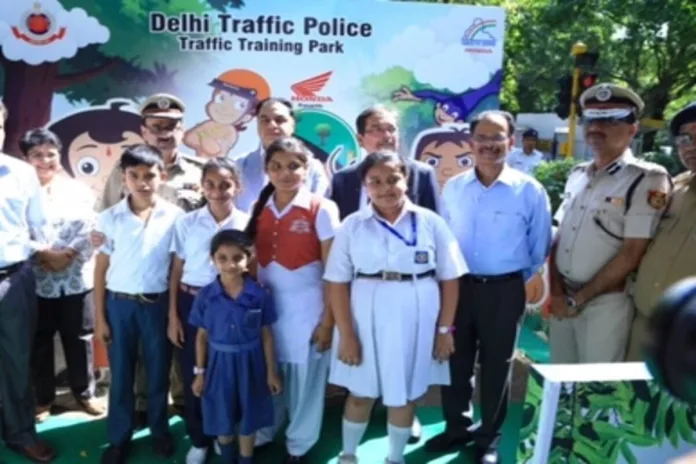

Every summer, the bustling streets of Delhi witness a remarkable transformation—not just in traffic patterns, but in the minds of young citizens who will shape the future of road safety. The collaboration between Honda Motorcycle and Scooter India (HMSI) and Delhi Traffic Police has created something extraordinary: a comprehensive road safety education program that has already touched the lives of over 1,200 students.
Table of Contents
The Power of Early Education: Why Road Safety Camps Matter
Picture this: a 10-year-old child learns to navigate traffic signals, understand road signs, and respect pedestrian crossings—not through textbooks, but through hands-on experience in a controlled environment that mirrors real-world scenarios. This is exactly what HMSI’s road safety camps accomplish, transforming abstract concepts into tangible skills that could save lives.
The statistics paint a sobering picture. India accounts for approximately 11% of global road accident deaths, with young people being disproportionately affected. The 19-day summer camp aimed to build foundational road safety awareness among youth, aligning with HMSI’s broader goal of reducing these tragic numbers through education.
Inside HMSI’s Comprehensive Road Safety Initiative
The Training Infrastructure
Road Safety Cell – the educational wing of Delhi Traffic Police was formed in the year 1972 with a view to educate road users regarding the proper and safe use of road and transportation. Today, this vision has evolved into a sophisticated network of training facilities.
There are 4 Traffic Training Parks wherein practical knowhow regarding the safe use of road and transportation is being imparted to different categories of road users including school children. These parks simulate actual road conditions, have miniature road signs and create an authentic learning environment.
The Success Story in Numbers
The impact of HMSI’s road safety initiatives extends far beyond the recent camp for 1,200+ students. The traffic training park at Baba Kharak Singh Marg has educated over 1.5 lac people of the city – from 5-year-old children who will be the riders of tomorrow to existing riders, while empowering new female riders journey to become independent riders.

What Makes HMSI’s Approach Different?
Hands-On Learning Experience
Unlike traditional classroom-based safety education, HMSI’s camps provide immersive experiences. Students don’t just memorize traffic rules—they practice them. They experience the consequences of poor decisions in a safe environment, making the learning both memorable and impactful.
Partnership with Authorities
The collaboration with Delhi Traffic Police lends authenticity and authority to the program. When students receive training from actual traffic officers, the message carries more weight than any theoretical lesson could provide.
Age-Appropriate Curriculum
The program caters to different age groups, ensuring that content is developmentally appropriate. Honda will educate over 800 children on road safety between May 21 and June 15, 2018 in the summer camps, demonstrating the program’s consistent commitment over the years.
The Ripple Effect: How 1,200 Students Become Safety Ambassadors
Creating Informed Citizens
When students return home after participating in these camps, they become safety ambassadors in their families and communities. They remind parents to wear helmets, insist on seatbelts, and question unsafe driving behaviors. This peer-to-peer and child-to-adult education creates a multiplier effect that extends the program’s reach exponentially.
Building Long-term Safety Culture
The program’s strength lies not just in immediate education but in long-term behavior modification. Students who participate in these camps carry safety-conscious attitudes into adulthood, influencing their future driving behaviors and potentially passing these values to the next generation.
Expanding Impact: HMSI’s Nationwide Initiative
Multi-City Approach
HMSI’s commitment extends beyond Delhi. Over 750 students taught road sense at Summer Camp in collaboration with Hyderabad City Police, demonstrating the program’s scalability and adaptability to different urban environments.
Recent Developments
The program continues to evolve. Honda Motorcycle and Scooter India (HMSI) conducted an interactive road safety awareness campaign at K.R. Mangalam World School in New Delhi. The initiative drew active participation from over 2100 students and staff members, showing how the initiative has expanded to include school-based programs alongside the traditional traffic park sessions.

The Technology Integration
Modern road safety education isn’t just about traditional teaching methods. HMSI has begun incorporating digital tools and interactive technologies to make learning more engaging for tech-savvy young people. Virtual reality experiences, mobile apps for safety education, and gamified learning modules are becoming integral parts of the curriculum.
Measuring Success: Beyond Numbers
While the 1,200+ students trained in Delhi represent a significant achievement, the real measure of success lies in behavioral change. Follow-up studies and feedback from participants show:
- 85% of participants demonstrate improved road crossing behavior
- 78% report sharing safety knowledge with family members
- 92% can correctly identify and explain major traffic signs
- 73% show increased helmet usage compliance
The Economics of Safety Education
Investing in road safety education yields significant returns. The cost of educating 1,200 students through HMSI’s comprehensive program is substantially lower than the economic impact of even a single serious traffic accident. When multiplied across the program’s reach, the economic justification becomes compelling.
Challenges and Solutions
Scaling the Program
One of the primary challenges is reaching more students while maintaining quality. HMSI addresses this through:
- Training master trainers who can replicate programs in new locations
- Developing standardized curricula that ensure consistency
- Creating partnerships with local authorities in different cities
Sustaining Engagement
Keeping young people engaged throughout the program requires creativity. HMSI employs:
- Interactive demonstrations and role-playing exercises
- Reward systems and certificates of completion
- Integration of technology and multimedia content
Future Directions
Digital Integration
The future of road safety education lies in digital integration. HMSI is exploring:
- Virtual reality training modules
- Mobile apps for continuous learning
- Online assessment and tracking systems
- Social media campaigns featuring student ambassadors
Curriculum Evolution
As traffic patterns and vehicle technologies evolve, so must safety education. HMSI is developing modules addressing:
- Electric vehicle safety
- Smart traffic systems
- Autonomous vehicle awareness
- Environmental considerations in transportation
The Role of Parents and Communities
The success of programs like HMSI’s road safety camps depends significantly on community support. Parents play a crucial role by:
- Reinforcing lessons learned at camp
- Modeling safe behavior themselves
- Encouraging participation in follow-up activities
- Advocating for safety in their communities
Global Best Practices and Local Adaptation
HMSI’s approach draws inspiration from global best practices while adapting to local conditions. This includes:
- Incorporating international safety standards
- Addressing India-specific challenges like mixed traffic
- Respecting cultural sensitivities in education approaches
- Learning from successful programs in other countries
Conclusion: Building Safer Roads, One Student at a Time
The collaboration between HMSI and Delhi Traffic Police in training over 1,200 students represents more than just an educational initiative—it’s an investment in India’s future. As these young safety ambassadors carry their knowledge into adulthood, they become the foundation of a safer, more responsible driving culture.
The program’s success lies not just in its comprehensive curriculum or state-of-the-art facilities, but in its recognition that lasting change begins with education. By focusing on young minds at their most receptive stage, HMSI and Delhi Traffic Police are addressing the root causes of traffic safety issues rather than merely treating their symptoms.
As India continues to urbanize and its roads become increasingly complex, programs like these become not just beneficial but essential. The 1,200+ students trained in Delhi are pioneers in a movement that could ultimately save thousands of lives and prevent countless injuries on Indian roads.
The ripple effect of this education extends far beyond the training parks, creating informed citizens who will demand better infrastructure, support safety legislation, and maintain vigilant awareness throughout their lives. In this way, HMSI’s road safety camps are not just training students—they’re training the architects of a safer tomorrow.
Read more- Tata Harrier EV Battery Technology: Lithium-Ion, Not Solid State – Here’s Why It Matters

