

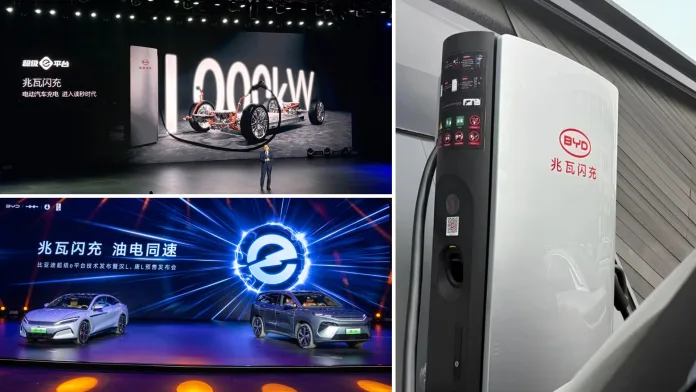

In a groundbreaking announcement that has sent ripples through the tech world, BYD has unveiled what could be the most significant advancement in electric vehicle infrastructure to date. The new BYD 1000 kW EV charging system promises to deliver what EV owners have long dreamed of – charging speeds that rival traditional gas station fill-ups.
Are you ready to witness the end of charging anxiety? Let’s dive into how this revolutionary technology works and what it means for the future of electric mobility.
How the BYD 1000 kW EV Charging System Works
The BYD 1000 kW EV charging system represents a breakthrough in electric vehicle technology, delivering an unprecedented 2 kilometers of range per second. This means a vehicle can gain approximately 400 kilometers (249 miles) of range in just 5 minutes – a feat that transforms the EV ownership experience.
At the heart of this system is BYD’s new “super e-platform” that achieves charging capabilities previously thought impossible for consumer vehicles. The system operates on three key technical pillars:
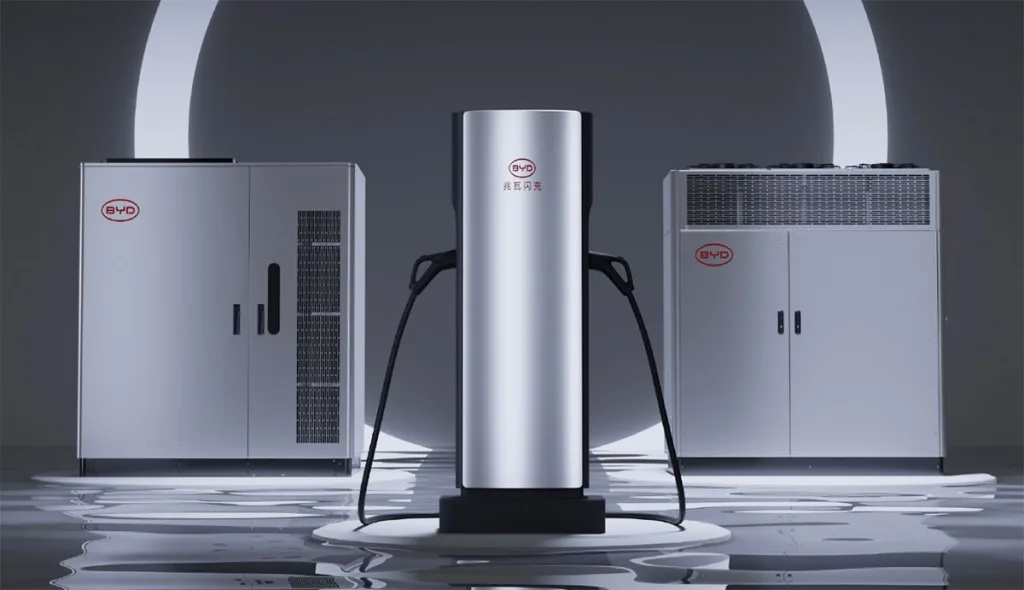
- Megawatt Power Delivery: The system delivers 1,000 kilowatts of power through a liquid-cooled terminal system
- High-Voltage Architecture: Operating at 1,000V with currents up to 1,000A
- Advanced Battery Technology: Featuring a specialized Flash Charging Battery with a 10C charging rate
“With the introduction of the BYD 1000 kW EV charging system, charging times now rival traditional gas refueling,” said a BYD representative during the announcement.
Technical Specifications That Set New Standards
| Component | Specification | Industry Significance |
|---|---|---|
| Charging Power | 1,000 kW | Highest in consumer EV market |
| Voltage Rating | 1,000V | Matches advanced industrial standards |
| Charging Current | 1,000A | Maximum safe current delivery |
| Range Addition | 2km/second | Fastest range addition rate |
| Battery Charging Rate | 10C | Highest for mass-produced batteries |
This revolutionary charging technology enables EVs to gain 400 kilometers of range in just 5 minutes, effectively eliminating one of the most significant barriers to EV adoption – charging time.
The Science Behind BYD’s Flash Charging Technology
The flash charging technology incorporates advanced battery cooling systems to manage heat, which has traditionally been the limiting factor in fast-charging capabilities. BYD’s engineering team has achieved several critical breakthroughs:
- 50% Reduction in Internal Resistance: Allowing for faster energy transfer without excessive heat generation
- Ultra-High-Speed Ion Channel Design: Facilitating rapid movement of ions between battery electrodes
- Advanced Thermal Management: Sophisticated cooling systems that prevent battery degradation during ultra-fast charging
- Silicon Carbide Power Chips: Automotive-grade components that can handle the extreme power requirements
“BYD’s new charging technology represents a significant leap forward for the entire EV industry,” noted an industry analyst following the announcement.
The system’s 10C charging rate is particularly noteworthy – this means the battery can theoretically charge from 0-100% in just 6 minutes, compared to hours with conventional charging systems.
BYD Electric Vehicles Compatible with Megawatt Charging
BYD electric vehicles are now compatible with the company’s groundbreaking 1000 kW charging platform, beginning with select models. The company has announced that the Han L and Tang L models will be the first to support this technology.
The future of BYD electric cars includes ultra-fast charging capabilities that eliminate range anxiety, potentially transforming how consumers view electric vehicles. These models feature:
- Starting prices of 270,000 yuan for the Han L
- Starting prices of 280,000 yuan for the Tang L
- Specially designed battery architecture to handle the extreme charging rates
The BYD Han EV will be among the first models to support the new 1000 kW charging system. Owners of the BYD Han EV can expect dramatically reduced charging times with the new technology, making long-distance travel as convenient as with traditional vehicles.
BYD Charging Station Network Expansion
The company plans to deploy 4,000 BYD charging station locations across China by the end of 2025, creating a comprehensive network of ultra-fast charging points. The initial rollout includes:
- 500 stations operational by April 2025
- Each station equipped with the 1000 kW flash charging capability
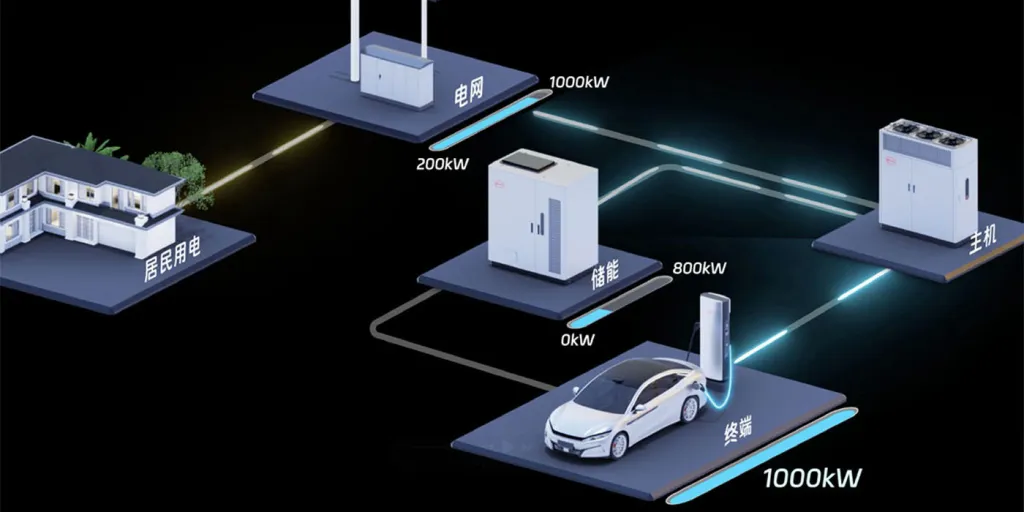
- Integration of energy storage facilities to manage grid load
Each BYD charging station in the new network will feature the 1000 kW flash charging capability, supported by battery energy storage systems (BESS) that buffer the electrical grid from the extreme power demands.
“The first BYD charging station with megawatt capabilities will be operational in April 2025,” according to company announcements, marking the beginning of a new era in EV infrastructure.
Competitive Landscape: How BYD Compares
BYD’s system represents a significant advancement over existing charging technologies. Here’s how it compares to other fast-charging systems:
| Manufacturer | Charging Power | Range Addition | Charging Time (for ~400km) |
|---|---|---|---|
| BYD | 1,000 kW | 400 km | 5 minutes |
| Tesla | 500 kW | 275 km | 15 minutes |
| Mercedes-Benz | Not specified | 325 km | 10 minutes |
| Li Auto | Not specified | 500 km | 12 minutes |
With flash charging capabilities, BYD aims to eliminate one of the biggest barriers to EV adoption – lengthy charging times. This positions the company at the forefront of EV infrastructure development and could accelerate the transition to electric mobility.
Implementation Challenges and Solutions
Despite the impressive technical achievements, implementing this technology at scale faces several challenges:
Technical Hurdles
- Grid Capacity Limitations
- Solution: Integrated battery storage at charging locations to buffer demand
- Implementation: Each station includes energy storage systems charged during off-peak hours
- Heat Management
- Solution: Advanced liquid cooling systems for both charger and vehicle
- Implementation: Specialized cooling circuits and thermal management algorithms
- Installation Costs
- Challenge: 80,000-120,000 yuan per charging unit
- Strategy: Phased rollout beginning with high-traffic corridors
Advanced charging technology with 10C rates is at the heart of BYD’s megawatt charging platform, but requires sophisticated infrastructure to support it. The company has developed integrated solutions that address these challenges while maintaining charging performance.
Market Impact and Future Implications
The announcement of the BYD 1000 kW EV charging system has already had measurable market effects:
- BYD shares increased by 4.1% following the announcement
- Increased interest in compatible vehicle models
- Competitive pressure on other manufacturers to accelerate charging technology development
This technology could fundamentally change consumer perceptions of electric vehicles by eliminating the convenience gap between EVs and traditional vehicles. As one industry expert noted, “When charging takes the same time as filling up with gas, the last major objection to EV adoption disappears.”
The long-term implications include:
- Accelerated EV adoption rates
- Reduced need for extremely large batteries (as fast charging reduces range anxiety)
- New design possibilities for vehicles that don’t need to maximize battery size
- Potential standardization of ultra-fast charging protocols
The Future of EV Charging is Here
The BYD 1000 kW EV charging system represents more than just an incremental improvement in charging technology – it’s a paradigm shift that could finally make electric vehicles as convenient as their gas-powered counterparts.
With charging speeds that add 2 kilometers of range every second, the days of planning trips around charging stops or waiting hours for a full battery may soon be behind us. As BYD rolls out its 4,000 charging stations across China and potentially expands globally, we may be witnessing the tipping point that makes EVs the obvious choice for consumers worldwide.
Engineers have designed the BYD 1000 kW EV charging system to deliver 2 kilometers of range per second, effectively solving one of the last major hurdles to widespread EV adoption. The question is no longer if electric vehicles will replace internal combustion engines, but how quickly the transition will happen now that charging times are no longer a barrier.
Also read- BluSmart puts operations on hold—SEBI’s looking into the company
FAQs
How does the BYD 1000 kW charging system compare to a gas station fill-up?
The BYD 1000 kW EV charging system can provide about 400 kilometers (249 miles) of range in approximately 5 minutes, which is comparable to the time it takes to fill a conventional vehicle’s gas tank. This effectively eliminates one of the key convenience advantages that gas vehicles have traditionally held over EVs.
Will this technology work with all electric vehicles?
No, only vehicles specifically designed for this charging rate can utilize the full 1000 kW capability. Currently, only select BYD models (starting with the Han L and Tang L) are compatible with this technology. Other EVs would charge at their maximum supported rate, which is typically much lower.

