

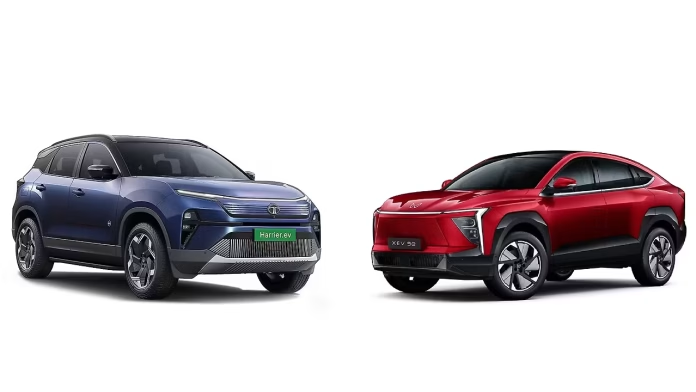

Picture this: Two Indian automotive giants stand at opposite ends of a showroom Mahindra XEV 9e and Tata Harrier EV, each clutching their best electric SUV. Mahindra brings the futuristic XEV 9e with its coupe-SUV silhouette and triple-screen cockpit. Tata counters with the rugged Harrier EV, India’s first AWD electric SUV. Which one deserves your hard-earned money? Let’s settle this debate.
Table of Contents
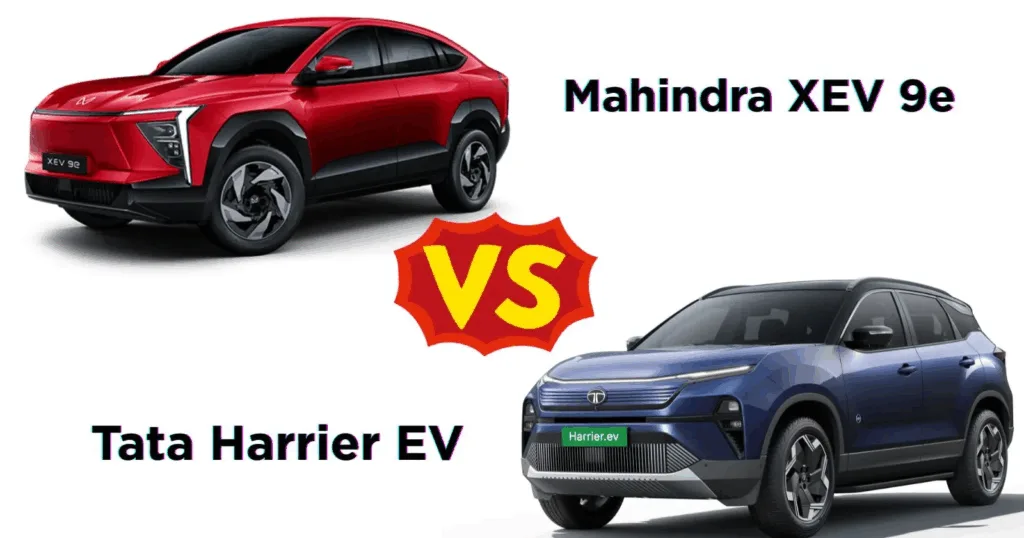
The Price Tag: Who Offers Better Value?
Money talks, and in this premium EV segment, it’s shouting. The battle starts with pricing that’s surprisingly close, but the devil’s in the details.
Starting Price Comparison:
| Model | Starting Price | Top Variant Price | Key Value Proposition |
|---|---|---|---|
| Tata Harrier EV | ₹21.49 lakh | ₹28.99 lakh (AWD) | Lower entry, AWD option available |
| Mahindra XEV 9e | ₹21.90 lakh | ₹30.50 lakh | Longer range, more tech features |
Tata wins the affordability game with a starting price of ₹21.49 lakh compared to Mahindra’s ₹21.90 lakh. More importantly, Harrier’s top-spec RWD variant undercuts the XEV 9e’s equivalent by ₹3 lakh, and even the AWD Harrier costs ₹1.5 lakh less than the XEV 9e Pack Three.
But here’s where it gets interesting: Mahindra justifies its premium with longer range and more futuristic features. Is the extra investment worth it? Keep reading.
Battery & Range: The Numbers Game
Range anxiety remains the biggest barrier to EV adoption. Both manufacturers understand this, offering dual battery options to cater to different needs and budgets.
Battery Pack & Range Specifications:
| Vehicle | Battery Options | MIDC Claimed Range | Real-World Range (Estimated) |
|---|---|---|---|
| Mahindra XEV 9e | 59 kWh | 542 km | 420-450 km |
| Mahindra XEV 9e | 79 kWh | 656 km | 500-530 km |
| Tata Harrier EV | 65 kWh | 538 km (RWD) | 480-505 km (C75 tested) |
| Tata Harrier EV | 75 kWh | 622-627 km (RWD/AWD) | 480-505 km (C75 tested) |
The XEV 9e’s 79 kWh variant delivers an impressive 656 km claimed range, outpacing the Harrier EV’s maximum 627 km. Even more remarkably, the XEV 9e’s smaller 59 kWh battery (542 km) beats the Harrier’s larger 65 kWh pack (538 km).
This suggests Mahindra’s INGLO platform extracts more efficiency from every kilowatt-hour. However, Tata’s internal C75 testing shows real-world range of 480-505 km for the 75 kWh pack—a refreshingly honest estimate compared to optimistic MIDC claims.
Winner: Mahindra XEV 9e for maximum range on paper, though both deliver sufficient range for inter-city travel.
Charging Speed: Who Gets You Back on the Road Faster?
When you’re on a highway trip and need a quick charge, every minute counts. Here’s where the technical differences become practical advantages.
DC Fast Charging Performance:
| Model | DC Charging Power | 20%-80% Charging Time | AC Home Charging (0-100%) |
|---|---|---|---|
| XEV 9e (59 kWh) | 140 kW | 20 minutes | 8.7 hours (7.2 kW) |
| XEV 9e (79 kWh) | 180 kW | 20 minutes | 11.7 hours (7.2 kW) |
| Harrier EV (65 kWh) | 100 kW | 25 minutes | 9.3 hours (7.2 kW) |
| Harrier EV (75 kWh) | 120 kW | 25 minutes | 10.7 hours (7.2 kW) |
The XEV 9e charges from 20-80% in just 20 minutes using a 180 kW fast charger, while the Harrier EV requires 25 minutes with a 120 kW charger. Those five minutes might seem trivial, but during a 500 km road trip with multiple charging stops, they add up significantly.
Interestingly, the Harrier EV charges slightly faster on AC home charging (10.7 hours vs 11.7 hours for the 79 kWh XEV 9e)—though you’ll be asleep for both, so it hardly matters.
Special Feature: Tata Harrier EV includes V2L (Vehicle-to-Load) and V2V (Vehicle-to-Vehicle) charging capability, meaning you can power your camping equipment or even charge another EV—a feature absent in the XEV 9e.
Power & Performance: AWD vs RWD Showdown
This is where the Harrier EV throws its knockout punch. Tata offers India’s first AWD electric SUV with dual motors producing 156 bhp (front) + 235 bhp (rear) for a combined 391 bhp and 504 Nm of torque.
Performance Comparison:
| Specification | Mahindra XEV 9e | Tata Harrier EV (AWD) |
|---|---|---|
| Drivetrain | RWD only | RWD & AWD options |
| Power Output | 231-286 bhp | 396 bhp (dual-motor) |
| Torque | 380 Nm | 504 Nm |
| 0-100 km/h | 6.8 seconds | 6.3 seconds |
The Harrier EV’s AWD system sprints from 0-100 km/h in 6.3 seconds, beating the XEV 9e’s 6.8 seconds. More importantly, AWD provides superior traction during monsoons, off-road adventures, and hill climbing—practical advantages beyond just bragging rights.
The XEV 9e sticks exclusively to rear-wheel drive, which keeps costs down but limits its all-terrain capability.
Dimensions & Space: Size Matters (Sometimes)
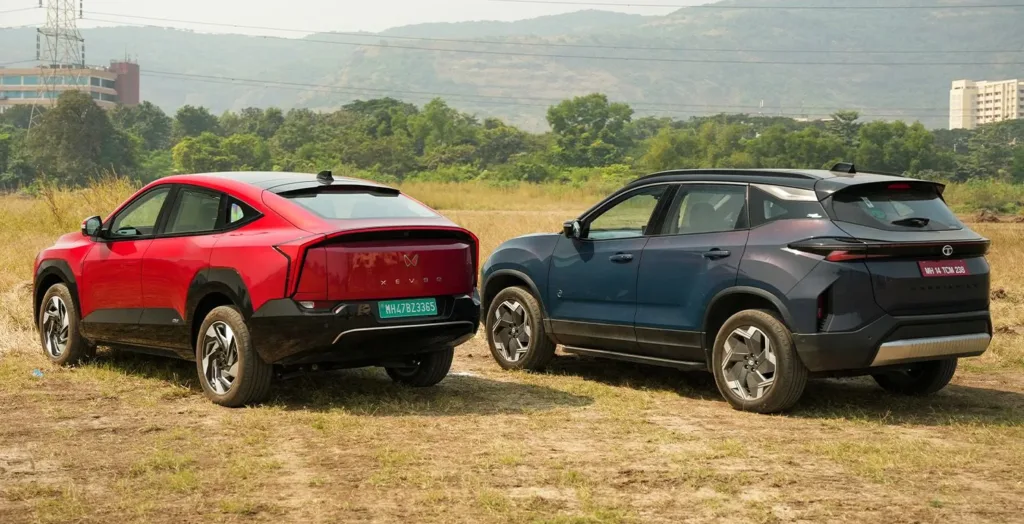
The Mahindra XEV 9e is significantly longer (4,789 mm) than the Harrier EV (4,607 mm) by 182 mm, while the Harrier leads in width by 225 mm and height by 46 mm.
Interior & Cargo Space:
| Dimension | Mahindra XEV 9e | Tata Harrier EV | Winner |
|---|---|---|---|
| Wheelbase | 2,775 mm | 2,741 mm | XEV 9e (+34 mm) |
| Boot Space | 663 litres | 502 litres | XEV 9e (+161 litres) |
| Frunk | 150 litres | 35 litres | XEV 9e (+115 litres) |
| Seating | 5 seats | 5 seats | Tie |
The XEV 9e offers 663 litres of boot space and 150 litres of frunk storage, dwarfing the Harrier’s 502-litre boot and 35-litre frunk. For families taking weekend trips or buyers needing cargo flexibility, Mahindra’s packaging is clearly superior.
However, the Harrier’s extra width and height provide a more imposing road presence and potentially better shoulder room for passengers.
Features & Technology: Future vs Practical
Both SUVs pack impressive technology, but their philosophies differ dramatically.
Mahindra XEV 9e Tech Highlights:
- Triple-screen setup spanning 43 inches across the dashboard
- Harman Kardon 16-speaker audio system
- Heads-up display
- Connected ‘smart cabin’ apps
- Panoramic glass roof
- Level 2 ADAS
- 360-degree camera
Tata Harrier EV Tech Highlights:
- 14.3-inch QLED touchscreen
- 10-speaker audio system
- Transparent under-car camera view
- E-valet and park assist modes
- Panoramic sunroof
- Level 2 ADAS
- 360-degree surround cameras
- V2L and V2V capability
The XEV 9e aims for luxury tech with its futuristic cabin, while the Harrier emphasizes rugged practicality and off-road savviness. Think Apple vs Samsung—both excellent, but serving different personalities.
Safety: Seven Airbags vs Six (Mostly)
The Harrier EV provides seven airbags as standard across all variants, while the XEV 9e includes six airbags as standard, reserving seven only for its top-spec model.
Additional Harrier safety features include:
- Knee airbag, Acoustic Vehicle Alert System (AVAS), all-wheel disc brakes with wiping function, and SOS call feature
The XEV 9e counters with:
- Air purifier, auto-defogging windshield, and comprehensive 360-degree live view with recording
Both achieved 5-star ratings from Bharat NCAP for adult and child safety, proving they’re equally capable of protecting occupants during crashes.
Charging Infrastructure: Ecosystem Matters
Beyond the vehicles themselves, access to reliable charging determines real-world usability.
Charging Network Comparison:
- Tata Power Network: Covers 530 cities with over 100,000 home chargers, 5,500+ public/semi-public charging points, and 1,100 bus charging stations
- Mahindra Network: Over 1,100 connected charging stations accessible through Adani Total Energies collaboration via Bluesense+ app
Tata’s charging ecosystem is significantly more extensive, providing peace of mind for long-distance travel—a critical advantage often overlooked when comparing spec sheets.
Warranty: Lifetime Battery Coverage (With Asterisks)
Both manufacturers offer lifetime battery warranty for the first buyer, reverting to 10 years from first registration date upon ownership transfer. This aggressive warranty signals confidence in battery longevity and helps reduce buyer anxiety about expensive battery replacements.
The Bottom Line
Over 10,000 buyers booked the Harrier EV within 24 hours of pre-orders opening, while Mahindra has delivered over 10,000 combined XEV 9e and BE 6 units—proof that both vehicles resonate with Indian buyers.
The Harrier EV wins on affordability, AWD capability, and practical features. The XEV 9e wins on range, charging speed, and futuristic technology. Your decision ultimately reflects whether you value performance and practicality (Harrier) or range and innovation (XEV 9e).

