


Remember when flying cars were just sci-fi fantasies? The Jetsons zooming through the air, James Bond escaping villains in aerial vehicles? Well, China just turned that dream into your 2026 reality. And here’s the twist: it’s all thanks to electric vehicle technology.
Table of Contents
From Traffic Jams to Sky Lanes: The $1.5 Trillion Vision
Imagine this: You’re stuck in Beijing’s notorious rush hour traffic. Your meeting starts in 30 minutes across the city. Suddenly, your car’s propellers emerge, and within seconds, you’re airborne, gliding above the gridlock. This isn’t science fiction anymore—the eVTOL market is projected to reach $1.5 trillion annually by 2040, and China is leading the charge.
The secret weapon? The same battery and electric motor technology that powers millions of Teslas, BYDs, and XPengs on roads today is now lifting vehicles into the sky.
China’s Sky-High Dominance
China already controls 50% of the world’s total eVTOL models, leaving the United States and Europe scrambling to catch up. But how did China leap so far ahead so quickly?
The answer lies in a perfect storm of innovation: world-leading EV technology, massive drone manufacturing experience, aggressive government support, and the willingness to move at breakneck speed.
China’s Flying Car Advantage:
| Factor | China’s Edge | Impact |
|---|---|---|
| EV Technology | World’s largest EV market & producer | Proven battery systems, motors, software |
| Drone Expertise | Leading multi-rotor drone manufacturer | Flight control systems already perfected |
| Manufacturing Scale | Massive production capabilities | Lower costs, faster deployment |
| Government Support | “Low-altitude economy” policy priority | Dedicated flightpaths, $278B target by 2030 |
| Speed of Execution | 50 days from MoU to groundbreaking | Rapid commercialization timelines |
The Three Phases of Flying Car Evolution
According to China’s official white paper on flying cars, the revolution will unfold in three distinct stages:
Timeline for Flying Car Development:
| Phase | Timeline | Milestone | What It Means |
|---|---|---|---|
| Phase 1.0 | 2025-2035 | Commercialization begins | Cargo eVTOLs operational; passenger demos in specific scenarios |
| Phase 2.0 | 2035-2050 | Large-scale manufacturing | Intelligent eVTOLs become major low-altitude transport mode |
| Phase 3.0 | 2050+ | Mass adoption | Amphibious flying cars integrate ground and air transport |
We’re entering Phase 1.0 right now. XPeng’s Chairman He Xiaopeng announced that mass production of their split flying car land aircraft carrier is expected in 2026.
Meet the Players: China’s Flying Car Pioneers
XPeng AeroHT: The Dual-Mode Dream
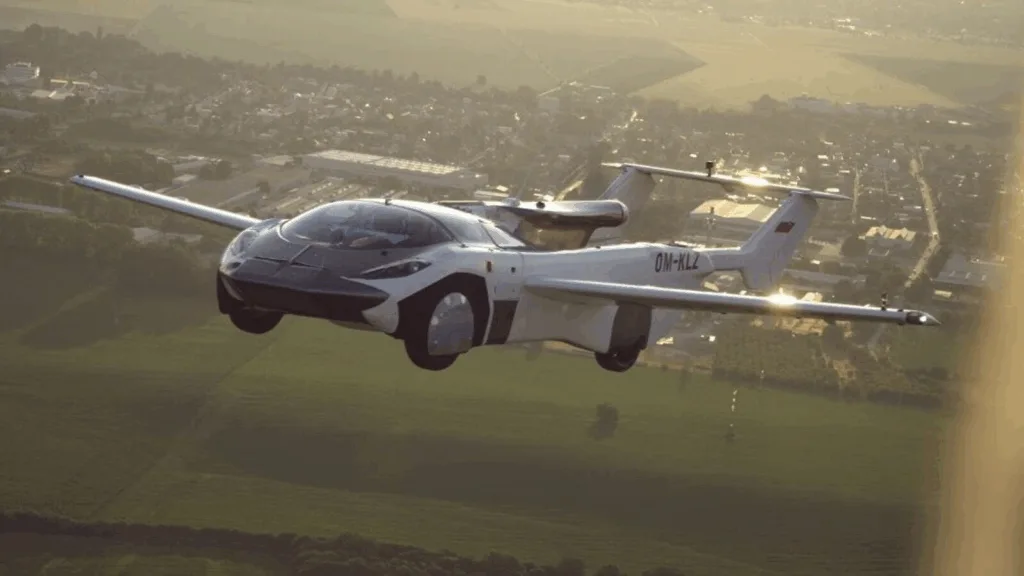
XPeng’s subsidiary AeroHT showcased two flying car types at CES 2024: the modular Land Aircraft Carrier and the sportier eVTOL with pop-out propellers. Unlike competitors, XPeng’s vehicles can actually drive on roads—not just fly.
The Land Aircraft Carrier features a separate aircraft that launches from the car itself. Think of it as a mobile helipad that you can drive to work. Deliveries are expected to begin in Q4 2025, with pricing comparable to luxury performance cars.
What makes XPeng special? They’re not aviation experts trying to build cars—they’re car experts applying proven EV technology to flight. Through August 2025, XPeng delivered 271,615 vehicles, a 252% increase year-over-year, proving they understand mass production.
EHang: The Pioneer Who Started It All
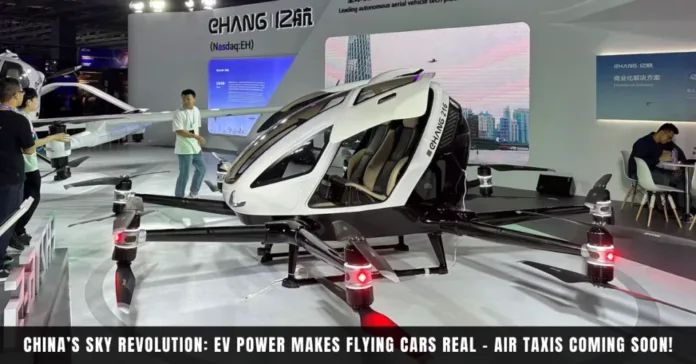
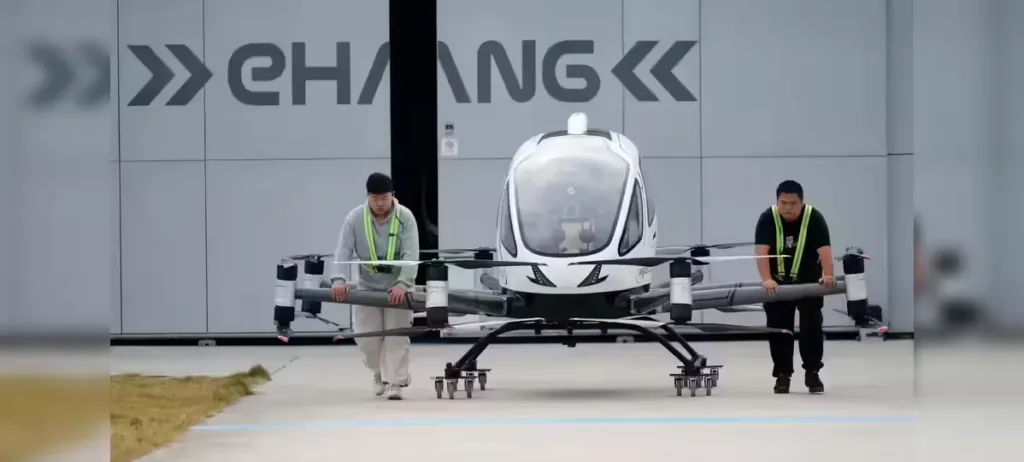
EHang made waves at CES 2016 with the EHang 184, becoming the first Chinese company to seriously pursue passenger drones. Years later, they’ve given journalists test flights and gone public on Nasdaq, validating the entire industry.
AutoFlight: Breaking Distance Barriers
In February 2024, AutoFlight achieved a milestone: their five-seater Prosperity eVTOL completed the world’s first inter-city electric air taxi flight between Shenzhen and Zhuhai. This wasn’t a short hop—it demonstrated practical, long-distance urban air mobility.
Why EV Technology Changes Everything
Here’s why electric vehicle breakthroughs are the secret sauce:
The EV-to-eVTOL Technology Bridge:
- Battery Energy Density: Advanced lithium-ion batteries developed for EVs provide the power-to-weight ratio needed for flight
- Electric Motors: High-efficiency motors that propel Teslas and BYDs can spin propellers with precision
- Power Management: Sophisticated battery management systems ensure safe, reliable operation
- Manufacturing Scale: China’s massive EV production infrastructure reduces costs dramatically
- Software & AI: Autonomous driving technology translates directly to autonomous flight control
The China Society of Automotive Engineers’ 2024 report confirmed that smart EV development has laid a solid industrial foundation for smart electric aviation. Technologies don’t need to be reinvented—they need to be adapted.
The “Low-Altitude Economy”: China’s Master Plan
Beijing didn’t stumble into this leadership position. They engineered it through strategic policy-making. The government has designated the “low-altitude economy” as a national priority, with authorities aiming to grow the sector from $69 billion in 2023 to $278 billion by 2030.
This includes:
- Establishing dedicated eVTOL flightpaths by local governments
- Streamlined certification processes through the Civil Aviation Administration of China
- Massive infrastructure investments in charging stations and landing pads
- Integration with logistics, emergency services, agriculture, tourism, and security sectors
Real-World Applications Already Taking Flight
Flying cars aren’t just for thrill-seekers. China envisions practical applications:
Urban Air Mobility: Skip traffic between cities for business meetings Emergency Medical Services: Transport patients faster than ambulances Cargo Logistics: Drone delivery on steroids for time-sensitive goods Tourism: Aerial sightseeing tours over scenic destinations Agricultural Services: Crop monitoring and precision farming Security Operations: Rapid response for law enforcement
The logistics sector alone is driving massive demand. China’s fiercely competitive delivery market is pushing companies to explore aerial transportation as conventional road capacity maxes out.
The Challenges: Regulation, Safety, and Social Acceptance
Let’s be real—not everything is smooth sailing (or smooth flying). XPeng President Brian Gu acknowledged that urban use of flying cars faces regulatory hurdles, suggesting initial deployment in unregulated areas before gradually moving to city centers.
Safety concerns are paramount. Unlike cars that can pull over, flying vehicles must maintain altitude and control at all times. That’s why companies are starting with cargo applications before carrying precious human passengers.
Then there’s the noise factor. Will neighborhoods accept the buzzing of dozens of eVTOLs overhead? Social acceptance will determine adoption speed as much as technology will.
Global Competition: Why the West Is Playing Catch-Up
Western companies face hurdles navigating stringent regulations and safety protocols, impeding progress beyond testing phases. While American and European firms like Joby Aviation and Airbus’s CityAirbus NextGen are developing impressive prototypes, they’re years behind Chinese commercialization timelines.
Joby Aviation plans to commercialize in 2025, and Airbus successfully flew its CityAirbus NextGen prototype in 2024. But neither has announced mass production dates or pricing comparable to Chinese competitors.
The regulatory environment matters immensely. China’s centralized approach allows faster approval processes, while Western regulatory fragmentation slows deployment.
What This Means for You
If you’re reading this from China, flying cars might become part of your transportation options within five years. For the rest of the world, China’s progress will force governments to modernize aviation regulations and infrastructure.
The broader implication? In 2024, more than 17 million EVs were sold globally, and the International Energy Agency forecasts that in 2025, battery-powered vehicles will account for one quarter of all cars sold worldwide. This same rapid adoption curve could apply to flying vehicles as technology matures and costs decline.
The Bottom Line
China’s flying car revolution isn’t about reinventing aviation—it’s about intelligently applying proven electric vehicle technology to an age-old dream. By leveraging their dominance in EVs, drones, and manufacturing, Chinese companies have positioned themselves to lead the $1.5 trillion eVTOL market.
Within two years, you might see XPeng’s Land Aircraft Carrier at a dealership near you. Within a decade, booking an aerial taxi could be as routine as ordering a ride-share today.
The Jetsons future isn’t coming. It’s already here—manufactured in China, powered by EV technology, and ready for takeoff.

