

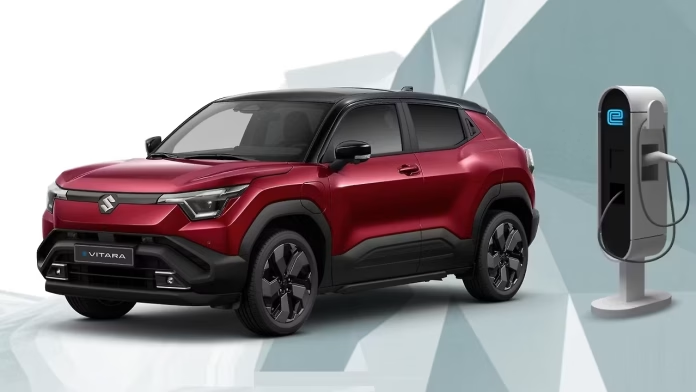

Imagine India’s most trusted car brand finally going electric. After decades of dominating petrol and diesel segments, Maruti Suzuki is about to drop its first-ever battery electric vehicle—the eVitara. Launching December 2, 2025, this isn’t just another EV launch. It’s Maruti declaring war on range anxiety, charging infrastructure fears, and sky-high EV prices. Here’s everything you need to know.
Table of Contents
Launch Timeline: The Wait Is Almost Over
Mark your calendars: December 2, 2025. That’s when Maruti Suzuki officially enters India’s electric vehicle revolution with the eVitara, unveiled earlier at the Bharat Mobility Global Expo 2025.
Maruti eVitara Timeline:
| Milestone | Date | Details |
|---|---|---|
| Global Unveiling | January 2025 | Bharat Mobility Global Expo 2025 |
| Production Start | August 2025 | Hansalpur plant, Gujarat |
| Export Launch | August 2025 | First units to UK, Europe |
| India Launch | December 2, 2025 | Official India debut |
| Deliveries Begin | December 2025 onwards | Through NEXA dealerships |
| Export Markets | Ongoing | 100+ countries including UK, Germany, Norway |
Production began at the Hansalpur plant in Gujarat for both India and exports, with about 7,000 units already shipped overseas since August. The UK has been the top importer, proving global confidence in Maruti’s first EV.
Price: The ₹20-25 Lakh Reality Check
Here’s where it gets interesting—and slightly controversial. While early estimates pegged the eVitara at ₹15-20 lakh, realistic pricing now points to around ₹20 lakh for the 49 kWh variant and approximately ₹25 lakh for the 61 kWh version.
Expected Pricing Structure:
| Variant | Battery | Expected Price | Key Competitor |
|---|---|---|---|
| Delta (Base) | 49 kWh | ₹20 lakh | Tata Curvv EV (₹17.49L) |
| Zeta (Mid) | 61 kWh | ₹22-23 lakh | Hyundai Creta EV (₹18-24L) |
| Alpha (Top) | 61 kWh | ₹24-25 lakh | Mahindra BE 6 (₹18.90-27.65L) |
(All prices ex-showroom, estimated)
This pricing positions the eVitara as a premium offering compared to the Tata Curvv EV and MG ZS EV but competitive with the Hyundai Creta Electric and Mahindra BE 6. The question is: Will Maruti’s brand trust justify the premium?
Battery & Range: The BYD Blade Advantage
Maruti isn’t playing around with battery technology. Both battery packs are the Blade type from BYD, making them robust, long-lasting, and high-range.
Battery Specifications Breakdown:
| Battery Pack | Motor Power | Torque | WLTP Range | Real-World Range (Est.) |
|---|---|---|---|---|
| 49 kWh | 142 hp | 193 Nm | 344 km | 300-320 km |
| 61 kWh (FWD) | 171 hp | 193 Nm | 426 km | 380-400 km |
| 61 kWh (AWD)* | 181 hp | 307 Nm | 395 km | 350-370 km |
*AWD variant planned for later launch, not available initially in India
The claimed maximum range for the larger battery is up to 500 km, making intercity trips genuinely feasible without charging anxiety. That’s Delhi to Jaipur or Mumbai to Pune on a single charge.
The 49 kWh pack delivers 142 hp and 193 Nm, while the 61 kWh front-wheel-drive version produces 171 hp and 193 Nm. Performance is smooth and predictable rather than Tesla-quick, but that aligns with Maruti’s philosophy of everyday usability over outright speed.
Charging Speed: Home & Highway Solutions
Nobody wants to wait hours for a charge. Maruti gets this.
Charging Time Comparison:
| Battery Size | AC 7 kW Charger | AC 11 kW Charger | DC Fast Charger (10-80%) |
|---|---|---|---|
| 49 kWh | ~6.5 hours (10-100%) | ~4.5 hours (10-100%) | ~45 minutes |
| 61 kWh | ~9 hours (10-100%) | ~5.5 hours (10-100%) | ~50 minutes |
Both batteries can charge from 10 to 80 percent in about 45 minutes using DC fast charging. That’s a lunch break at a highway dhaba—perfectly timed for Indian road trips.
For home charging, plug in overnight with an 11 kW charger, and you’re fully topped up by morning. Maruti plans smart home chargers, plug-and-play DC fast chargers at dealerships, and an e-for-me app to manage charging.
Design: Rugged SUV Meets Modern Electric
Forget sleek, futuristic EV styling. The eVitara channels traditional SUV toughness.
Exterior Highlights:
- Slim black plastic strip connecting Y-shaped LED DRLs
- Chunky front bumper with rugged skid plate
- Generous body cladding for SUV stance
- 18-inch wheels standard; 19-inch aero wheels on top variants
- Connected LED taillamps
- Charging port on left front quarter panel
Dimensions:
The SUV measures 4.27 meters long with a 2.7-meter wheelbase, placing it squarely in the compact SUV segment where Maruti thrives.
The design philosophy follows what Maruti calls the “Emotional Versatile Cruiser” idea with High Tech and Adventure themes—marketing speak for “it looks like an SUV that can handle Indian roads.”
Interior & Features: Maruti’s Premium Push
This is where the eVitara surprises. It’s loaded with features Maruti has never offered before.
Tech & Comfort Features:
| Feature Category | What You Get |
|---|---|
| Infotainment | 10.25-inch touchscreen, wireless Apple CarPlay/Android Auto |
| Digital Display | 10.1-inch fully digital driver’s display |
| Audio | 10-speaker Infinity sound system (premium!) |
| Seating | 10-way power-adjustable driver seat, ventilated front seats |
| Ambient Lighting | Multi-color configurable ambient lighting |
| Sunroof | Fixed single-pane panoramic sunroof |
| Wireless Charging | Phone charging pad |
| Rear Comfort | Sliding rear seats to balance legroom and cargo space |
The eVitara will be the first car from Maruti to feature up to seven airbags, with six as standard. Additional safety includes:
- Level 2 ADAS (Advanced Driver Assistance Systems)
- 360-degree camera
- Front and rear parking sensors
- Electronic parking brake
- All-disc brakes
- TPMS (Tire Pressure Monitoring System)
- Electronic stability control
The driver-side knee airbag is expected on higher trims only.
Platform: Built for EVs from Ground Up
Unlike converted petrol cars masquerading as EVs, the eVitara uses the ground-up HEARTECT-e platform developed specifically for battery electric vehicles.
Platform Advantages:
- Low-weight structure optimized for range
- High-voltage protection integrated from design stage
- Battery mounting structure with energy-absorbing crash protection
- Main floor without underfloor members to maximize battery space
- Adaptive grille shutters to reduce drag and improve range
The eVitara uses a three-in-one drive unit integrating motor, inverter, and transmission, improving efficiency and reducing weight compared to separate components.
Driving Modes & Regeneration: Tailored for India
The eVitara offers multiple driving modes to suit different conditions:
Drive Modes:
- Eco: Maximum range, relaxed acceleration
- Normal: Balanced performance and efficiency
- Sports: Full power delivery for overtaking
- Snow: Special mode for slippery conditions (yes, really!)
Regenerative braking supports near one-pedal driving, though regen braking can be fiddly to adjust as it must be set via touchscreen and activated through a console button—a minor ergonomic complaint from international reviewers.
Production Challenges: The Rare Earth Problem
Not everything is smooth sailing. Maruti has drastically slashed production targets for the eVitara by nearly 69% due to a critical shortage of rare earth materials resulting from China’s export restrictions.
Production Reality:
| Timeline | Original Target | Revised Target | Shortfall |
|---|---|---|---|
| April-Sept 2025 | 26,500 units | 8,200 units | -69% |
This production disruption could delay exports to Europe and Japan, signaling the challenges of building EVs when global supply chains face geopolitical headwinds.
For Indian buyers, Maruti targets modest sales of around 1,000 units monthly initially—conservative but realistic given this is their first EV.
Competition: The Midsize EV Battleground
The eVitara enters India’s most competitive EV segment, facing established and upcoming rivals.
Competitive Landscape:
| Competitor | Price Range | Battery | Range | Key Strength |
|---|---|---|---|---|
| Tata Curvv EV | ₹17.49-22.24L | 45/55 kWh | 502 km | Affordable, established |
| Hyundai Creta EV | ₹18.02-24.40L | 42/51.4 kWh | 473 km | Premium features |
| MG ZS EV | ₹17.99-20.50L | 50.3 kWh | 461 km | Value proposition |
| Mahindra BE 6 | ₹18.90-27.65L | 59/79 kWh | 656 km | Longest range |
| Maruti eVitara | ₹20-25L (est.) | 49/61 kWh | 500 km | Brand trust + infrastructure |
The eVitara’s competitive edge lies not in specifications alone but in Maruti’s unmatched dealer network, service reach, and brand credibility—factors that often matter more to Indian buyers than spec sheets.
Export Success: Global Validation
The first export unit was flagged off in August 2025, and by September, more than 2,900 units were exported to the UK, Germany, Norway, France, Denmark, Switzerland, Netherlands, Sweden, Hungary, Iceland, Austria, and Belgium.
The UK market offers the eVitara from £29,999 to £37,799, providing global pricing context. The India model is expected to be priced more competitively, leveraging local manufacturing advantages.
Toyota Connection: Badge Engineering Returns
Maruti will also manufacture a badge-engineered Toyota version called the Urban Cruiser EV at the same Gujarat plant. This model will share most features with the eVitara but carry Toyota branding, expected to arrive a few months after the Maruti version.
This partnership mirrors Maruti and Toyota’s collaboration on models like the Glanza, Urban Cruiser, and Hyryder/Invicto, allowing both brands to share development costs while accessing each other’s customer bases.
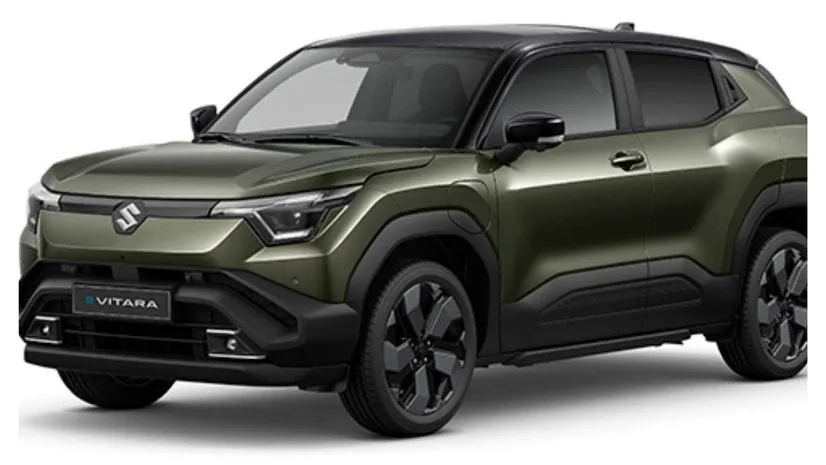
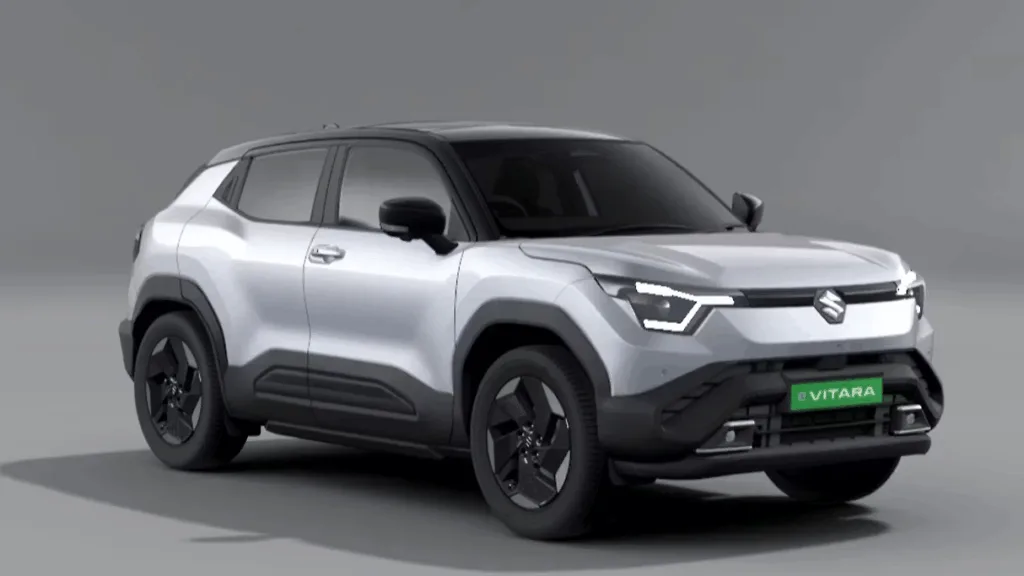
Color Options: 10 Choices Including Dual-Tone
The eVitara will be available in 10 colors, including dual-tone options:
Color Palette:
- Bluish Black (solid)
- Arctic White (solid and with Bluish Black roof)
- Splendid Silver (solid and with Bluish Black roof)
- Opulent Red (solid and with Bluish Black roof)
- Land Breeze Green with Bluish Black roof
- Nexa Blue
- Grandeur Grey
Dual-tone options add visual flair, particularly appealing to younger buyers who want their EV to stand out.
Safety: Four-Star Euro NCAP Rating
The India-made eVitara scored four stars at Euro NCAP crash testing, validating its structural safety for global markets. While not the maximum five stars, four stars represents solid protection, especially considering this is Maruti’s first EV built on an entirely new platform.
Standard safety equipment includes seven airbags, electronic stability control, ISOFIX child seat anchors, e-call emergency assistance, and comprehensive ADAS features.
The Bottom Line: Will It Succeed?
The Maruti eVitara faces a classic challenge: premium pricing from a mass-market brand. At ₹20-25 lakh, it’s asking buyers to pay Hyundai/Mahindra money for a Maruti badge.

