

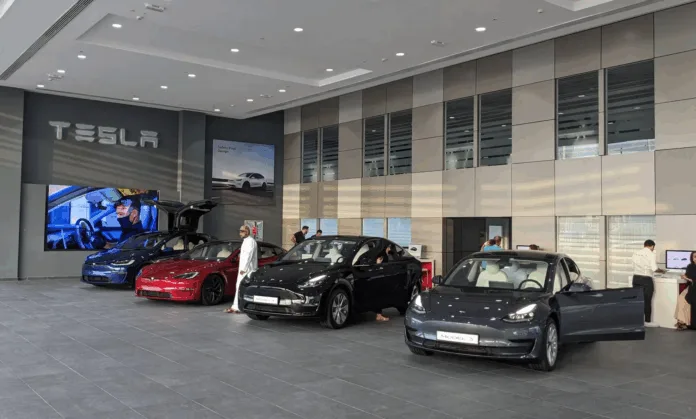

Tesla’s highly anticipated entry into India has delivered underwhelming results since its July 2025 launch, with the company struggling to gain traction in the world’s third-largest automotive market. The Elon Musk-led electric vehicle maker has received orders for just over 600 cars since launching sales in mid-July, a number that’s fallen short of the company’s own expectations, according to people familiar with the matter. That’s roughly the number of vehicles Tesla delivered every four hours globally during the first half of the year.
| Tesla India Performance Snapshot | Details |
|---|---|
| Launch Date | Mid-July 2025 |
| Total Orders (First 6 Weeks) | ~600 units |
| September 2025 Deliveries | 64 units |
| October 2025 Deliveries | 40 units (37.5% decline MoM) |
| Cumulative Sales (July-October) | 104 units |
| Model Y Starting Price | ₹59.89 lakh (~$70,000 USD) |
| Import Duty Impact | Up to 100-110% on CBU imports |
| Initial Sales Target 2025 | 2,500 units |
| Revised Expectation | 350-500 units |
| Market Share (Oct 2025) | Significantly behind BYD (541 units), BMW (307 units), Mercedes-Benz (95 units) |
Table of Contents
Tesla’s Prohibitive Pricing Due to Import Tariffs
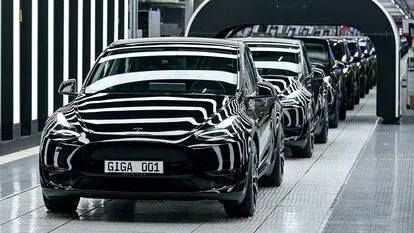
At the heart of Tesla’s challenge is India’s aggressive import tax regime. Vehicles shipped fully built from abroad are subject to duties of up to 100%, effectively doubling the cost of each Model Y imported from Tesla’s Shanghai factory. This tax burden creates a massive price disparity compared to Tesla’s pricing in other markets.
The Tesla web site shows the price of a Model Y at 61,07,190 rupees, or about $71,000. However, the same car is listed on the company’s site for US buyers at about $45,000 before applying a $7,500 federal tax credit for electric vehicles (EV), which would lower the cost to $37,500. This nearly 2x price difference fundamentally undermines Tesla’s value proposition in a highly price-sensitive market.
The result is an entry price of around ₹60 lakh (C$94,000/US$70,000), nearly three times higher than the average electric vehicle (EV) sold in India, which typically retails for about ₹22 lakh. The pricing places Tesla squarely in the luxury EV segment — a niche market that accounted for fewer than 3,000 sales overall in the first half of 2025.
Price-Sensitive Market Dynamics
India’s automotive market operates on fundamentally different economics than it’s traditional strongholds. Most cars in India are sold in a price bracket of 8 lakhs to 15 lakhs ($6000–$9600), dominated by cars like the TATA Punch and Maruti Suzuki Swift, followed by the mid-range segment of sedans and compact SUVs.
According to market analysis, electric car sales in India rose 20% year on year in 2024. The market is, however, small: EVs comprised only 2.5% of the 4.3 million cars sold in the country last year. India’s EV market is estimated to be worth $54.41 billion, and expected to reach $111 billion by 2029.
The competitive landscape heavily favors locally manufactured affordable options. Domestic automobile giant Tata Motors commands 60% of the electric car market in India, followed by JSW MG Motor India — a joint venture between India’s JSW Group and China’s SAIC Motor — and Indian automobile manufacturer Mahindra & Mahindra. The companies offer a range of affordable EV car options in the price-sensitive Indian market.
Inadequate Charging Infrastructure
Infrastructure limitations have further dampened enthusiasm. Outside of major metros, India’s public charging network remains sparse, and it’s own Supercharger coverage is still limited to Mumbai and Delhi. The company plans to open a third experience center in South India next year and expand its charging footprint, but for now, range anxiety and lack of service accessibility remain barriers for potential buyers.
This infrastructure deficit creates a chicken-and-egg problem: consumers hesitate to purchase EVs without widespread charging availability, while companies are reluctant to invest heavily in infrastructure without sufficient vehicle volumes to justify the capital expenditure.
Limited Retail Presence and Service Network
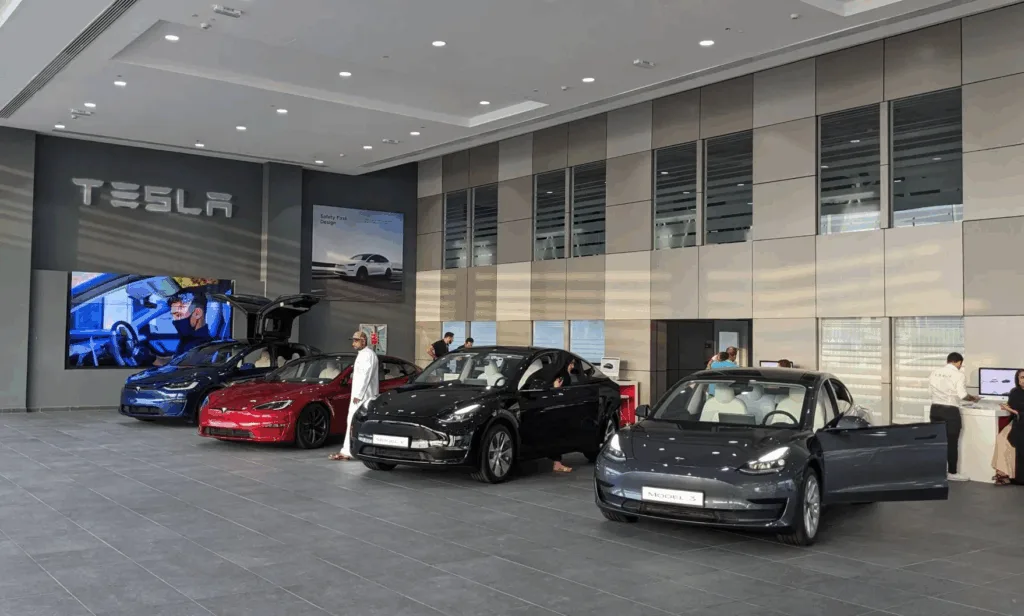
With just two showrooms, one in Mumbai and one in Delhi, Tesla has a limited retail footprint in India. Online, however, the company accepts orders from customers across the country. It is initially delivering the Model Y in four cities: Delhi, Mumbai, Gurugram, and Pune.
This minimal physical presence contrasts sharply with established competitors who have extensive dealership networks across tier-1, tier-2, and even tier-3 cities, providing customers with accessible service centers, test drive opportunities, and the confidence that comes from visible brand presence.
Competitive Disadvantages vs. Local and International Rivals
Tesla’s CBU (completely built unit) import strategy puts it at a severe disadvantage. To put things in perspective, BYD, Tesla’s closest rival, shipped 541 electric cars in India in September, while BMW and Mercedes-Benz registered 307 and 95 units in EV sales, respectively. While these competing brands offer multiple EVs, including some locally assembled models that benefit from lower tariffs, the American EV maker only sells the Model Y, and that, too, as a CBU import, attracting a steep import duty that significantly shoots up the price.
Even newcomer VinFast demonstrated stronger momentum, with 131 units sold in October compared to Tesla’s 40 units, highlighting how it’s premium pricing and limited model availability constrain market penetration.
Luxury Segment Limitations
Electric cars in the premium range, priced at over $20,000, accounted for only 6.6% of the EVs sold in India last year. The country is grappling with widening income inequality — 90% of its population has no money to spend on non-essential items, according to a study by venture capital firm Blume Ventures.
This stark economic reality means Tesla’s addressable market in India remains extremely constrained. Musk’s electric cars will initially be “a status symbol for fairly well-off, maybe tech-oriented, and business-anchored crowd in the large cities,” David Bach, president of the International Institute for Management Development stated, acknowledging the narrow demographic that can afford Tesla vehicles.
No Local Manufacturing Commitment
Tesla executives have spoken of a desire to build a plant in India, but at the moment its existing plants in the United States, China and Germany have more capacity than there is demand for its vehicles. Its plans for another plant in Mexico are currently on hold.
This lack of commitment to local production prevents Tesla from accessing India’s preferential tariff structure for domestically manufactured vehicles, which would dramatically reduce prices and improve competitiveness. Competitors like Tata, Mahindra, and MG Motor benefit from local assembly, allowing them to offer compelling value propositions.
Long-Term Strategic Approach
Despite the slow start, Tesla appears to be playing a long game. Executives have framed India as a strategic future market rather than an immediate sales driver, focusing first on brand awareness and establishing a presence among affluent early adopters. Until policy reforms bring prices closer to the mainstream market, Tesla’s growth in India is likely to remain slow and steady rather than electric.
The company’s current strategy emphasizes building brand recognition and establishing operational infrastructure rather than pursuing aggressive volume targets, suggesting Tesla views India as a multi-year investment rather than an immediate growth opportunity.
Market Context: Growing EV Adoption Despite Tesla’s Struggles
Despite it’s difficulties, India’s overall EV market continues expanding. The retail market for electric vehicles in India is expanding overall, despite Tesla’s sales decrease. The Federation of Automobile Dealers Associations (FADA) reports that retail sales of electric passenger vehicles reached 18,055 units in October, up 17.78% from 15,329 units in September.
This growth trajectory indicates strong underlying demand for electric vehicles in India—just not at Tesla’s current price points and with its limited infrastructure footprint. The success of domestic manufacturers demonstrates that Indians are willing to embrace electric mobility when pricing aligns with local purchasing power and adequate charging infrastructure exists.
For more updates on India’s electric vehicle market dynamics and luxury EV segment analysis, stay connected with our comprehensive industry coverage.
Official Links:

