

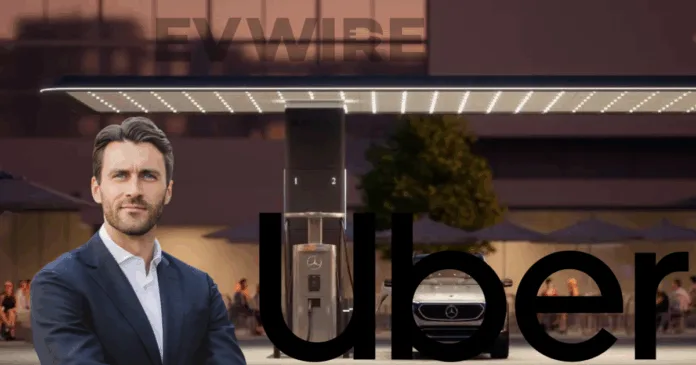

When a high-powered executive leaves luxury automaker Mercedes-Benz to join a ride-sharing company, the automotive world pays attention. Andrew Cornelia’s decision to become Uber’s Global Head of Electrification & Sustainability isn’t just a career move—it’s a signal that the future of transportation is being written in real-time, on city streets, not just showrooms.
Table of Contents
From Charging Stations to City Streets
Andrew Cornelia, CEO of Mercedes-Benz High-Power Charging North America since 2023, will join Uber in December 2025 as the company’s Global Head of Electrification & Sustainability. He’s leaving behind an impressive legacy: nearly 500 ultrafast chargers deployed across North America in just two years.
But why trade the prestige of Mercedes for the gig economy giant?
The Numbers That Changed Everything
The answer lies in a striking statistic. Rideshare drivers on Uber are going electric five times faster than the general population across the US, Canada, and Europe. That’s not gradual adoption—that’s a revolution happening in plain sight.
For Cornelia, the math is simple and compelling. High-mileage driving makes EVs not only cleaner, but fundamentally more cost-effective. When you’re putting 200+ miles on your car daily, fuel savings become game-changing income.
Andrew Cornelia’s Career Journey
| Role | Company | Duration | Achievement |
|---|---|---|---|
| Strategic Finance Lead | Tesla | ~5 years | Shaped global Supercharger network |
| VP Corporate Strategy | Volta Charging | 2+ years | Grew business 5x, raised $700M |
| CEO | Mercedes-Benz HPC NA | 2023-2025 | Deployed 500 chargers across NA |
| Global Head | Uber (Starting Dec 2025) | Upcoming | Leading zero-emissions by 2040 |
Why Uber Needs Him Now
Uber isn’t dabbling in electrification—it’s betting the company on it. Uber aims to have all its rides be zero-emissions by 2040. That’s an audacious goal requiring someone who understands both the technology and the economics at scale.
Cornelia brings battle-tested credentials. Before Mercedes, he spent nearly five years at Tesla helping build the Supercharger network—arguably the gold standard in EV charging. At Volta Charging, he pioneered innovative business models that redefined how charging stations operate.
The Real Challenge: Making EVs Work for Gig Workers
Here’s where it gets interesting. Uber operates with millions of independent contractor drivers worldwide. Unlike fleet operators who can mandate vehicle choices, Uber must make EVs the obvious economic choice.
In October, Uber announced it would give drivers $4,000 to switch to EVs—new or used—in New York City, California, Colorado and Massachusetts. They’ve also partnered with charging networks to secure better access and rates for drivers.
Cornelia’s mission? Remove every remaining barrier. As he explains it, “Two of the most important forces reshaping how people and goods move are electrification and autonomy—not just as technologies, but as core drivers of growth, scale and stronger economics”.
Uber’s Electrification Strategy at a Glance
| Initiative | Details |
|---|---|
| Driver Incentives | $4,000 bonuses for EV adoption in select markets |
| Charging Partnerships | Network access with preferential rates |
| Battery Matching | Trip assignments based on current range |
| Autonomous Vehicles | Partnerships with Waymo, Nuro, NVIDIA |
| 2040 Goal | 100% zero-emission rides globally |
Beyond Just Cars
Cornelia’s role extends beyond ride-sharing. Uber’s global operations span rides, delivery and freight services, with millions of drivers and couriers worldwide. That includes everything from meal deliveries to autonomous robotaxis.
The company recently unveiled partnerships with NVIDIA and Stellantis to deploy 5,000 autonomous vehicles. They’re also expanding “battery matching” technology that ensures drivers only receive trip requests their current charge can complete—eliminating range anxiety one ride at a time.
What This Means for the Industry
Cornelia’s move signals a fundamental shift. The future of EVs won’t be won in dealerships with $100,000 luxury sedans. It’ll be won in the daily grind of professional drivers calculating cost-per-mile and waiting times at chargers.
His experience building Mercedes’ premium charging network—complete with covered stalls, 400-kilowatt chargers, restrooms, and snacks—taught him what quality looks like. Now he’ll apply those lessons at a company moving millions of people daily.
The Bottom Line
“I’m grateful to join such an exceptional team and help build the next era of mobility,” Cornelia shared when announcing his move. It’s not just corporate-speak. For an executive who’s spent over a decade in electric mobility, Uber represents the ultimate testing ground.
The platform’s scale presents both an opportunity for rapid EV deployment and significant infrastructure challenges around charging access and vehicle costs. Success requires partnerships with charging networks, vehicle manufacturers, and municipal governments.
If anyone can navigate these challenges, it’s someone who’s already built charging empires at Tesla and Mercedes. The question isn’t whether Cornelia is the right person for the job—it’s whether the industry can keep pace with his vision.
As millions of Uber drivers consider their next vehicle purchase, one thing is clear: the road to an electric future just got a proven navigator.

