


The world’s largest two-wheeler maker just proved it’s not slowing down. Hero MotoCorp delivered its highest-ever quarterly revenue in Q2 FY25, posting impressive growth across all key financial metrics. While competitors scramble to adapt to India’s changing mobility landscape, Hero is accelerating—both literally and figuratively. The numbers tell a powerful story of resilience, rural recovery, and a company betting big on electric mobility without abandoning its ICE stronghold.
Table of Contents
The Numbers That Matter
Hero MotoCorp’s standalone revenue surged 11% year-over-year to ₹10,463 crore, while profit after tax jumped 14% to ₹1,204 crore in Q2 FY25. But these aren’t just numbers—they’re proof that Hero understands India’s two-wheeler market better than anyone.
| Metric | Q2 FY25 | Q2 FY24 | Growth |
|---|---|---|---|
| Revenue | ₹10,463 cr | ₹9,445 cr | +11% YoY |
| Profit After Tax | ₹1,204 cr | ₹1,054 cr | +14% YoY |
| EBITDA | ₹1,516 cr | ₹1,328 cr | +14% YoY |
| EBITDA Margin | 14.5% | 14.1% | +40 bps |
| Units Sold | 15.2 lakh | — | — |
The company also achieved its highest-ever quarterly revenue from parts, accessories, and merchandising at ₹1,456 crore—a detail that often gets overlooked but signals Hero’s ecosystem strength beyond just selling bikes.
The Rural Resurgence
Here’s what’s really driving Hero’s growth: India’s villages are buying again.
The festive season delivered Hero’s highest-ever retail sales of 16 lakh units, powered by robust demand from rural sectors following strong monsoon conditions. Remember when everyone predicted rural markets would stay depressed? Hero just proved them wrong.
CEO Niranjan Gupta nailed it: “We believe that the strong monsoon will help the momentum in the industry going forward. The fundamentals look good for the Indian economy in general and the 2-wheeler industry in particular.”
The EV Strategy Nobody’s Talking About
While headlines focus on Tesla and VinFast, Hero is quietly building an electric empire under everyone’s radar.
The VIDA EV business is ramping up, with market share consistently climbing. Yes, it’s currently causing a 200 basis point margin contraction—but that’s the price of transformation. Hero isn’t just dipping its toes in electric; they’re diving in.
Hero plans to expand the VIDA portfolio to cover all price segments soon, alongside three new ICE scooter launches by March 2025. That’s the genius: dominate petrol while building electric. Don’t choose sides; win both battles.
The Premium Segment Play
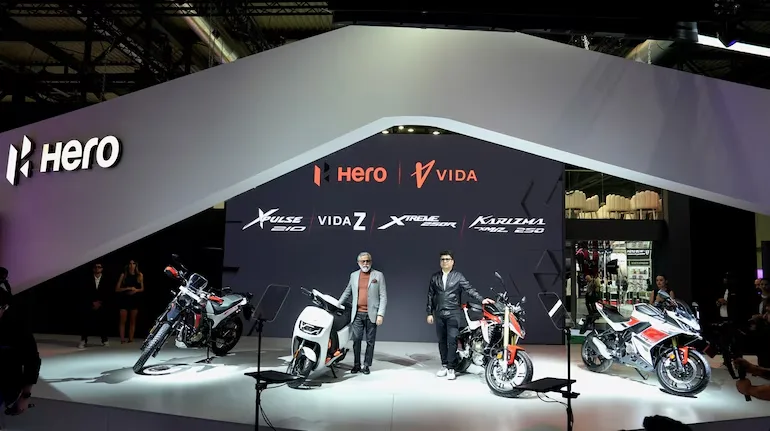
Hero’s premium ambitions are crystallizing fast. Three new motorcycles were unveiled at EICMA 2024—the Xpulse 210, Xtreme 250R, and Karizma XMR 250—set to launch within six months.
These aren’t just bikes; they’re Hero’s declaration that they can compete with Royal Enfield, KTM, and the foreign brands in the aspirational segment. The company is targeting over 100 Premia stores by the end of FY25—dedicated premium outlets that signal serious intent.
What Analysts Are Saying
The market responded enthusiastically. Hero MotoCorp shares rallied as much as 5.12% to hit ₹4,840.40 following the Q2 results announcement.
Brokerages are bullish:
Nomura: Raised target price to ₹5,805, citing reduced EV-related drag and improved margins ahead. They anticipate 10% growth in the two-wheeler industry over FY25-26, driven by balanced growth and favorable monsoon conditions.
Motilal Oswal: Despite lowering FY26 estimates by 11%, they maintain a ‘Buy’ rating at ₹5,420, calling the stock “attractively valued.”
Nirmal Bang: Target of ₹5,934, noting the favorable risk-reward ratio given recovery in the entry segment.
The consensus? Hero’s best days aren’t behind it—they’re ahead.
The Cash Flow Story
Hero’s strong focus on cash management has delivered robust cash flow, strengthening the company’s financial position. This isn’t just profitable growth—it’s sustainable growth.
That cash position allows Hero to “aggressively invest behind brand building” while competitors worry about staying afloat.
The Challenges Ahead
Let’s be honest: It’s not all smooth riding.
The EV business is diluting margins short-term. Competition is intensifying from foreign players. Input costs remain volatile. The premium segment is crowded and unforgiving.
But here’s the thing: Hero commands around 54% contribution from rural markets and maintains ICE margins above 16%—both massive advantages.
What This Means for India
Hero MotoCorp selling 16 lakh units in a festive season isn’t just a corporate milestone. It’s 1.6 million families gaining mobility, freedom, and economic opportunity.
When rural India buys bikes, it signals confidence. Jobs are available. Incomes are stable. The economy is moving.
Hero’s Q2 results are an economic indicator as much as a corporate achievement.
The Road Ahead
The next six months will be fascinating. Three premium bikes launching. Three ICE scooters debuting. VIDA expanding across price segments. Premia stores crossing 100 outlets.
Hero isn’t playing defense. They’re attacking on multiple fronts simultaneously—premium, electric, rural, urban, domestic, export.
Final Thoughts
As CEO Niranjan Gupta stated: “We have continued our exceptional performance in Q2 FY25, once again creating a new high in both topline and bottomline.” That’s not corporate speak. That’s the confidence of a company that knows its market, trusts its strategy, and is executing flawlessly.
Q2 FY25 proved Hero MotoCorp isn’t just India’s largest two-wheeler maker—it’s the smartest. And in a market transforming as rapidly as India’s, intelligence matters more than legacy.

