

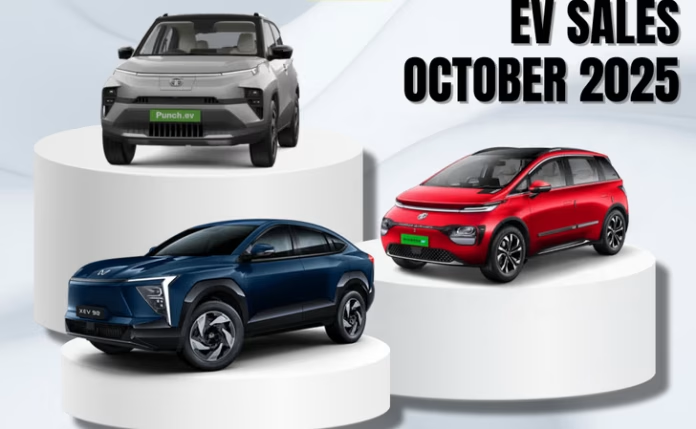

Tata EV Sales October 2025 just rewrote India’s electric vehicle story. While the overall passenger vehicle market celebrated record dispatches exceeding 500,000 units, the real headline emerged from the electric segment—17,783 EVs delivered nationwide, marking a staggering 56 percent year-on-year surge.
Here’s the twist: This wasn’t just another sales report. October became the first full month after GST 2.0 kicked in on September 22, narrowing the once-massive price gap between conventional and electric vehicles. With small car taxes slashed from 28 percent to 18 percent while EVs maintained their 5 percent advantage, the competitive landscape fundamentally shifted.
And in this electrified battlefield, Tata Motors stands tall as the undisputed champion.
Table of Contents
The October Winners: Who’s Charging Ahead?
| Rank | Manufacturer | Oct 2025 Sales | YoY Growth | Market Share |
|---|---|---|---|---|
| 1 | Tata Motors | 7,118 units | +8% | 40% |
| 2 | JSW MG Motor India | 4,497 units | +61% | 25% |
| 3 | Mahindra | 3,867 units | +303% | 22% |
| 4 | Kia | 655 units | +1,293% | 4% |
| 5 | BYD India | 560 units | -6% | 3% |
Tata Motors: The Unshakeable Leader
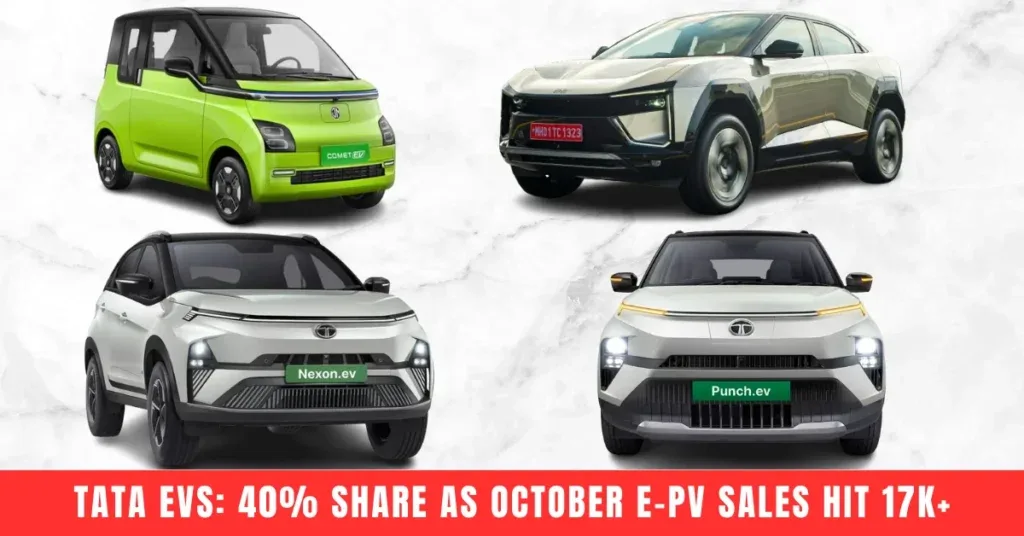
With 7,118 units delivered—Tata’s second-highest monthly performance ever—the homegrown giant commands a commanding 40 percent market share. That’s not just leadership; that’s dominance.
What’s fueling this success? Four electric warriors: the Punch EV, Nexon EV, Curvv EV, and the recently launched Harrier EV. The latter has particularly revived consumer demand, proving that when Tata plays in the premium segment, buyers respond enthusiastically.
The 8 percent year-on-year growth might seem modest compared to competitors, but context matters. When you’re already at the top, maintaining that position while growing steadily shows sustainable strength, not flash-in-the-pan success.
MG Motor: The Aggressive Challenger
JSW MG Motor India isn’t just participating—it’s hunting. With 4,497 units sold and a blistering 61 percent year-on-year growth, MG has captured 25 percent of the market, directly eating into Tata’s once-unassailable lead.
The Windsor EV with its revolutionary Battery-as-a-Service (BaaS) option has become MG’s secret weapon, making electric ownership financially accessible. Add the premium M9 MPV and the head-turning Cyberster electric roadster to the portfolio, and you’ve got a manufacturer playing chess while others play checkers.
The 8 percent month-on-month growth from September signals consistency—MG isn’t slowing down anytime soon.
Mahindra: The Comeback Story
Remember when Mahindra sold just 957 EVs in October 2024? Fast forward twelve months, and they’ve delivered 3,867 units—a jaw-dropping 303 percent explosion. This isn’t growth; it’s a resurrection.
The born-electric BE 6 and XEV 9e SUVs have struck a chord with Indian buyers seeking homegrown innovation. With 22 percent market share secured, Mahindra has firmly established itself as the third force in India’s EV triangle.
The Rising Stars and Luxury Players
Kia’s Spectacular Jump: From ninth place to fourth, Kia’s 655 units represent a 1,293 percent year-on-year leap. The locally made Carens Clavis EV is driving this momentum, proving that affordable electrification sells.
BYD’s Slight Stumble: The Chinese giant slipped to fifth place with 560 units, down 6 percent from September. Despite offerings like the Atto 3 SUV and Seal sedan, BYD faces mounting pressure from aggressive local competition.
Hyundai’s Puzzling Plateau: With the Creta Electric launched in January, Hyundai expected fireworks. Instead, sales have tapered from 905 units in March to just 437 in October—a concerning 20 percent month-on-month growth that masks deeper demand issues.
The Luxury Battlefield
BMW India leads the premium segment with 303 units and a dominant 65 percent luxury EV share. Mercedes-Benz trails with 90 units, while newcomer Tesla delivered 40 Model Y units in its second month—modest numbers for a brand with over 600 bookings, signaling supply chain constraints rather than demand problems.
Vietnamese newcomer Vinfast made noise with 131 units of its locally assembled VF6 and VF7, showing impressive 2,083 percent month-on-month growth from its September debut.
What October Really Tells Us
The 9 percent month-on-month recovery after September’s dip proves one thing: India’s EV market isn’t fragile—it’s evolving rapidly. The GST 2.0 realignment, expanding charging infrastructure, and manufacturer confidence in local production are creating perfect storm conditions for electric mobility.
Here’s the projection that matters: With cumulative 2025 sales already at 144,352 units (surpassing 2024’s entire 99,688 units), industry experts forecast 170,000-180,000 EVs will be delivered by year-end. That’s not just a record—it’s a paradigm shift.
The Road Ahead
Tata Motors holds the crown, but MG and Mahindra are sharpening their swords. International players like Tesla and Vinfast are establishing beachheads. Traditional giants like Hyundai and Kia are recalibrating strategies.
October 2025 didn’t just deliver sales numbers—it delivered a message: India’s electric vehicle revolution isn’t coming. It’s here, accelerating hard, and reshaping mobility as we know it. The only question left? Who’ll be leading the pack come December?

