

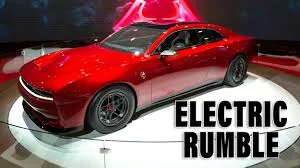

Dodge Charger, the roar of a muscle car is sacred. That deep, chest-thumping V8 rumble isn’t just noise—it’s an identity, a culture, a religion for gearheads. So when Dodge announced they were killing off the legendary Hemi V8 for an electric powertrain, enthusiasts didn’t just complain. They mourned.
But Dodge had a trick up their sleeve—one that’s divided the automotive world like nothing else in recent memory.
Table of Contents
The Fratzonic Revolution
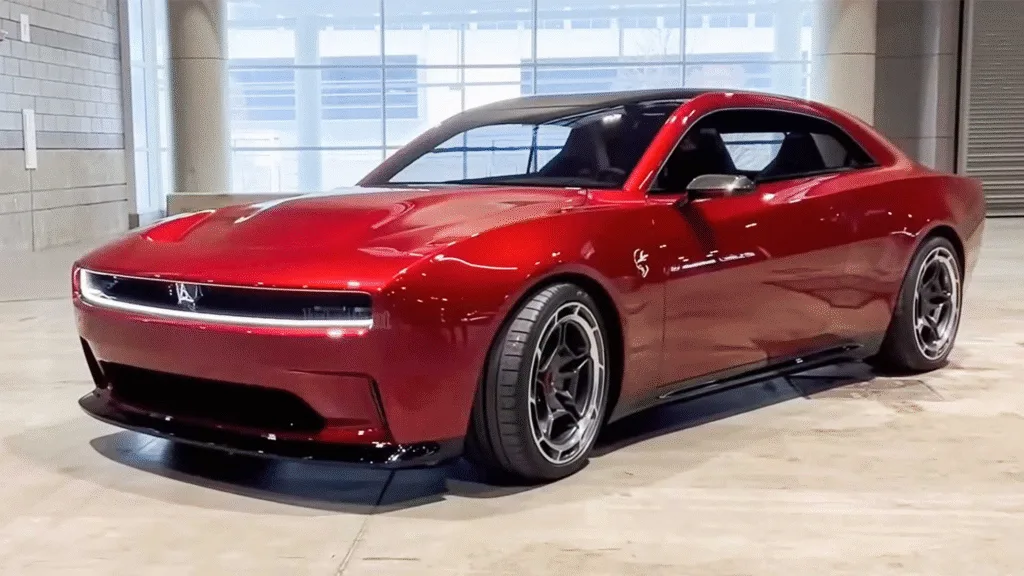
Meet the Fratzonic Chambered Exhaust: a synthetic sound system that mimics a V-8 engine and can produce 126 decibels—the same volume as the supercharged Hellcat V8. It’s not piped into the cabin through speakers like BMW’s collaboration with Hans Zimmer. This thing actually projects outward from the rear of the car, just like a real exhaust.
Named after Dodge’s iconic Fratzog logo from the 1960s, this isn’t your typical EV pedestrian warning chime. The system uses big speakers bolted to the underside of the car with specially-shaped air channels to project the noise, targeting that 126-decibel mark the outgoing Hellcat produced at full roar.
How Does It Actually Work?
Here’s where engineering meets theater:
Fratzonic System Components
| Component | Function | Purpose |
|---|---|---|
| Dual Transducers | Generate synthetic V8 sound | Creates base audio signal |
| Passive Radiators | Amplify and shape sound waves | Adds depth and resonance |
| Chambered Housing | Directs airflow and acoustics | Projects sound externally |
| Dedicated Amplifier | Powers the entire system | Delivers Hellcat-level volume |
| Real-time Processor | Monitors throttle, speed, load | Syncs sound with driving |
The system doesn’t sample noise from the Charger EV’s motors, but generates a synthetic sound based on the cadence from a Hemi V8, which screams at higher revs. Think of it as a live performance rather than a recording—the sound adjusts dynamically based on how you drive.
The Sound: Love It or Hate It
Opinions? They’re everywhere. At startup, there’s an odd electric whirring that melds into an eight-cylinder explosion and jet-like whistling all at once. On the move, the revs coming from the rear are heavy on gasoline engine simulation.
Some journalists describe it as convincing enough to fool listeners without context. Others call it unsettling, like “Darth Vader as a car.” The truth? It depends on your expectations.
What Works:
- Volume matches the legendary Hellcat (126 dB)
- Adjusts dynamically to throttle inputs
- Can be completely silenced via “Stealth Mode”
- Adds emotional connection to electric driving
What Needs Work:
- When you switch drive modes, there’s an audible changeover with a blip of silence, like skipping to the next song in a playlist
- Lacks the interactive features found in competitors like the Hyundai Ioniq 5 N
- No simulated gear shifts or rev-matched downshifts
- Single-note sound doesn’t change pitch like a real engine
More Than Just Noise
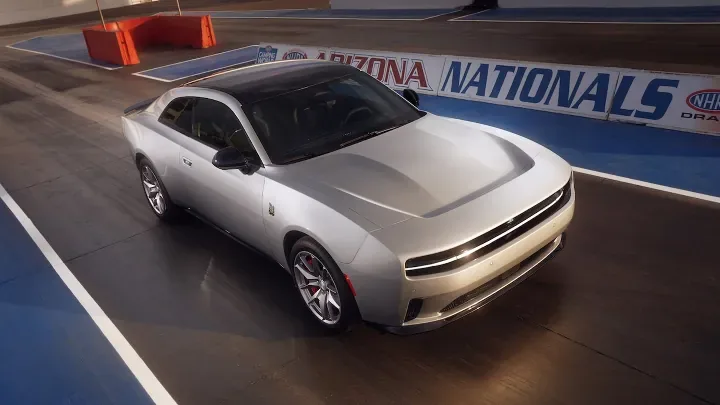
The 2026 Dodge Charger Daytona Scat Pack isn’t pretending to be something it’s not. With 670 horsepower and 627 lb-ft of torque from its dual-motor setup, it delivers zero-to-60 mph times as quick as 3.3 seconds—faster than the old Charger SRT Hellcat.
There’s even a “PowerShot” button that unleashes an extra 40 horsepower for 10-second bursts—perfect for passing or showing off.
Performance Specs at a Glance
| Specification | 2026 Charger Daytona Scat Pack |
|---|---|
| Horsepower | 670 hp (710 hp in PowerShot) |
| 0-60 mph | 3.3 seconds |
| Drivetrain | Dual-motor AWD |
| Battery | 93.9 kWh |
| Range | 241 miles |
| Fast Charging | 20-80% in 24 minutes |
The Cultural Debate
CEO Tim Kuniskis admitted they changed the sound 100 times and the debate was still raging within Dodge. This isn’t just about engineering—it’s about identity.
For purists, the Fratzonic feels like sacrilege. Real muscle cars have real engines, period. For others, it’s an ingenious compromise that preserves the emotional experience while embracing inevitable electrification.
Consider this: The Fratzonic system will likely run afoul of noise restrictions in certain cities like New York. That’s actually kind of perfect for a Dodge—even the fake exhaust is rebellious.
What’s Next for Muscle Car Sound?
Dodge isn’t alone in this quest. Hyundai’s Ioniq 5 N offers simulated gear shifts. BMW collaborated with film composers. But no one else has committed to external V8 mimicry at 126 decibels.
The question isn’t whether the Fratzonic sounds exactly like a Hellcat—it doesn’t. The question is whether it captures enough of the muscle car spirit to satisfy the faithful while attracting a new generation of performance enthusiasts.
Early reviews suggest Dodge is close, but not quite there. The technology exists. Now it’s about refinement.
The Bottom Line
The 2026 Dodge Charger with Fratzonic represents something bigger than clever engineering. It’s a statement that EVs don’t have to be sterile appliances. Performance cars can retain character, attitude, and yes—even volume—in the electric age.
You can now order the four-door sedan version alongside the two-door coupe, both packing the same 670-hp punch and that controversial synthetic soundtrack. Whether you love it, hate it, or feel somewhere in between, you can’t ignore it.
And maybe that’s the point. Muscle cars were never meant to be ignored.
The Fratzonic Chambered Exhaust isn’t perfect, but it’s bold, audacious, and unapologetically loud—exactly what you’d expect from the brand that gave us the Hellcat, Demon, and every other absurdly powerful creation that made automotive journalists question their sanity.
Welcome to electric muscle. It sounds different. But it’s still Dodge.

