

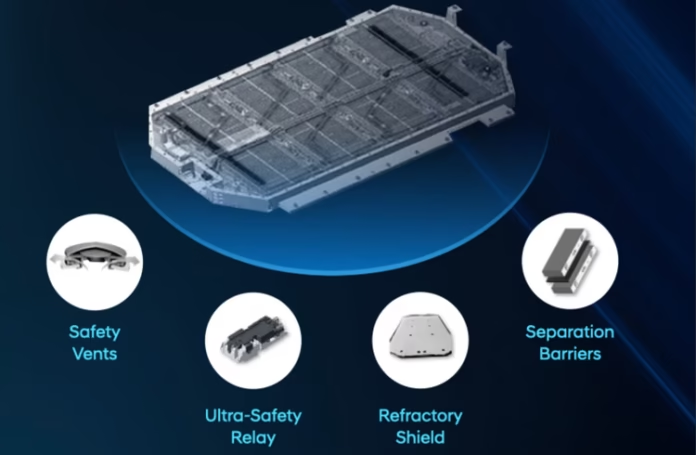

Hyundai has unveiled ambitious next-generation battery technology targeting 30% cost reduction, 15% higher energy density, and 15% faster charging by 2027, addressing the three biggest barriers to mass EV adoption: range anxiety, charging times, and affordability. This technological leap could fundamentally reshape India’s electric vehicle landscape.
Table of Contents
The Longevity Promise That Matters
Real-world data from 50,000 Ioniq 5 vehicles, including units exceeding 250,000 miles (4 lakh km), shows the majority retaining 90% or more of original battery capacity. This isn’t laboratory testing—it’s actual customer usage validating that battery degradation fears are largely overblown with modern EV technology.
| 2027 Battery Target | Improvement |
|---|---|
| Cost Reduction | 30% cheaper than current |
| Energy Density | 15% increase (770+ Wh/L) |
| Charging Speed | 15% faster |
| Capacity Retention | 90%+ after 4 lakh km |
| Cloud BMS | Real-time health monitoring (from 2026) |
Cloud-Based Battery Intelligence
Starting in 2026, Hyundai will deploy cloud-based battery management systems (BMS) that continuously monitor pack health during driving, charging, and parking, enabling faster and more precise diagnostics. This predictive approach can identify potential issues before they become problems, maximizing battery lifespan and owner peace of mind.
What 15% Energy Density Means in Practice
Current Ioniq 5 batteries achieve 670 watt-hours per liter; a 15% increase pushes that above 770 Wh/L, translating directly into extended range without increasing battery pack size or vehicle weight. For Indian consumers already enjoying Ioniq models with over 300 miles EPA range, this improvement makes long-distance touring genuinely stress-free.
Charging That Actually Competes with Petrol Pumps
The standard-range Ioniq 5 currently charges from 10% to 80% in 24 minutes on a 350-kilowatt charger; the next-generation technology targets sub-20 minute charging. While seemingly modest, achieving this requires significant breakthroughs in battery chemistry, cooling systems, and thermal management—the kind of engineering that separates leaders from followers.
The India Advantage: Local Manufacturing
Hyundai’s battery roadmap includes region-specific products, with cost reductions achieved through local manufacturing and supply chain optimization. For India, this strategy aligns perfectly with government incentives supporting domestic EV and battery production under schemes like FAME II and PLI.
The company’s commitment to localizing battery production in India addresses both cost and supply chain resilience—critical factors in making EVs affordable for middle-class buyers beyond metro cities.
Extended Range EVs: The Game Changer
From 2027, Hyundai will launch Extended Range EVs (EREVs) offering over 600 miles (960 km) of range using in-house high-performance batteries with less than half the usual battery capacity, eliminating range anxiety while reducing costs. This breakthrough technology could redefine what consumers expect from electric vehicles.
Market Implications for India’s EV Revolution
The 30% cost reduction by 2027 directly addresses India’s price sensitivity. With the Creta Electric already proving that localized EVs can compete with ICE pricing, next-generation battery economics could make EVs genuinely cheaper than petrol equivalents on total cost of ownership.
Combined with India’s expanding fast-charging infrastructure and stable GST structure for EVs, the timing couldn’t be better. Hyundai’s technological roadmap validates that affordable, practical EVs aren’t a distant dream—they’re arriving within three years.
Why This Matters Beyond Hyundai
These advances highlight how much room still exists to improve lithium-ion batteries across multiple dimensions: software management, chemistry, manufacturing, design, and packaging. The entire industry benefits as leaders like Hyundai push boundaries, proving that incremental innovation compounds into transformative change.
For Indian consumers weighing EV adoption, Hyundai’s battery roadmap offers concrete reasons for optimism: longer-lasting batteries, faster charging, better range, and significantly lower costs—all arriving by 2027.
Track Hyundai’s battery innovation and India’s EV technology evolution at IndiaEVNews.com.

