


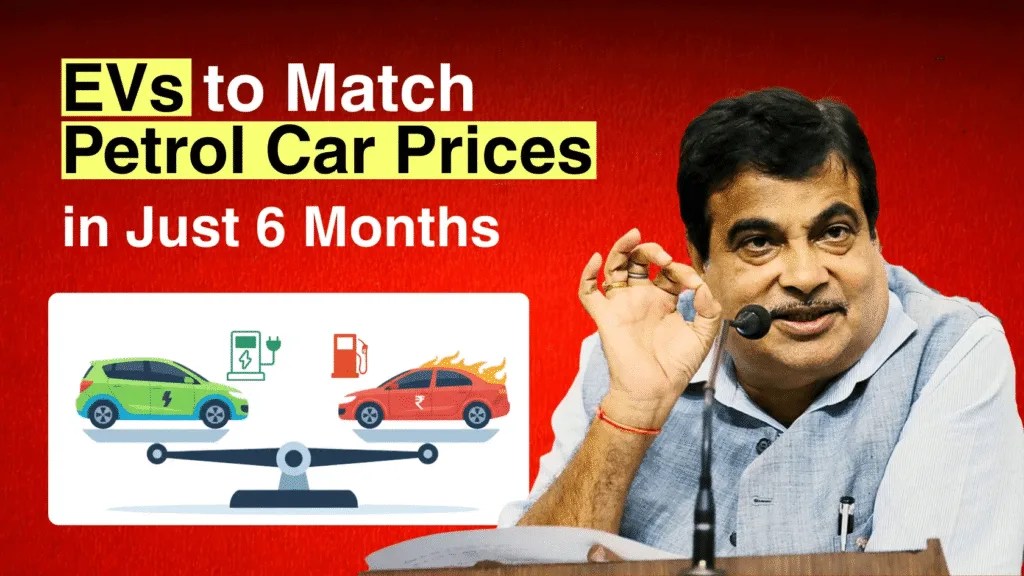
EV Prices to Match Petrol Vehicles, Picture this: You walk into a car showroom, and for the first time, that sleek electric vehicle costs exactly the same as its petrol counterpart. No premium, no excuses. According to Union Road Transport Minister Nitin Gadkari, this isn’t a distant dream—it’s just 4-6 months away.
Table of Contents
The Breakthrough Announcement
Speaking at the 20th FICCI Higher Education Summit 2025, Gadkari dropped a bombshell that could reshape India’s automotive landscape. “Within the next four to six months, the cost of electric vehicles will be equivalent to that of petrol vehicles,” he declared confidently.
This prediction stems from a remarkable achievement in battery technology. When EVs first launched in India, battery costs stood at a staggering $150 per kilowatt-hour. Today? They’ve plummeted to just $55-65 per kilowatt-hour. That’s a 60% reduction driving affordability straight to your garage.
Why This Matters for Your Wallet
India currently hemorrhages ₹22 trillion annually on fuel imports—money that literally goes up in smoke. By switching to electric, you’re not just saving on fuel costs; you’re participating in a national economic revolution.
Recent GST reforms have already slashed car prices dramatically:
| Brand | Model | Price Reduction |
|---|---|---|
| Maruti Suzuki | S-Presso | Up to ₹1,29,600 |
| Maruti Suzuki | Alto K10 | Up to ₹1,07,600 |
| Hyundai | Tucson | Up to ₹2,40,303 |
| Tata Motors | Nexon | Up to ₹1,55,000 |
| Mahindra | XUV3XO Diesel | Up to ₹1,56,000 |
India’s Bold Automotive Vision
Gadkari isn’t stopping at price parity. His vision? Making India the world’s largest automobile market within five years. Currently ranked third globally behind the USA (₹78 trillion) and China (₹47 trillion), India’s automotive industry has already exploded from ₹14 trillion to ₹22 trillion under his tenure.
The Environmental Win
Beyond economics, there’s an urgent environmental imperative. Every electric vehicle on the road reduces our fossil fuel dependency and cuts carbon emissions. With cities choking on pollution, this transition couldn’t come sooner.
What’s Driving This Change?
Three key factors are converging:
1. Battery Technology Revolution: Rapid advancements have made batteries cheaper and more efficient.
2. Government Support: GST restructuring and policy reforms are lowering entry barriers.
3. Manufacturing Scale: Increased production volumes are bringing costs down across the board.
The Road Ahead
Farmers are already benefiting from India’s energy transition, earning an additional ₹45,000 crore from ethanol production. This multi-pronged approach—electric vehicles, biofuels, and renewable energy—is positioning India as a global clean mobility leader.
For consumers, the message is clear: hold off on that petrol car purchase. In just a few months, you could buy an EV for the same price, slash your running costs by 70%, and drive guilt-free knowing you’re part of India’s sustainable future.
The electric revolution isn’t coming. It’s already here, and it’s about to become irresistibly affordable.

