

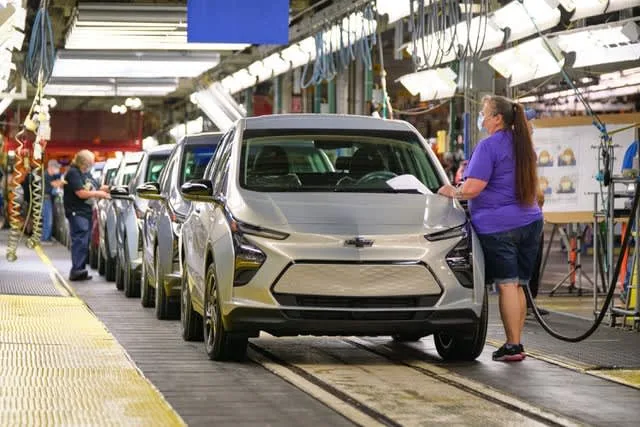

The electric vehicle revolution just hit a speed bump. General Motors, America’s second-largest automaker, has dramatically scaled back its ambitious Chevrolet Bolt production plans, cutting from two shifts to just one at its Kansas plant. The culprit? The looming elimination of federal EV tax credits under the Trump administration’s shifting policies.
Table of Contents
The Production Reality Check
GM’s decision reflects brutal market mathematics. The company will start the Bolt launch in December with one shift at its Kansas plant, less than the two shifts initially planned due to uncertain EV demand. This 50% reduction signals how quickly automakers must adapt to changing political winds.
The ripple effects extend beyond the Bolt. GM is also cutting production of two Cadillac EVs until the automaker can measure the full impact of incentive losses.
GM’s EV Strategy Under Pressure
| Vehicle Model | Original Plan | Revised Plan | Impact |
|---|---|---|---|
| Chevrolet Bolt | Two shifts | One shift | 50% production cut |
| Cadillac EVs | Full production | Reduced output | Delayed expansion |
| Overall Strategy | Aggressive EV push | Wait-and-see approach | Market uncertainty |
The Policy Domino Effect
GM CFO Paul Jacobson anticipated these headwinds, predicting a rush on EVs before tax credits expire, followed by slower demand. This forecast is now playing out in real-time across production floors.
The House has sent a bill to President Trump’s desk that kills tax credits of up to $7,500 for EV customers, creating immediate market uncertainty. For consumers, this could mean thousands more in upfront costs for electric vehicles.
Market Implications
The timing couldn’t be more critical. Chevy recently became the #2 electric vehicle brand in the US, with Cadillac leading luxury EVs. This production pullback threatens to surrender hard-won market share to competitors like Tesla and Ford.
The Bolt EV and EUV already lost federal tax credit eligibility as of January 1st, 2025, making the upcoming model crucial for GM’s affordable EV strategy.
What This Means for Consumers
For car buyers, GM’s cautious approach signals broader industry uncertainty. The automaker’s “wait-and-see” strategy suggests potential delays in new EV model launches and possibly higher prices as manufacturers adjust to reduced government support.
This production cut represents more than manufacturing adjustments—it’s a crystal ball showing how policy changes directly impact America’s transition to electric transportation.
The question remains: Will other automakers follow GM’s lead, or double down on electric despite uncertain incentives?

